Standing Waves on a String, Explained
After reading this you will know why a string fixed at both ends sings only at a discrete set of frequencies, how to predict those frequencies from tension and mass, and how to read the nodes and antinodes of a standing wave.
What a standing wave is
Pluck a guitar string and it holds a note. Drive that same string with a motor at the wrong frequency and it just shudders weakly. Tune the drive to the right value and the whole string leaps into a smooth arc, still at the ends and swinging hard in the middle. That sudden burst of motion is resonance, and the shape it settles into is a standing wave.
A standing wave looks frozen in place. It has points that never move (nodes) and points that swing with the largest amplitude (antinodes). It comes from two travelling waves of equal frequency and amplitude moving in opposite directions. On a string fixed at both ends, one wave is the drive you send in and the other is its reflection off the far end. When those two line up, they add to a pattern that oscillates in size but does not travel.
The catch: the reflections only reinforce the drive at special frequencies. At every other frequency the reflected wave arrives out of step, partly cancels the drive, and the string barely moves. The tool lets you sweep the drive frequency and hear and see this switch between quiet shudder and loud resonance.
When this model helps, and when it misleads
Use this model when you want to understand fixed-end resonance: guitar and violin strings, organ pipes (with a small change of boundary condition), the bars of a xylophone, and any driven system where reflections build up. The core idea, that a bounded medium picks out a discrete set of natural frequencies, carries directly into acoustics, optics and quantum mechanics.
The tool models the string as a row of point masses joined by springs. That is a discrete approximation of a continuous string. It works well when you use many segments. With few segments the model develops its own errors: a chain of N masses has exactly N modes, not infinitely many, and the higher modes sit at lower frequencies than the ideal formula predicts. So do not trust the tenth harmonic of a 12-segment string.
Real strings are not perfectly flexible. Stiffness pushes the higher harmonics slightly sharp, so a real piano string is not exactly harmonic. This tool ignores stiffness, so its harmonics land at exact integer multiples. Treat the perfect ratios as the ideal case, not a measurement of any real instrument.
The formula and where it comes from
A wave on a string travels at a speed set by how tightly it is pulled and how heavy it is:
Here v is the wave speed in metres per second, T is the tension in newtons, and \mu is the linear mass density in kilograms per metre (mass divided by length). Pull harder and waves go faster. Load the string with more mass and they slow down.
A string of length L fixed at both ends must have a node at each end. The only wave shapes that fit are those with a whole number of half-wavelengths between the ends:
Here \lambda_n is the wavelength of the nth mode and n counts the half-waves. Rearranging gives \lambda_n = 2L/n. Since frequency is speed divided by wavelength, the natural frequencies are:
The lowest, f_1, is the fundamental. Every other resonance is an integer multiple of it: f_n = n \cdot f_1. That integer relationship is why a plucked string sounds like a single pitch rather than a mush of unrelated tones.
A worked example with the demo settings
Run the demo with its default values and you can check the arithmetic by hand. Take a string of length L = 1 metre, tension T = 100 newtons, and linear density \mu = 0.01 kilograms per metre.
Predicting the first five harmonics
- Wave speed: v = \sqrt{100/0.01} = \sqrt{10000} = 100 m/s.
- Fundamental: f_1 = v/(2L) = 100/(2 \cdot 1) = 50 Hz.
- Second harmonic: f_2 = 2 \cdot 50 = 100 Hz.
- Third: f_3 = 150 Hz. Fourth: f_4 = 200 Hz. Fifth: f_5 = 250 Hz.
So if you sweep the drive from 0 to 300 Hz you should see clean standing waves flare up near 50, 100, 150, 200 and 250 Hz, and near-silence in between. The nth mode shows n antinodes and n-1 interior nodes. The fundamental at 50 Hz has one hump; the third harmonic at 150 Hz has three.
Reading nodes, antinodes and the response curve
Two things tell you which mode you are in. First, count the antinodes: the nth harmonic has exactly n of them. Second, watch the amplitude. Off resonance the string wobbles with a small, messy shape. On resonance the shape becomes a clean sine curve and the swing grows until damping stops it.
The response curve below plots how big the steady swing gets as you tune the drive across the fundamental. It is a resonance peak, the same Lorentzian shape you meet everywhere from radio tuning to atomic spectra.
The width of the peak tells you the damping. A peak that is half its height at 48 and 52 Hz (a full width of 4 Hz around a 50 Hz centre) has a quality factor of roughly Q = 50/4 \approx 12.5. Lighter damping narrows the peak and raises its top, so a gentle drive builds a huge swing. That is the mechanism a trained singer uses to crack a wine glass: match the glass's natural frequency, and small pushes accumulate.
To find a resonance fast, sweep slowly and watch the antinode count settle. If the string keeps a single messy shape, you are between modes. When the shape snaps to a clean set of evenly spaced humps and the amplitude jumps, you have hit f_n.
Common mistakes
The errors below trip up most first-time users of a string simulator.
- Expecting resonance at every frequency
- Between harmonics the string simply cannot hold a standing wave, so it stays quiet. That quiet is correct behaviour, not a broken simulation.
- Reading harmonics off a coarse string
- With few segments the model's own high modes shift down in frequency. Increase the segment count before trusting anything above the third or fourth harmonic.
- Confusing amplitude with energy
- Doubling the amplitude of a standing wave roughly quadruples its energy, since energy scales with amplitude squared. A peak that looks twice as tall holds about four times as much energy.
- Forgetting that damping sets the ceiling
- At resonance with zero damping the amplitude would grow without bound. Any real string has losses, so the swing settles at a finite size fixed by how fast energy leaks out.
- Assuming the ratios hold for real instruments
- Stiffness makes real overtones slightly sharp. The exact integer multiples here are the idealised case.
Related tools
Standing waves are one corner of wave physics, and several other simulators show neighbouring ideas. To see the two travelling waves that add up to a standing one, and to watch fringes form, try the Wave Interference ripple tank. For standing waves in two dimensions, where nodal lines replace nodal points, the Chladni Plate Patterns tool vibrates a square plate and gathers sand along the nodes. The same spring-and-mass model used here also drives the Cloth Simulator and the Soft-Body Jelly, where many coupled oscillators wobble at once. If you want to hear how two frequency ratios combine into a curve, the Harmonograph draws Lissajous figures from damped pendulums.
Frequently asked questions
Why does the string only resonate at certain frequencies?
Because both ends are fixed, only wave shapes with a node at each end survive. That forces a whole number of half-wavelengths onto the string, which allows only the frequencies f_n = n \cdot f_1. At any other frequency the reflected wave arrives out of step with the drive and cancels most of it.
How do I raise the pitch of the string?
Increase the tension or shorten the string. Both raise f_1 = (1/2L)\sqrt{T/\mu}. Quadrupling the tension doubles every frequency, since f_1 depends on the square root of T. Adding mass per unit length lowers the pitch, which is why the bass strings of a guitar are wound with extra wire.
What sets how large the swing gets at resonance?
Damping alone. On resonance the drive keeps feeding energy in step, and the amplitude grows until the energy lost to damping each cycle equals the energy the drive adds. Halve the damping and the peak roughly doubles in height and halves in width.
Why do I need many segments?
A chain of N masses can only support N modes, and its high modes sit below the ideal frequencies. Using 60 or more segments keeps the first several harmonics close to the continuous prediction of f_n = n \cdot f_1.
Is this how a real guitar works?
The frequency selection is the same, but a real string has stiffness that pushes overtones slightly sharp, and the body radiates sound and adds its own resonances. The tool captures the clean physics; a real instrument layers extra effects on top.
Related tools
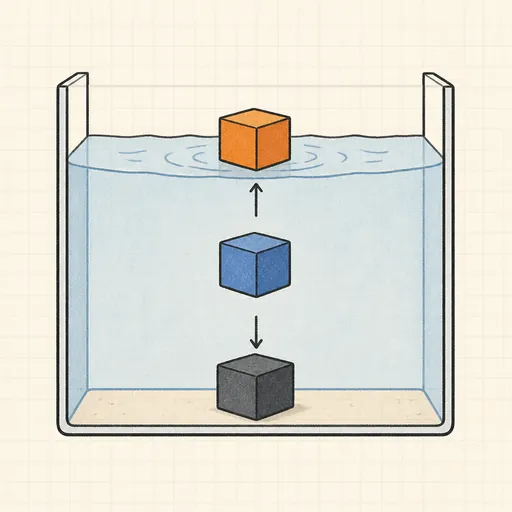
Buoyancy Tank
Drop blocks of different density into water and watch Archimedes decide what floats, sinks or hovers.
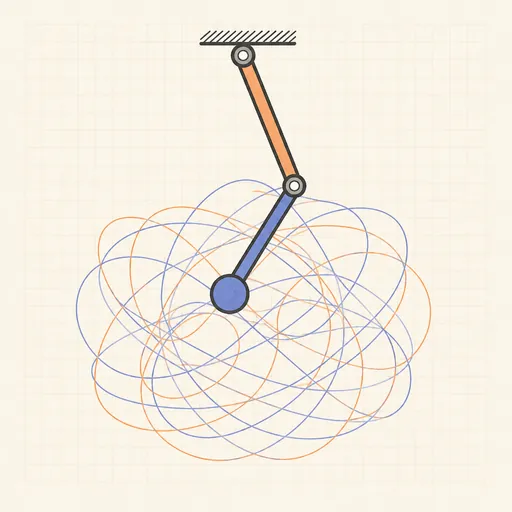
Double Pendulum
Swing a chaotic double pendulum and split it into a rainbow swarm to watch nearby starts diverge.
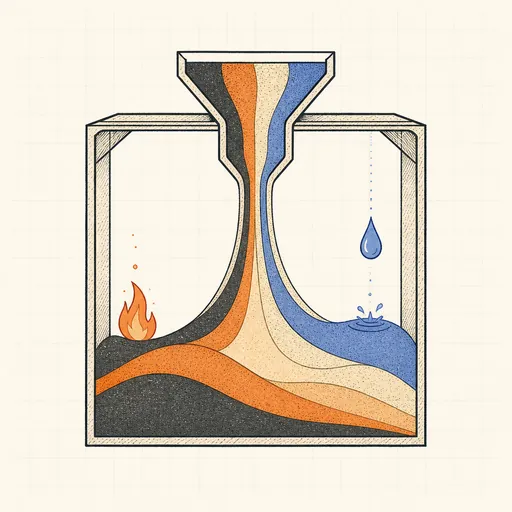
Falling-Sand Playground
Paint sand, water, oil, fire and more and watch them pour, settle, burn and react pixel by pixel.

Fluid Flow Simulator
Stir glowing dye through a real-time GPU fluid simulation.
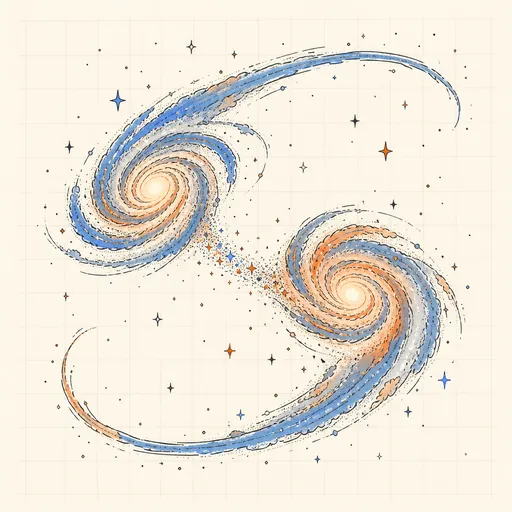
Galaxy Collision Simulator
Smash two spiral galaxies together and watch tidal tails and bridges form.
Hear the Shape of a Drum
Draw any drum and hear its true vibration modes — then meet two different drums that sound exactly the same.