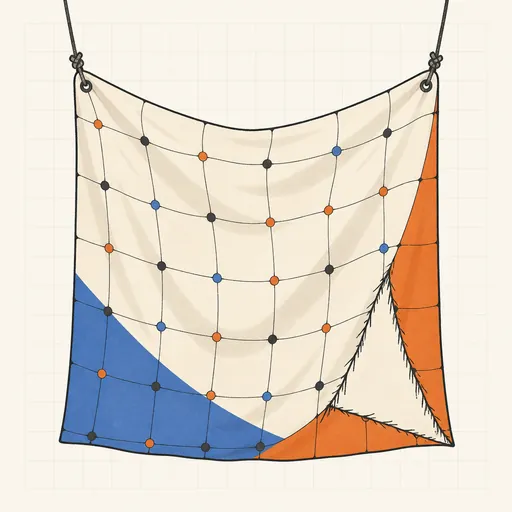
Cloth Simulator
A curtain of about 1,200 point masses hangs from pins along its top row, joined by distance constraints into a 44×28 grid. Each frame the points move by Verlet integration under gravity and gusting wind, then a few relaxation passes pull every constraint back toward its rest length. Each thread is coloured by stress — blue when slack, white when taut, red near breaking — so load paths light up as you pull. Grab the cloth with the mouse or a finger and swing it around, switch to cut mode to slice threads under the pointer, and tick the tear box to let overstretched threads snap on their own. Sliders set the wind strength and gravity, reset re-hangs a fresh cloth, and the count of intact threads is reported live.
Runs 100% in your browser — simulations are computed locally on your device.
Read the full guide to this tool
Notes
- Verlet integration stores each point’s current and previous position; velocity is implicit in the difference, which makes constrained systems remarkably stable (Jakobsen’s "Advanced Character Physics", 2001, built the Hitman ragdolls this way).
- Constraint relaxation is Gauss–Seidel iteration: each pass moves both endpoints half the length error, and just three passes per frame approximate an inextensible fabric.
- Threads here fail when stretched past about 2.4× rest length; real fabric fails the same way, with stress concentrating at the edge of an existing hole — which is why a small cut rips onward so easily.
- Runs 100% in your browser — simulations are computed locally on your device.
Related tools
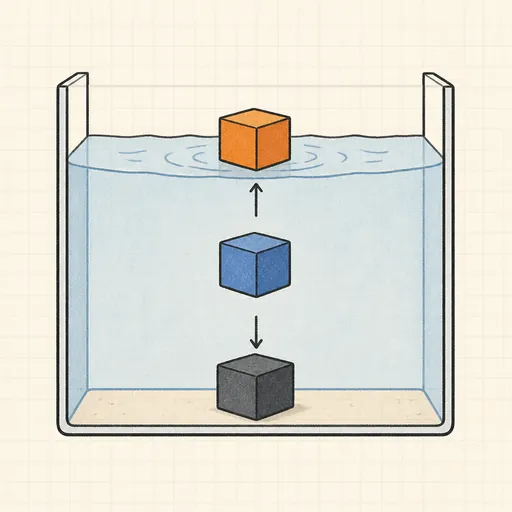
Buoyancy Tank
Drop blocks of different density into water and watch Archimedes decide what floats, sinks or hovers.
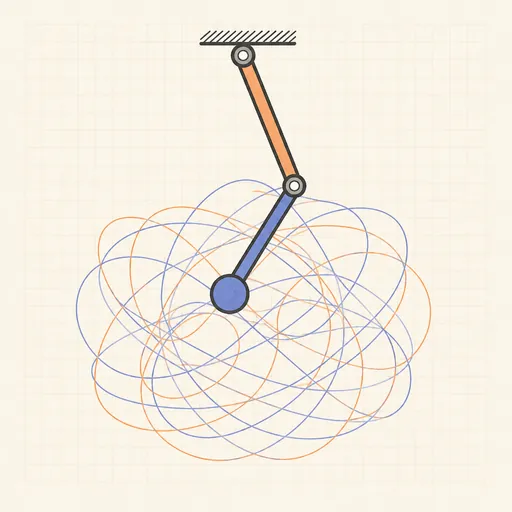
Double Pendulum
Swing a chaotic double pendulum and split it into a rainbow swarm to watch nearby starts diverge.
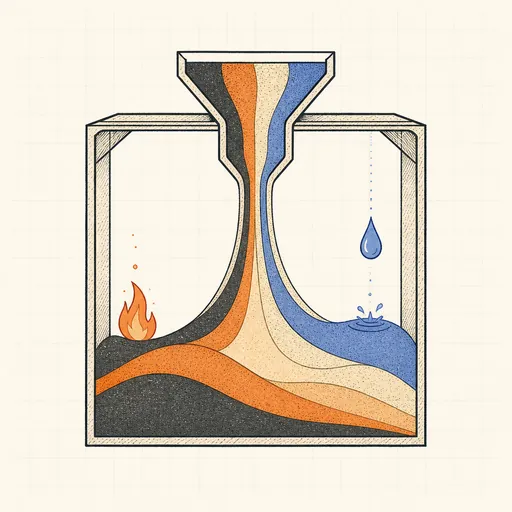
Falling-Sand Playground
Paint sand, water, oil, fire and more and watch them pour, settle, burn and react pixel by pixel.
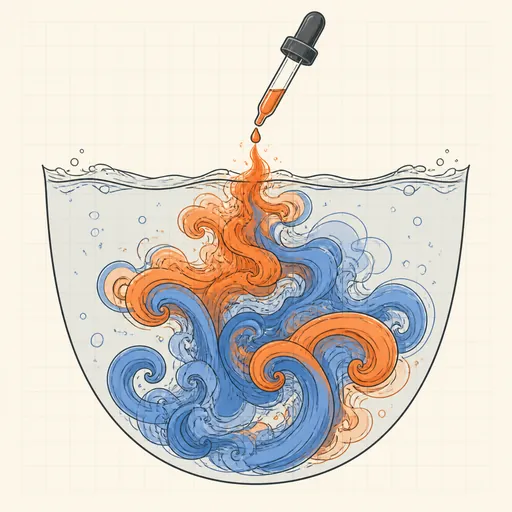
Fluid Flow Simulator
Stir glowing dye through a real-time GPU fluid simulation.
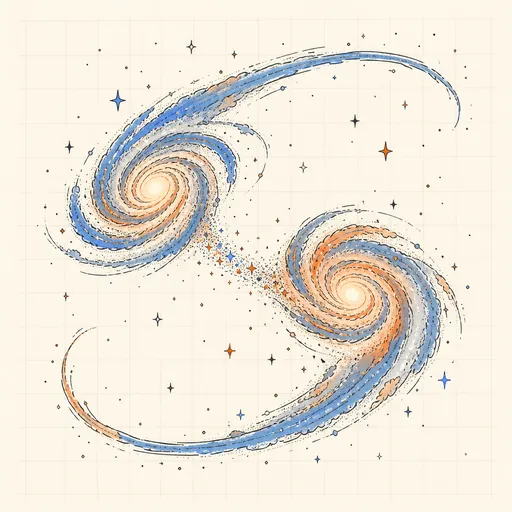
Galaxy Collision Simulator
Smash two spiral galaxies together and watch tidal tails and bridges form.
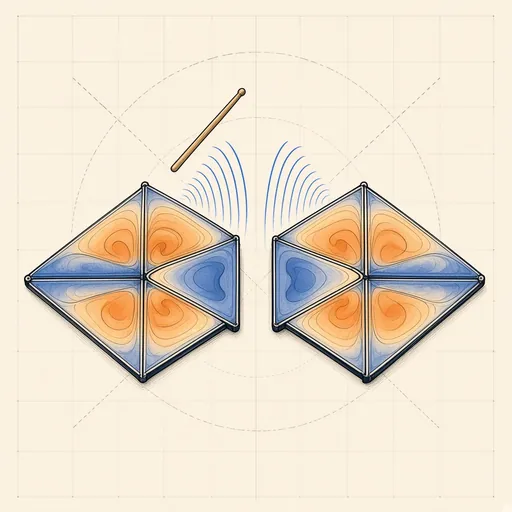
Hear the Shape of a Drum
Draw any drum and hear its true vibration modes — then meet two different drums that sound exactly the same.