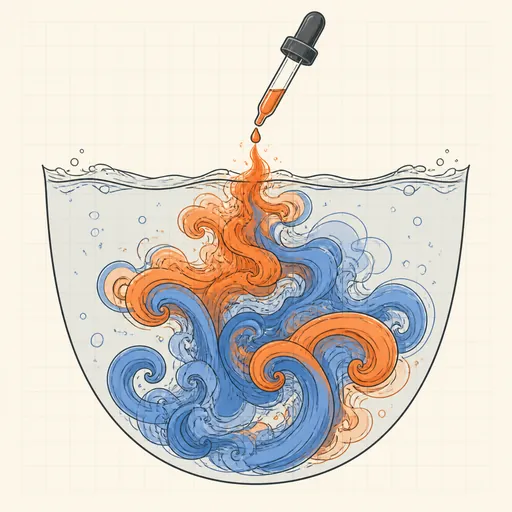
Fluid Flow Simulator
An incompressible fluid solver running entirely on the graphics card: every step, WebGL fragment shaders advect the velocity field along itself (Jos Stam’s semi-Lagrangian method), add vorticity confinement to keep small whirls alive, compute the divergence, solve for pressure with about twenty Jacobi iterations and subtract its gradient so the flow stays divergence-free. Drag across the canvas with mouse or finger to inject velocity and a dye whose hue drifts slowly through the spectrum; left alone, the simulation splats itself every few seconds so it never sits still. Sliders control how fast dye and velocity dissipate, the vorticity (curl) strength and the splat radius. Needs WebGL with floating-point textures; a notice appears if the browser can’t provide them.
Runs 100% in your browser — simulations are computed locally on your device.
Read the full guide to this tool
Notes
- Stam’s "Stable Fluids" (SIGGRAPH 1999) traces each cell backward along the velocity field and interpolates — unconditionally stable at any time step, which is why it runs at 60 fps where classical explicit solvers blow up.
- Incompressibility (∇·u = 0) is enforced by Helmholtz–Hodge decomposition: solve the Poisson equation ∇²p = ∇·u, then subtract ∇p from the velocity field.
- Semi-Lagrangian advection is numerically diffusive and smears small vortices; vorticity confinement (Fedkiw et al., 2001) measures the local curl and adds a force that spins them back up.
- Runs 100% in your browser — simulations are computed locally on your device.
Related tools
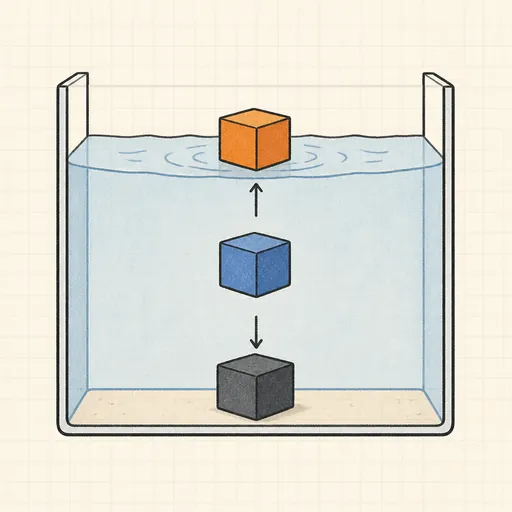
Buoyancy Tank
Drop blocks of different density into water and watch Archimedes decide what floats, sinks or hovers.
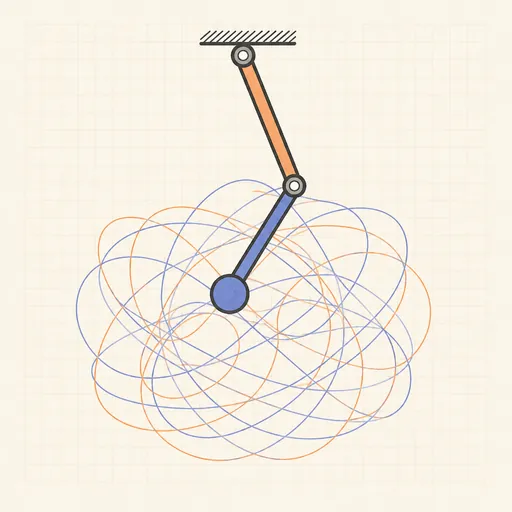
Double Pendulum
Swing a chaotic double pendulum and split it into a rainbow swarm to watch nearby starts diverge.
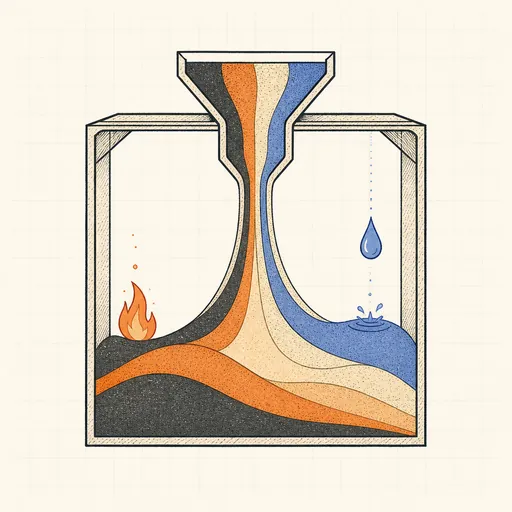
Falling-Sand Playground
Paint sand, water, oil, fire and more and watch them pour, settle, burn and react pixel by pixel.
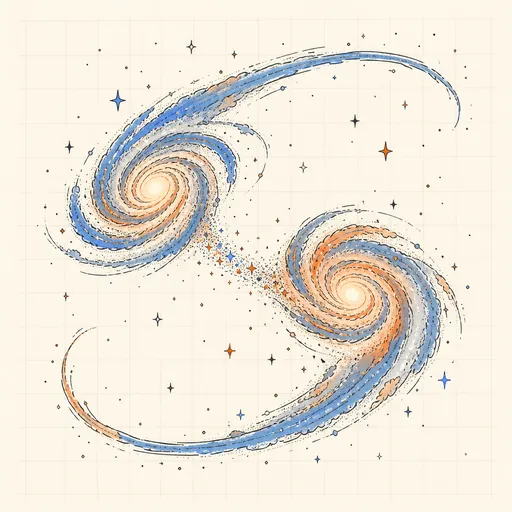
Galaxy Collision Simulator
Smash two spiral galaxies together and watch tidal tails and bridges form.
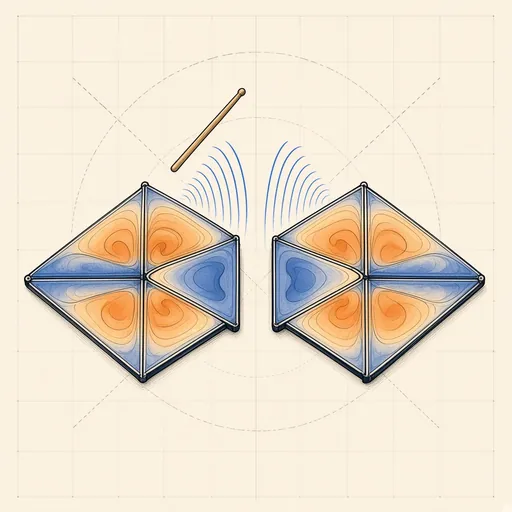
Hear the Shape of a Drum
Draw any drum and hear its true vibration modes — then meet two different drums that sound exactly the same.
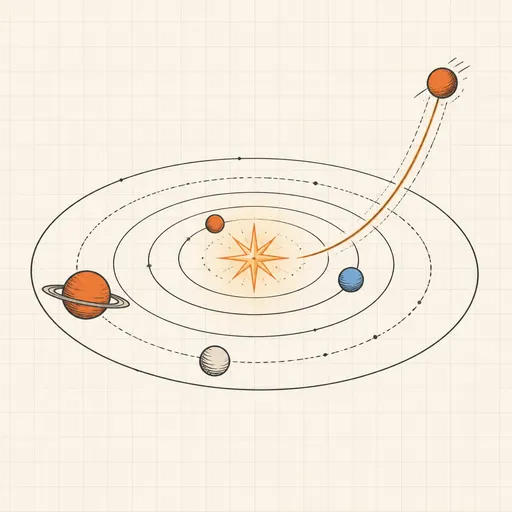
Orbit Sandbox
Fling planets around a star and watch Newtonian gravity draw ellipses, slingshots and chaotic dances.