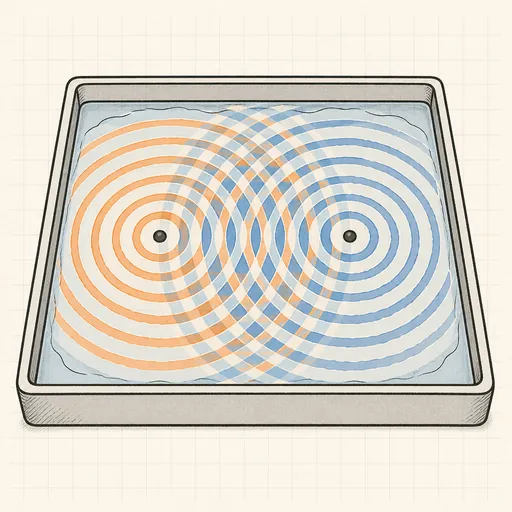
Wave Interference
A virtual ripple tank: the two-dimensional wave equation is stepped on a 240×160 grid with a leapfrog scheme, surrounded by an absorbing sponge layer so waves die at the edges instead of reflecting. Pick a preset — a single oscillating source, two sources, a double slit fed by a plane wave from the left, or a scatter of random sources — then click or tap anywhere to drop extra sources into the tank. Sliders set the driving frequency, the source and slit spacing, a global damping and the display contrast. Crests render red and troughs blue through a diverging blue-white-red colour map, so the hyperbolic fringes of two-source interference and the fan of beams behind the double slit stand out immediately. Everything animates at full speed and the current frame exports as a PNG.
Runs 100% in your browser — simulations are computed locally on your device.
Read the full guide to this tool
Notes
- The field obeys ∂²u/∂t² = c²∇²u; the leapfrog scheme is stable only while c²Δt²/Δx² stays below the CFL limit of 1/2 in two dimensions.
- Two sources reinforce where their path difference is a whole number of wavelengths and cancel on half-integer differences — the same geometry as Young’s 1801 double-slit experiment that established the wave nature of light.
- Perfectly non-reflecting edges are impossible on a finite grid, so the tank uses a sponge layer: the outer cells are gently attenuated every step until outgoing waves fade to nothing.
- Runs 100% in your browser — simulations are computed locally on your device.
Related tools
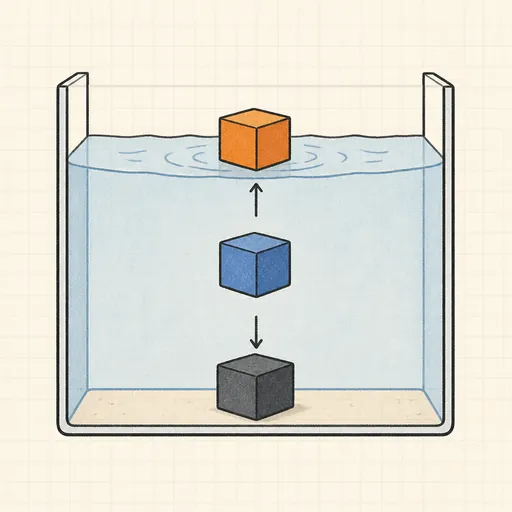
Buoyancy Tank
Drop blocks of different density into water and watch Archimedes decide what floats, sinks or hovers.
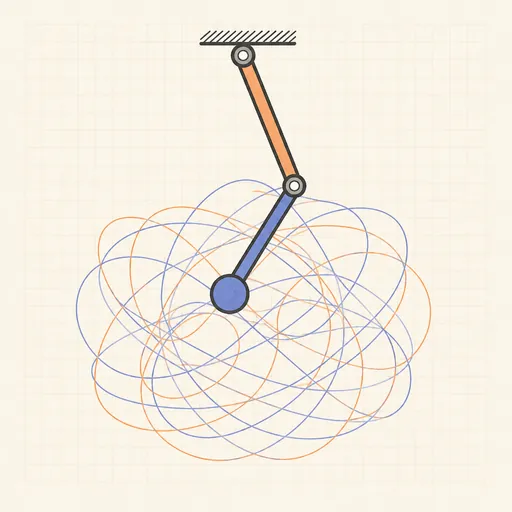
Double Pendulum
Swing a chaotic double pendulum and split it into a rainbow swarm to watch nearby starts diverge.
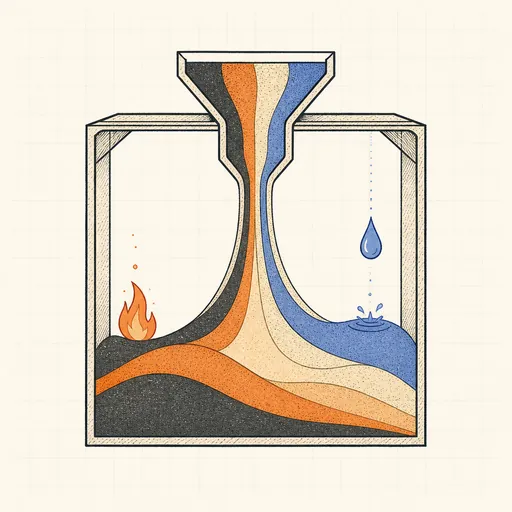
Falling-Sand Playground
Paint sand, water, oil, fire and more and watch them pour, settle, burn and react pixel by pixel.
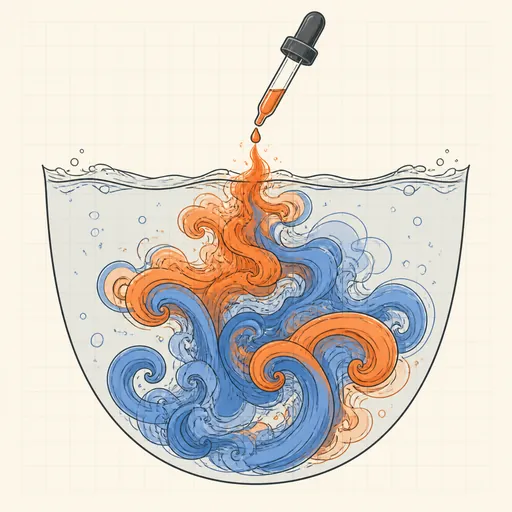
Fluid Flow Simulator
Stir glowing dye through a real-time GPU fluid simulation.
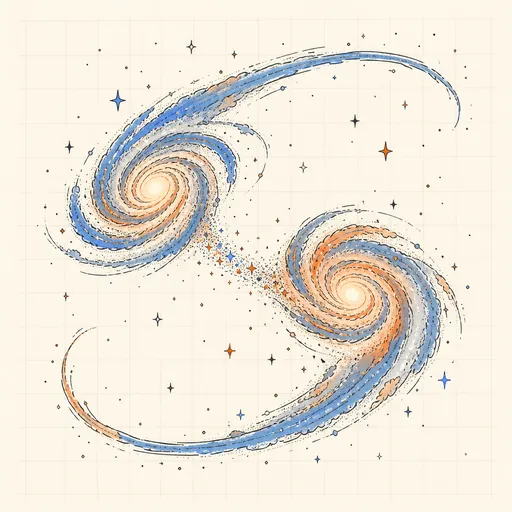
Galaxy Collision Simulator
Smash two spiral galaxies together and watch tidal tails and bridges form.
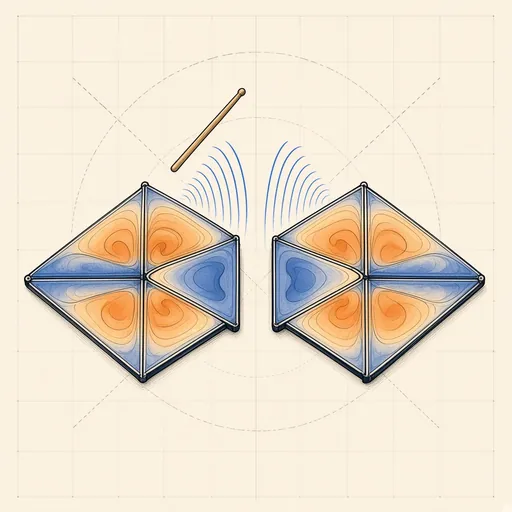
Hear the Shape of a Drum
Draw any drum and hear its true vibration modes — then meet two different drums that sound exactly the same.