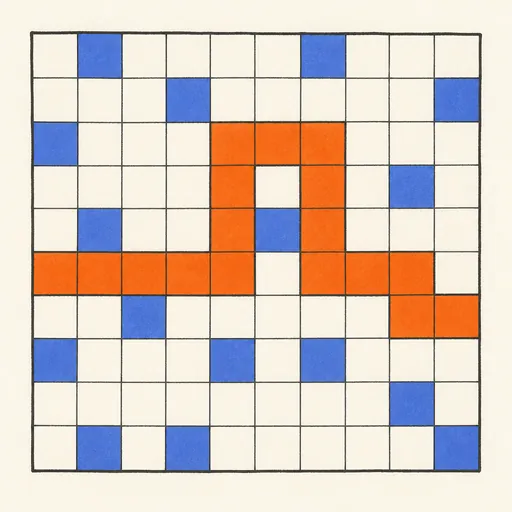
Percolation
Percolation asks a simple question with a sharp answer: if you open each cell of a grid independently with probability p, when does an open path first reach all the way across? Drag p from 0 to 1 and the tool fills the grid, floods the connected clusters in colour and highlights any cluster that spans top to bottom. Below a critical p the clusters stay small and isolated; cross it and a giant cluster suddenly appears and the grid conducts. This threshold is startlingly abrupt for something built from independent coin flips, and the tool marks the spanning transition as you sweep p.
Runs 100% in your browser — simulations are computed locally on your device.
Read the full guide to this tool
Notes
- Each site is open independently with probability p, so there is no coordination anywhere — yet a system-spanning cluster appears suddenly at a critical p, near 0.5927 for site percolation on a square grid.
- Below the threshold the largest cluster is tiny compared with the grid; above it, one cluster fills a finite fraction of the whole — the same abrupt jump seen in phase transitions.
- Percolation models many real spreading problems: current through a random conductor, water through soil, fire through a forest and disease through a contact network.
- Runs 100% in your browser — simulations are computed locally on your device.
Related tools
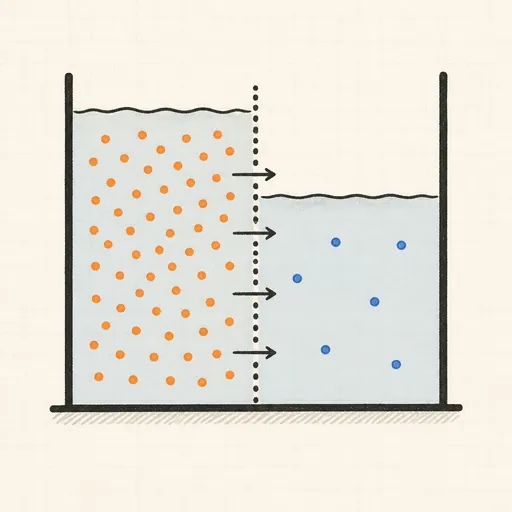
Diffusion & Osmosis
Split a tank with a semipermeable wall and watch particles diffuse and water flow to equalise concentration.
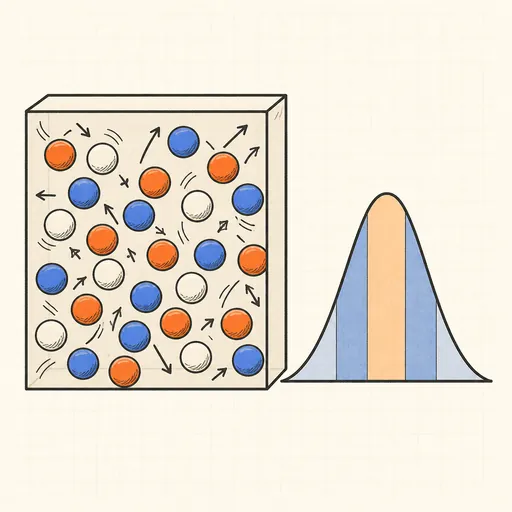
Ideal Gas & Maxwell–Boltzmann
Bounce hard-disc molecules in a box and watch their speeds settle into the Maxwell–Boltzmann distribution.
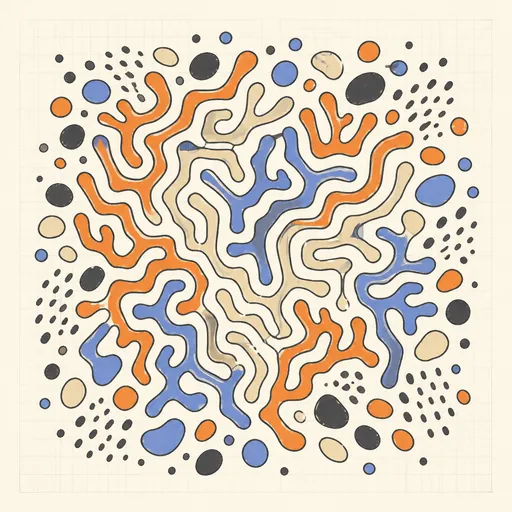
Reaction–Diffusion Patterns
Grow coral, spots and zebra stripes from two virtual chemicals with the Gray–Scott model.
Belousov–Zhabotinsky Reaction
Watch an oscillating chemical medium organize itself into rotating spiral waves.
Crystal Growth Simulator
Grow branching fractal crystals one wandering particle at a time with diffusion-limited aggregation.
Flame Simulator
Paint fire and shape a living flame with fuel, cooling, wind and turbulence.