Diffusion & Osmosis
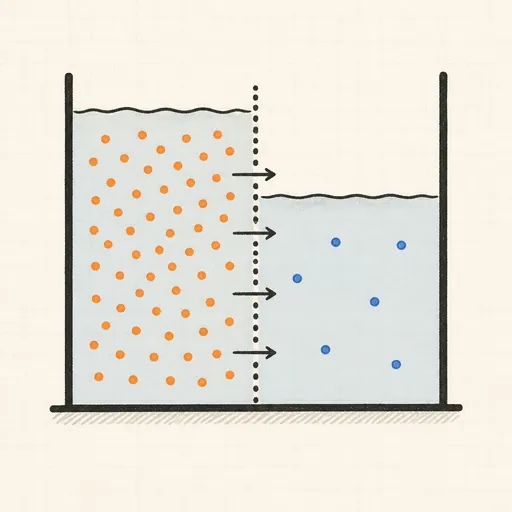
Put two kinds of particle in a box divided by a wall and let them jostle at random, and the second law does the rest: whatever can cross the wall spreads until both sides match. This model shows diffusion and osmosis side by side. Small solvent particles pass freely through the pores of a semipermeable membrane while large solute particles cannot, so solvent drifts toward the saltier side to dilute it, raising its level — osmosis. Switch the wall to fully permeable and both species simply diffuse until evenly mixed. Set the starting concentrations on each side, watch the particle counts and the osmotic level difference converge, and see that the flow is driven purely by random motion, with no force pulling the particles anywhere.
Runs 100% in your browser — simulations are computed locally on your device.
Read the full guide to this tool
Notes
- Nothing pulls the particles across: each moves at random, but there are simply more ways to be spread out than clustered, so concentrations equalise — diffusion is statistics, not force.
- Osmosis is diffusion of the solvent through a membrane the solute cannot cross: water moves toward the saltier side because fewer water molecules there are free to move back, raising that side until the pressure difference balances the flow.
- The height the water climbs measures the osmotic pressure, given for dilute solutions by van ’t Hoff’s law Π = cRT — the same principle that keeps plant cells turgid and drives water up from roots.
- Runs 100% in your browser — simulations are computed locally on your device.
Related tools
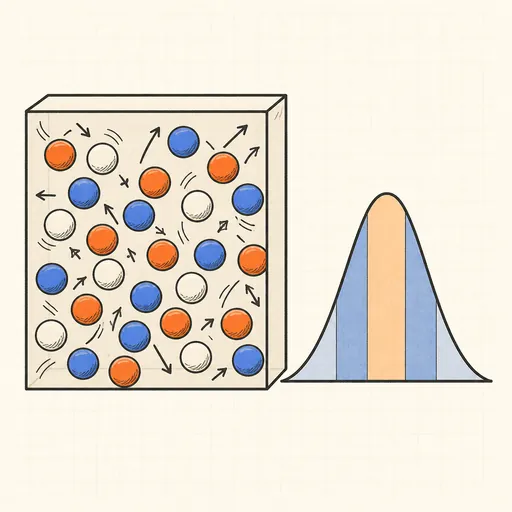
Ideal Gas & Maxwell–Boltzmann
Bounce hard-disc molecules in a box and watch their speeds settle into the Maxwell–Boltzmann distribution.
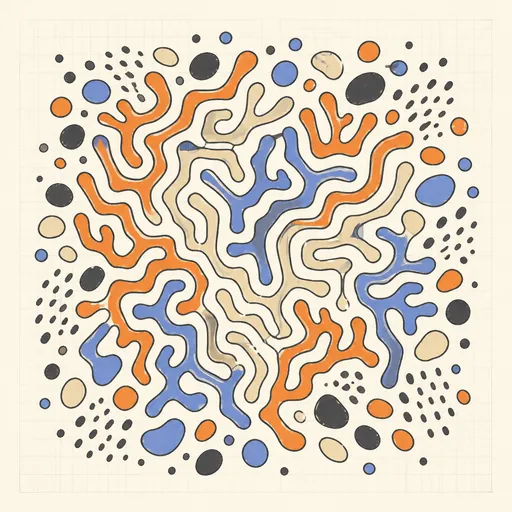
Reaction–Diffusion Patterns
Grow coral, spots and zebra stripes from two virtual chemicals with the Gray–Scott model.
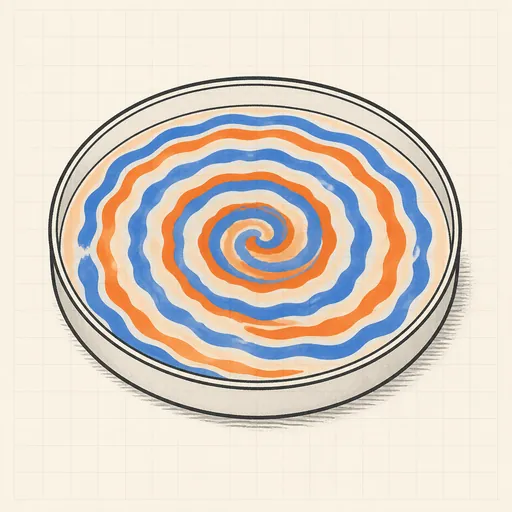
Belousov–Zhabotinsky Reaction
Watch an oscillating chemical medium organize itself into rotating spiral waves.
Crystal Growth Simulator
Grow branching fractal crystals one wandering particle at a time with diffusion-limited aggregation.
Flame Simulator
Paint fire and shape a living flame with fuel, cooling, wind and turbulence.
Ising Model Ferromagnet
Flip a grid of spins at any temperature and watch magnetic domains freeze in or melt at the critical point.