Ideal Gas & Maxwell–Boltzmann
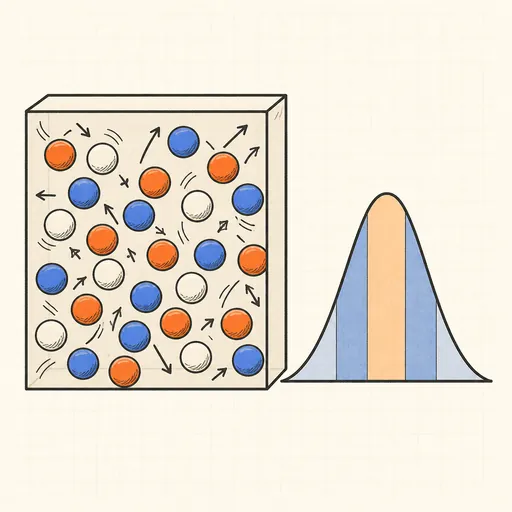
This is a box of hard discs that collide elastically with each other and the walls, the simplest working model of a gas. Start every molecule at the same speed and the collisions quickly randomise them: a few end up fast, a few nearly stopped, and the histogram of speeds settles into the smooth Maxwell–Boltzmann curve no matter how you started. Drag the temperature, the molecule count and the box volume, and watch the pressure on the walls, measured from real wall impacts, track the ideal-gas law. A live speed histogram sits beside the box with the theoretical curve overlaid.
Runs 100% in your browser — simulations are computed locally on your device.
Read the full guide to this tool
Notes
- Temperature is just average kinetic energy: ½ m⟨v²⟩ = k_B T (per degree of freedom), so heating the gas is literally speeding the molecules up.
- Elastic collisions redistribute energy until the speeds reach the Maxwell–Boltzmann distribution, a stable shape the system relaxes to from almost any start — an example of thermal equilibrium.
- Wall pressure comes from momentum transferred by molecules bouncing off, and averaging those impacts reproduces PV = N k_B T, the ideal-gas law, directly from mechanics.
- Runs 100% in your browser — simulations are computed locally on your device.
Related tools
Diffusion & Osmosis
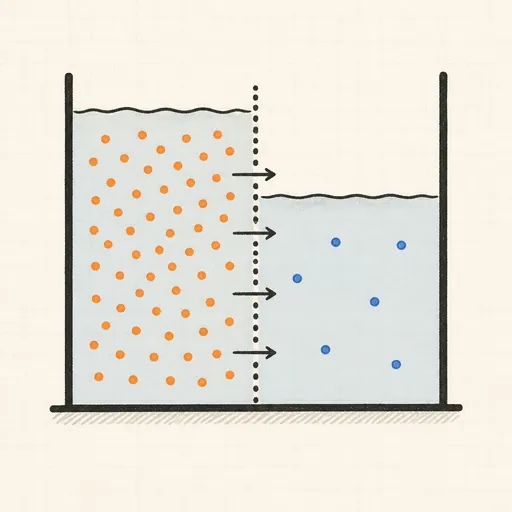
Split a tank with a semipermeable wall and watch particles diffuse and water flow to equalise concentration.
Reaction–Diffusion Patterns
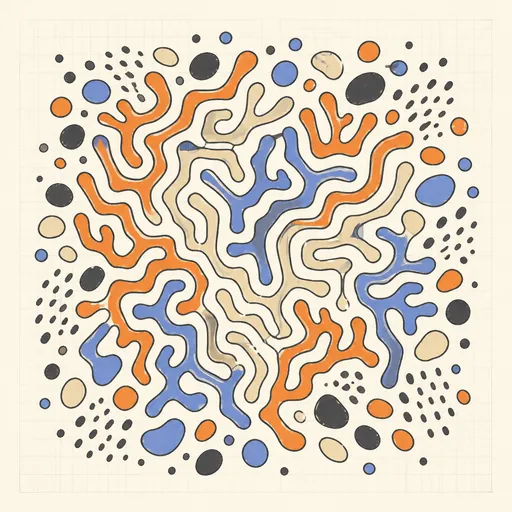
Grow coral, spots and zebra stripes from two virtual chemicals with the Gray–Scott model.
Belousov–Zhabotinsky Reaction
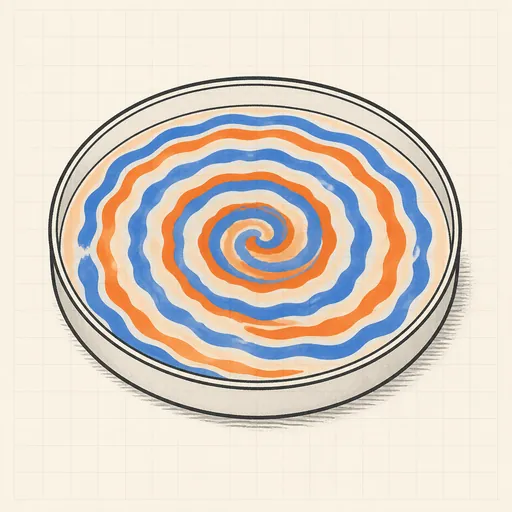
Watch an oscillating chemical medium organize itself into rotating spiral waves.

Crystal Growth Simulator
Grow branching fractal crystals one wandering particle at a time with diffusion-limited aggregation.
Flame Simulator
Paint fire and shape a living flame with fuel, cooling, wind and turbulence.
Ising Model Ferromagnet
Flip a grid of spins at any temperature and watch magnetic domains freeze in or melt at the critical point.