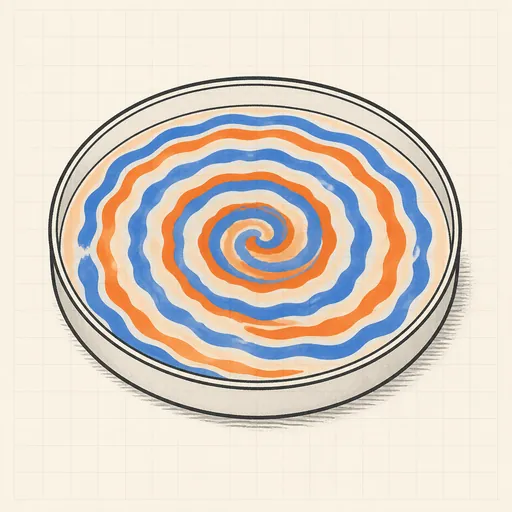
Belousov–Zhabotinsky Reaction
Belousov–Zhabotinsky is the famous oscillating reaction: a beaker that flips colour periodically instead of settling down. This simulation runs a compact cyclic model of it — three concentrations a, b and c live on every cell, each step every cell is stirred together with its neighbours (diffusion) and then a grows at b’s expense, b at c’s and c at a’s: chemical rock-paper-scissors. Started from pure random noise, the field synchronizes itself into expanding target rings and rotating spiral waves within seconds, the same structures seen in a thin dish of the real reagents. The α, β and γ sliders set the three reaction rates and change the wavelength and character of the waves, clicking or dragging injects excitation where you point, and stir re-randomizes the dish. Colours follow a ferroin-style blue–orange–white banding.
Runs 100% in your browser — simulations are computed locally on your device.
Read the full guide to this tool
Notes
- Boris Belousov found the oscillation in the 1950s while modelling the Krebs cycle — and journals rejected his paper as thermodynamically impossible. Anatol Zhabotinsky confirmed and extended the work in the 1960s, long before Belousov was vindicated.
- The real chemistry is bromate oxidising malonic acid, catalysed by cerium or ferroin; the Field–Körös–Noyes ("Oregonator") mechanism of 1972 explained the oscillation through a web of autocatalytic bromide reactions.
- A BZ dish is the canonical excitable medium: the same rotating spiral waves appear in heart muscle, where they underlie certain arrhythmias, and in aggregating slime-mould colonies.
- Runs 100% in your browser — simulations are computed locally on your device.
Related tools
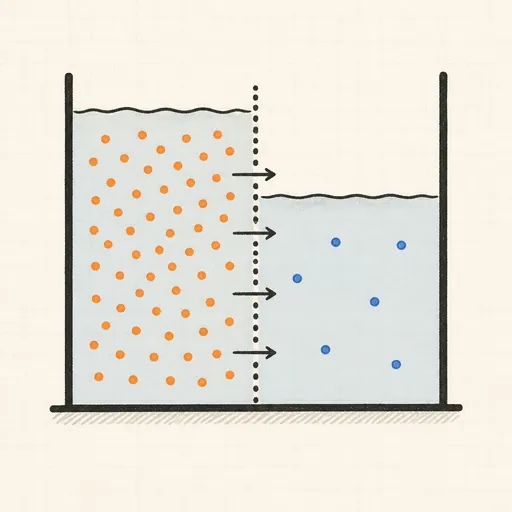
Diffusion & Osmosis
Split a tank with a semipermeable wall and watch particles diffuse and water flow to equalise concentration.
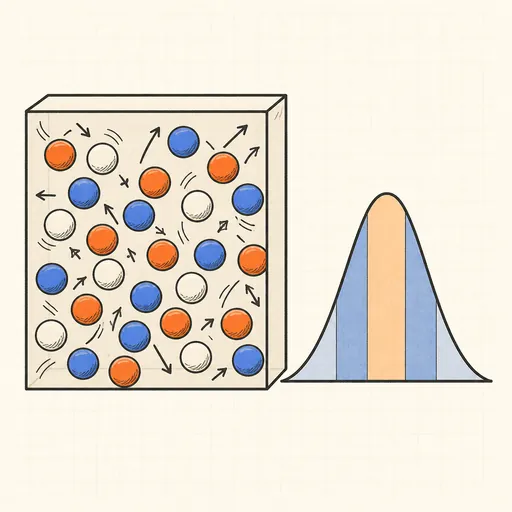
Ideal Gas & Maxwell–Boltzmann
Bounce hard-disc molecules in a box and watch their speeds settle into the Maxwell–Boltzmann distribution.
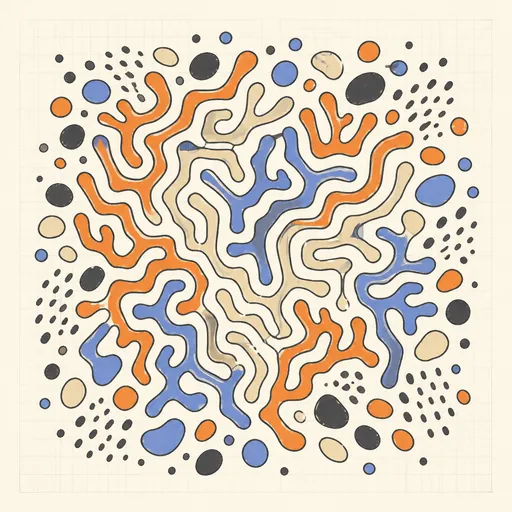
Reaction–Diffusion Patterns
Grow coral, spots and zebra stripes from two virtual chemicals with the Gray–Scott model.
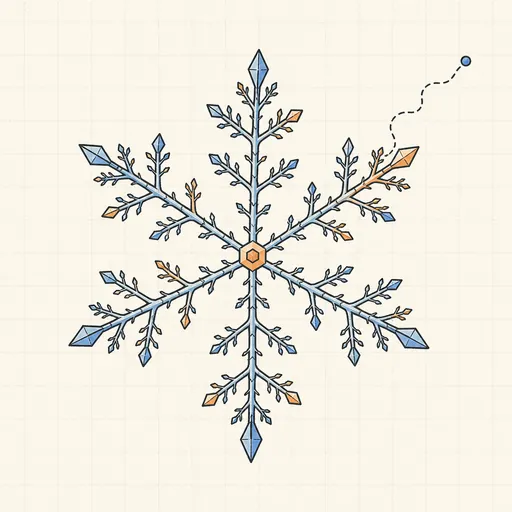
Crystal Growth Simulator
Grow branching fractal crystals one wandering particle at a time with diffusion-limited aggregation.
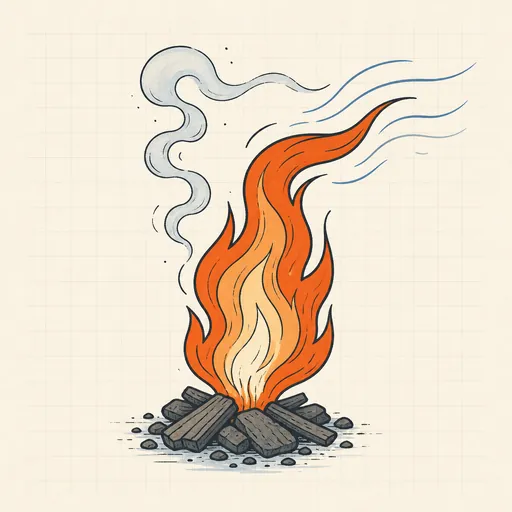
Flame Simulator
Paint fire and shape a living flame with fuel, cooling, wind and turbulence.
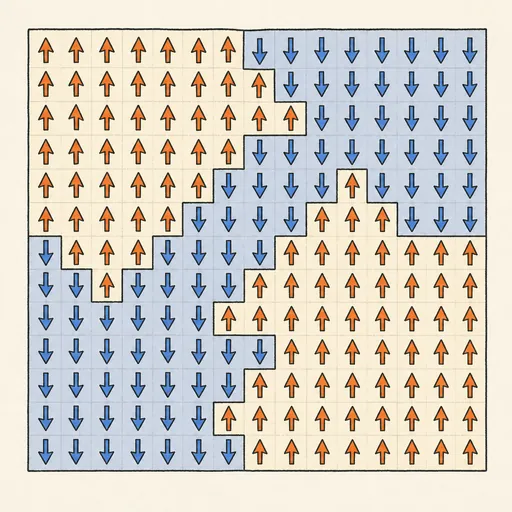
Ising Model Ferromagnet
Flip a grid of spins at any temperature and watch magnetic domains freeze in or melt at the critical point.