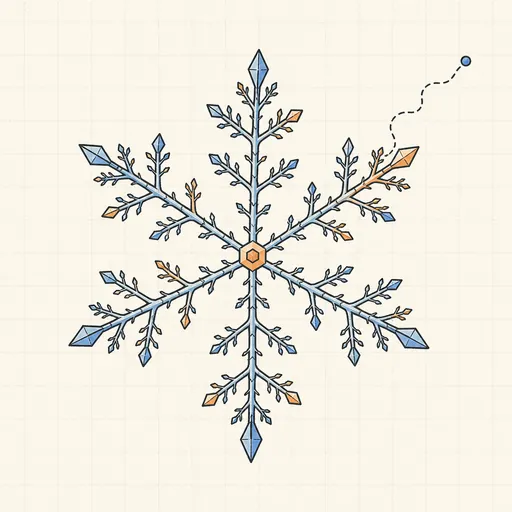
Crystal Growth Simulator
Diffusion-limited aggregation grows a crystal one particle at a time: random walkers are released from a ring around the cluster, wander in Brownian steps and freeze the moment they touch it, starting from a single seed in the centre. Because wandering particles are almost always caught by the outermost tips, the deposit grows branched and fractal rather than solid. The stickiness slider makes attachment probabilistic — lower values let walkers roll deeper into the gaps before sticking, giving denser, more compact crystals — and the walkers slider sets how much material rains in. Snowflake mode deposits every particle with six-fold mirror symmetry, so a dendritic star grows instead of a free-form thicket. Deposits are coloured by age from deep violet through magenta and gold to white for the newest growth; click or drag to add seed material, and the readout tracks particle count and cluster radius.
Runs 100% in your browser — simulations are computed locally on your device.
Read the full guide to this tool
Notes
- Witten and Sander introduced diffusion-limited aggregation in 1981 to explain soot-like metal aggregates; DLA clusters are fractals of dimension ≈ 1.71 in the plane, so mass grows as r^1.71 rather than r².
- Tips win: a diffusing particle is far more likely to hit a protruding branch than to survive the walk into a fjord. The same screening instability (Mullins–Sekerka) sharpens real dendrites in solidification and electrodeposition.
- DLA look-alikes are everywhere: manganese-oxide "mineral fern" dendrites on limestone, zinc electrodeposits, dielectric breakdown (Lichtenberg figures) and viscous fingering between glass plates.
- Runs 100% in your browser — simulations are computed locally on your device.
Related tools
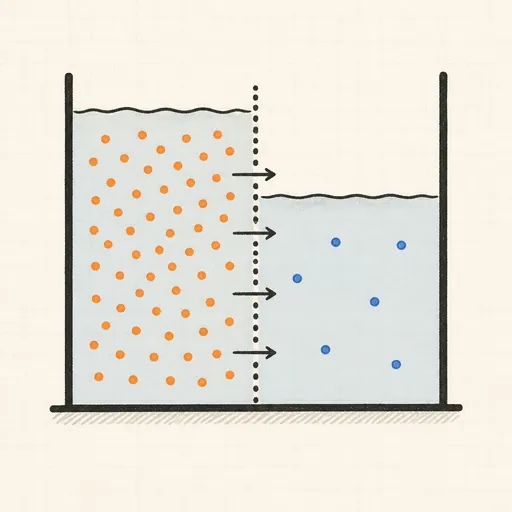
Diffusion & Osmosis
Split a tank with a semipermeable wall and watch particles diffuse and water flow to equalise concentration.
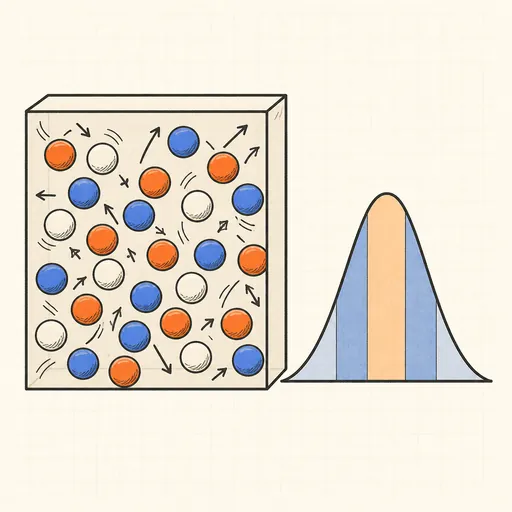
Ideal Gas & Maxwell–Boltzmann
Bounce hard-disc molecules in a box and watch their speeds settle into the Maxwell–Boltzmann distribution.
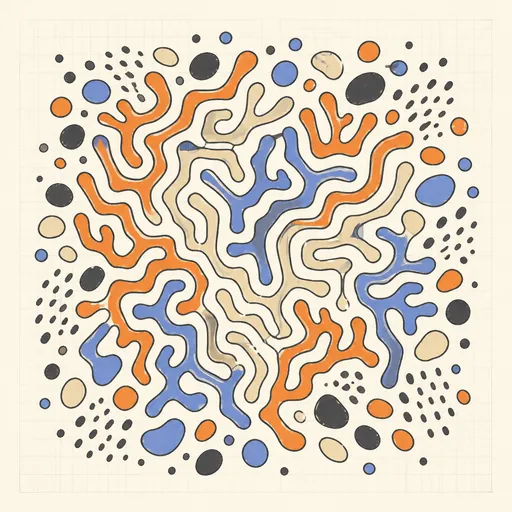
Reaction–Diffusion Patterns
Grow coral, spots and zebra stripes from two virtual chemicals with the Gray–Scott model.
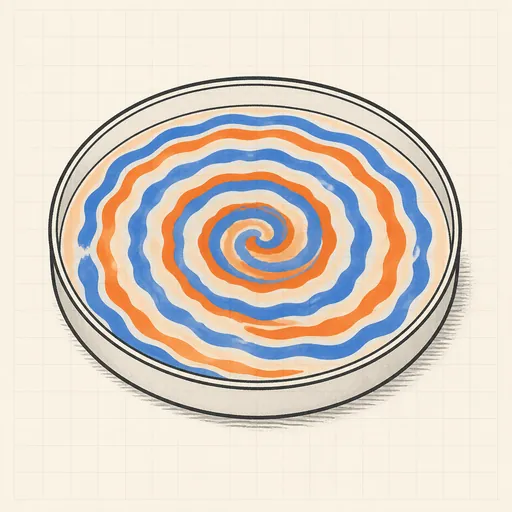
Belousov–Zhabotinsky Reaction
Watch an oscillating chemical medium organize itself into rotating spiral waves.
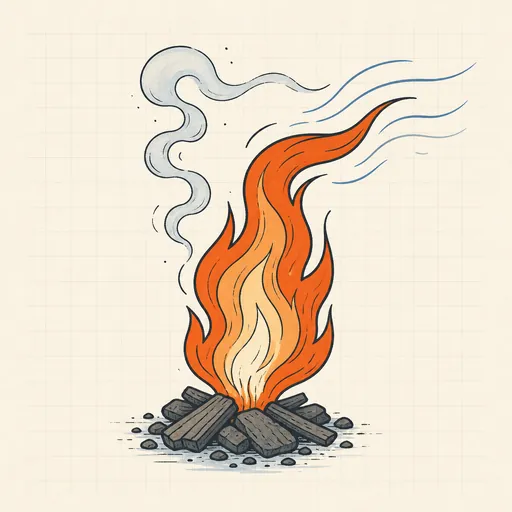
Flame Simulator
Paint fire and shape a living flame with fuel, cooling, wind and turbulence.
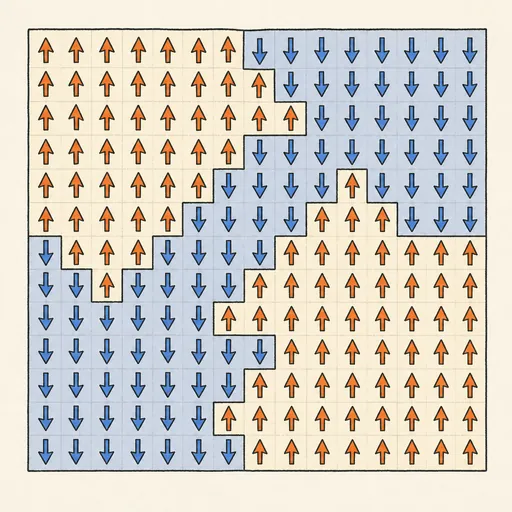
Ising Model Ferromagnet
Flip a grid of spins at any temperature and watch magnetic domains freeze in or melt at the critical point.