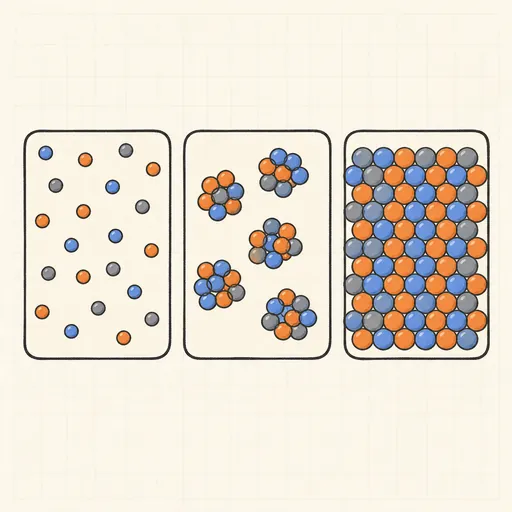
Molecular Dynamics: Phases of Matter
A few hundred atoms interact through the Lennard-Jones potential — harsh repulsion up close, gentle van der Waals attraction further out — and are integrated with the velocity-Verlet algorithm in a periodic box, using a cell-list neighbour search and a Berendsen thermostat that nudges the kinetic energy toward your target temperature. Start hot and the box is a structureless gas; drag the temperature down and atoms condense into liquid droplets, then lock into hexagonally packed crystal rafts — three phases of matter from a single pair force. Atoms are coloured by kinetic energy from cold blue through white to hot orange, and you can drag through the box to stir the fluid. Particle-count and density sliders reshape the box, and live readouts report the instantaneous temperature and the potential energy per atom.
Runs 100% in your browser — simulations are computed locally on your device.
Read the full guide to this tool
Notes
- The potential V(r) = 4ε[(σ/r)¹² − (σ/r)⁶] was proposed by John Lennard-Jones in 1924: the r⁻⁶ tail is the physically correct induced-dipole attraction, the r⁻¹² core a computational convenience.
- Velocity Verlet is time-reversible and symplectic, so energy stays honest over long runs — Loup Verlet used it to simulate liquid argon in 1967, one of the first molecular-dynamics computations.
- Freezing in two dimensions is special: true long-range positional order is forbidden (Mermin–Wagner), and melting is predicted to pass through a "hexatic" phase via unbinding defects (KTHNY theory).
- Runs 100% in your browser — simulations are computed locally on your device.
Related tools
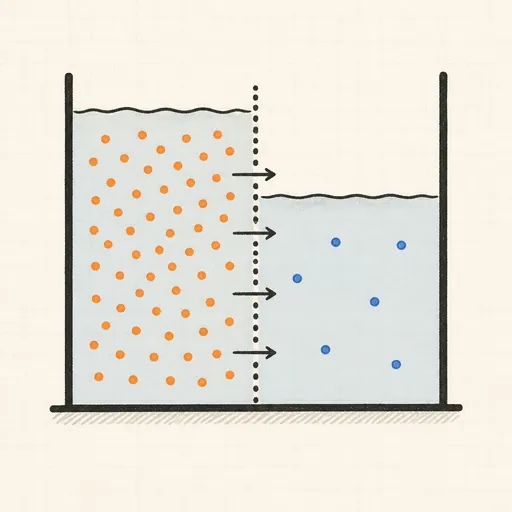
Diffusion & Osmosis
Split a tank with a semipermeable wall and watch particles diffuse and water flow to equalise concentration.
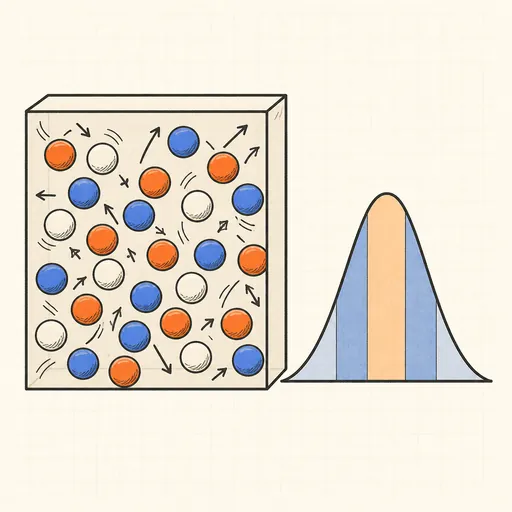
Ideal Gas & Maxwell–Boltzmann
Bounce hard-disc molecules in a box and watch their speeds settle into the Maxwell–Boltzmann distribution.
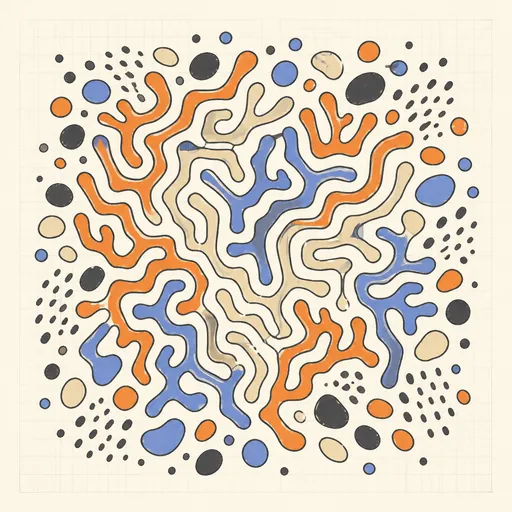
Reaction–Diffusion Patterns
Grow coral, spots and zebra stripes from two virtual chemicals with the Gray–Scott model.
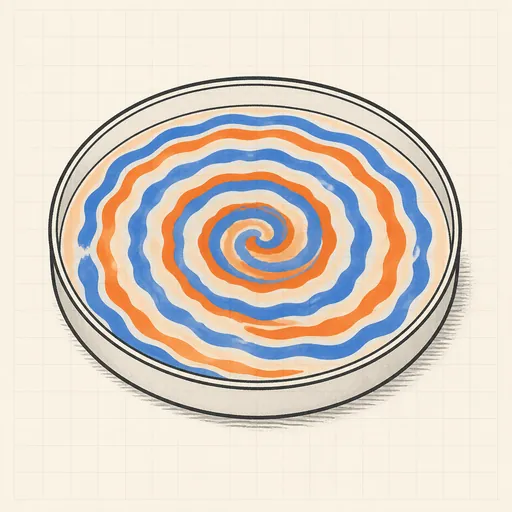
Belousov–Zhabotinsky Reaction
Watch an oscillating chemical medium organize itself into rotating spiral waves.

Crystal Growth Simulator
Grow branching fractal crystals one wandering particle at a time with diffusion-limited aggregation.

Flame Simulator
Paint fire and shape a living flame with fuel, cooling, wind and turbulence.