Why the Ocean Has Two Tidal Bulges
After reading this you can explain why the ocean bulges on both sides of the Earth, predict the 12h25m tidal rhythm, and work out why the Moon out-tides the Sun even though the Sun pulls far harder.
What the two-bulge picture actually says
Stand on a beach and you will see the sea rise and fall roughly twice a day. The naive explanation is that the Moon pulls the water toward it, so the ocean piles up on the Moon side. That predicts one high tide per day. The observed count is two. The naive picture is wrong.
The correct picture is about differences in gravity, not gravity itself. The Moon pulls the near side of the Earth harder than it pulls the center, and pulls the center harder than the far side. Subtract the pull on the center (which is what accelerates the whole planet, coasts and all) and you are left with a stretching field: water on the near side is tugged toward the Moon, and water on the far side is left behind. Both ends bulge outward. Spin the Earth under those two fixed bulges and a coast sweeps through two highs and two lows each day.
The simulator draws these bulges (heavily exaggerated), rotates the Earth beneath them, and traces the sea level at a marked coast. Everything below explains the numbers that trace produces.
When this model helps and when it misleads
This is equilibrium tide theory: imagine a frictionless global ocean that settles instantly into the shape the forcing wants. It is the right tool for understanding why there are two bulges, why they align at new and full moon, and why successive highs can differ. It gives you the rhythm and the structure.
It is the wrong tool for predicting the tide height at a specific harbor on a specific afternoon. Real oceans have continents in the way, water sloshes in basins with their own resonant periods, and friction adds lag. That is why the tidal range runs from a few centimeters in the Mediterranean to over 15 meters in the Bay of Fundy, where the basin resonance nearly matches the tidal period. Use the equilibrium model for insight, not for a tide table.
The equilibrium bulge height for the Moon is only about 0.36 meters. Real ranges of several meters come almost entirely from basin resonance amplifying that tiny forcing. The model gets the timing right and the amplitude very wrong.
The formula and why it falls off as one over distance cubed
The Moon's gravitational acceleration at distance d is a = GM/d^2. What raises tides is not a but how much a changes across the width of the Earth. Take the derivative with respect to distance and multiply by the Earth's radius R:
Here G = 6.674 \times 10^{-11} is the gravitational constant, M is the mass of the tide-raising body, R = 6.371 \times 10^6 meters is the Earth's radius, and d is the distance to the body's center. The key feature is the d^3 in the denominator. Total pull falls off as 1/d^2, but the tidal stretch falls off faster, as 1/d^3.
That extra power of distance is why the Moon wins. The Sun's total pull on the Earth is about 180 times the Moon's. But the Sun is 390 times farther away, and 390^3 is roughly 5.9 \times 10^7, while the Sun's mass beats the Moon's by about 2.7 \times 10^7. Divide and the solar tide comes out around 0.46 of the lunar tide. Distance cubed turns the far larger Sun into the junior partner.
Reproducing the demo: lunar and solar tidal accelerations
Run the simulator with its default values (mean Moon distance, Sun toggled on). Here are the two tidal accelerations computed from the formula above.
- Moon: M = 7.342 \times 10^{22} kg, d = 3.844 \times 10^{8} m. Then d^3 = 5.681 \times 10^{25}.
- Numerator: 2 \times 6.674 \times 10^{-11} \times 7.342 \times 10^{22} \times 6.371 \times 10^{6} = 6.244 \times 10^{19}.
- Lunar tidal acceleration: 6.244 \times 10^{19} / 5.681 \times 10^{25} = 1.099 \times 10^{-6} m/s².
- Sun: M = 1.989 \times 10^{30} kg, d = 1.496 \times 10^{11} m, so d^3 = 3.348 \times 10^{33}.
- Solar tidal acceleration: 2 \times 6.674 \times 10^{-11} \times 1.989 \times 10^{30} \times 6.371 \times 10^{6} / 3.348 \times 10^{33} = 5.053 \times 10^{-7} m/s².
- Ratio: 5.053 \times 10^{-7} / 1.099 \times 10^{-6} = 0.46.
The Sun's tidal effect is 46% of the Moon's. That single number drives the whole spring/neap story below.
Spring and neap tides from adding two fields
When the Sun and Moon line up (new moon and full moon alike, because both bulge pairs point along the same axis), their tidal accelerations add. The combined stretch is 1.099 + 0.505 = 1.604 in units of 10^{-6} m/s². Those are spring tides, the largest range of the month. The word has nothing to do with the season; it means the tide springs up high.
At the quarter moons the Sun sits 90 degrees away. Its bulges now line up with the Moon's lows, partly filling them. The fields subtract: 1.099 - 0.505 = 0.594. Those are neap tides, the smallest range. The ratio of spring range to neap range is 1.604 / 0.594 \approx 2.70, so a coast that swings 4 meters at spring might swing only about 1.5 meters at neap.
The 12h25m rhythm and the diurnal inequality
If the Moon stood still, a point on Earth would return under the same bulge every 24 hours, giving highs 12 hours apart. But the Moon moves along its orbit in the same direction the Earth spins, about 13.2 degrees per day. The Earth has to turn an extra 13.2 degrees to catch up. At 15 degrees per hour that takes 0.88 hours, roughly 53 minutes, spread over the day. The result is the lunar day of about 24 hours 50 minutes, so successive high tides fall about 12 hours 25 minutes apart.
Now tilt the Moon off the equator (its declination). The two bulges no longer sit on the equator; one points into the northern hemisphere, the other into the southern. A coast at mid-latitude passes through one deep bulge and one shallow bulge each lunar day. The two daily highs come out unequal. This is the diurnal inequality, and it is why real tide tables list a higher high water and a lower high water.
Reading the sea-level trace
The plotted curve is the projection of your coast's position against the bulge shape as the Earth rotates. Three features carry all the meaning.
- Period
- The spacing between successive highs. Expect about 12h25m for the lunar semidiurnal signal. Measure it on the curve and you have confirmed the Moon's orbital motion.
- Range
- The vertical distance from high to low. Compare it at new moon versus first quarter to see the spring-to-neap ratio near 2.7.
- Inequality
- The height difference between the two highs in one lunar day. It grows as you raise lunar declination or move the coast toward the poles, and it vanishes when the Moon sits on the equator.
Common mistakes
Do not say "the far-side bulge is caused by centrifugal force from the Earth-Moon spin." The two-bulge symmetry comes from the tidal field alone: subtract the pull on the Earth's center and both ends stretch outward. The Earth-Moon orbit matters for the barycenter, but the far bulge exists even in the pure differential-gravity picture.
Two more traps catch people often. First, assuming the Sun matters little because the Moon dominates: the Sun still supplies 46% of the lunar forcing, enough to nearly triple the range from neap to spring. Second, reading spring tides as a seasonal event. They happen twice a month, at every new and full moon, because alignment is what counts, not the calendar.
A subtler error is expecting the equilibrium heights to match a real tide gauge. They will not. The model's 0.36 meter lunar bulge is a forcing, not a measured range. Judge the model on timing and structure, not on absolute height.
Related tools
Tides are one member of a family of gravity and wave effects you can explore here. The Orbit Sandbox lets you see the Newtonian orbits whose distance changes drive tidal strength. The Galaxy Collision Simulator shows the same differential-gravity stretching at cosmic scale, where it pulls tidal tails out of colliding galaxies. For the wave side of ocean physics, the Wave Interference tool shows how sources add and cancel, the same superposition that combines the lunar and solar bulges. And the Coriolis Effect tool covers the rotating-frame physics that steers real tidal currents into rotating patterns the equilibrium model leaves out.
Frequently asked questions
Why are there two high tides a day and not one?
Because tides come from the difference in the Moon's pull across the Earth, not the pull itself. The near side is pulled toward the Moon and the far side is left behind, so both sides bulge outward. A rotating coast passes through both bulges each lunar day, giving two highs.
Why does the Moon cause bigger tides than the Sun if the Sun is heavier?
Tidal forcing falls off as 1/d^3, not 1/d^2. The Sun is 390 times farther, and 390^3 outweighs the Sun's mass advantage. The result is that solar tides are about 0.46 of lunar tides.
What makes spring and neap tides?
At new and full moon the solar and lunar bulges align and add, giving the large spring range (combined forcing 1.604). At the quarter moons they are perpendicular and partly cancel, giving the small neap range (0.594). The ratio is about 2.7.
Why are successive high tides sometimes unequal?
When the Moon stands off the equator, the two bulges sit in different hemispheres. A mid-latitude coast passes through one deep bulge and one shallow one per lunar day, so the two highs differ. This is the diurnal inequality.
Why is the tidal cycle 12 hours 25 minutes and not exactly 12 hours?
The Moon moves about 13.2 degrees along its orbit each day, so the Earth must spin an extra amount to bring a coast back under the bulge. That stretches the lunar day to about 24h50m, making successive highs 12h25m apart.
Related tools
Buoyancy Tank
Drop blocks of different density into water and watch Archimedes decide what floats, sinks or hovers.
Double Pendulum
Swing a chaotic double pendulum and split it into a rainbow swarm to watch nearby starts diverge.
Falling-Sand Playground
Paint sand, water, oil, fire and more and watch them pour, settle, burn and react pixel by pixel.
Fluid Flow Simulator
Stir glowing dye through a real-time GPU fluid simulation.
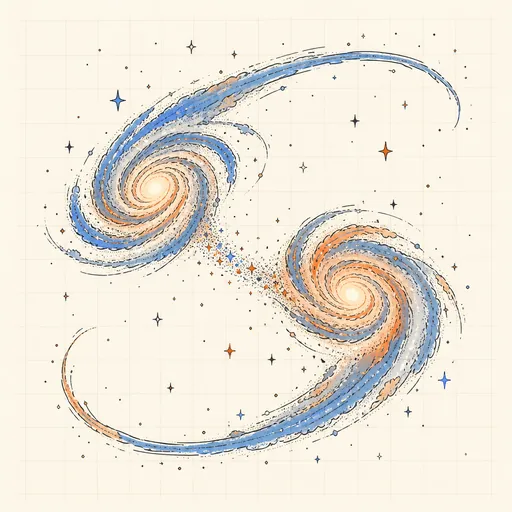
Galaxy Collision Simulator
Smash two spiral galaxies together and watch tidal tails and bridges form.
Hear the Shape of a Drum
Draw any drum and hear its true vibration modes — then meet two different drums that sound exactly the same.