Tides Simulator
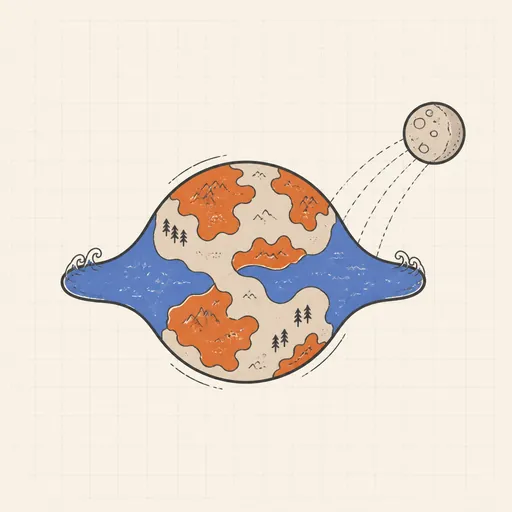
The most common misconception in physics class: “the Moon pulls the water, so there is one bulge.” There are two — the Moon’s gravity is stronger than average on the near side and weaker than average on the far side, so relative to the Earth’s centre both sides get stretched outward. This simulator draws the exaggerated equilibrium bulges, spins the Earth underneath them, and plots the resulting sea level at a marked coast: two highs and two lows per day, 12 hours 25 minutes apart because the Moon keeps moving along its orbit. Toggle the Sun to watch spring tides (bulges aligned at new and full moon) and neap tides (at quarter moons), pull the Moon closer or farther, and change latitude and lunar declination to see the two daily highs become unequal.
Runs 100% in your browser — simulations are computed locally on your device.
Read the full guide to this tool
Notes
- Tides come from the *difference* in gravity across the Earth, which falls off as 1/d³ — that is why the Moon out-tides the Sun despite the Sun’s vastly stronger total pull, and why a 10% change in Moon distance moves the range by about 30%.
- Spring tides happen whenever Sun, Earth and Moon line up — at full moon as well as new moon, since two aligned bulge pairs add either way. At quarter moon the solar bulge partly fills the lunar low: neap tides.
- When the Moon stands off the equator, a coast at mid-latitude passes through one deep and one shallow bulge per day — the diurnal inequality that makes successive high tides unequal.
- This is the equilibrium theory: a frictionless global ocean instantly at rest with the forcing. Real coasts add resonating basins, shelves and lag, which is why actual ranges vary from centimetres to Bay-of-Fundy metres — but the two-bulge rhythm underneath is this one.
- Runs 100% in your browser — simulations are computed locally on your device.
Related tools
Buoyancy Tank
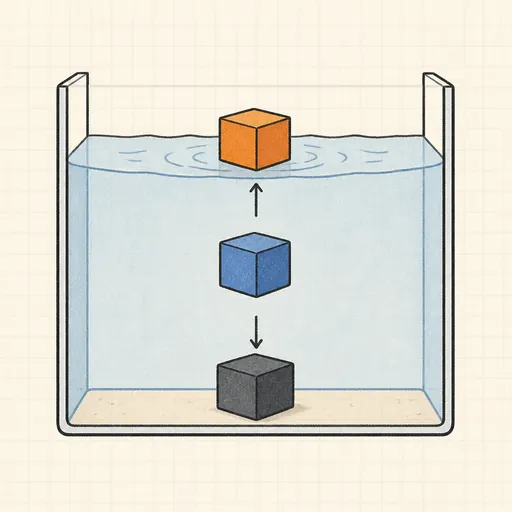
Drop blocks of different density into water and watch Archimedes decide what floats, sinks or hovers.
Double Pendulum
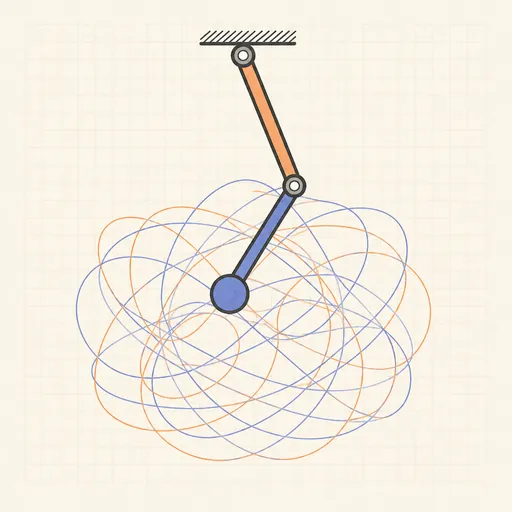
Swing a chaotic double pendulum and split it into a rainbow swarm to watch nearby starts diverge.
Falling-Sand Playground
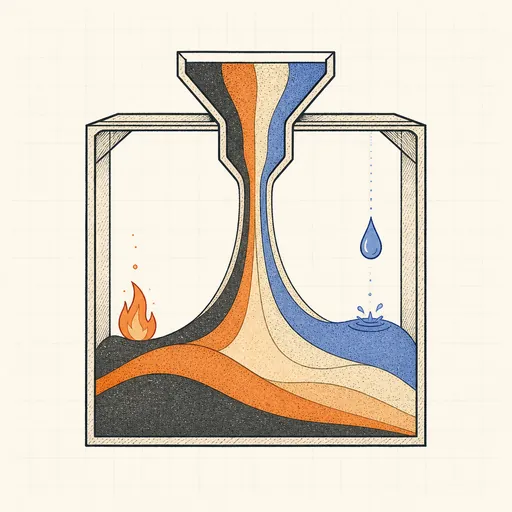
Paint sand, water, oil, fire and more and watch them pour, settle, burn and react pixel by pixel.
Fluid Flow Simulator
Stir glowing dye through a real-time GPU fluid simulation.
Galaxy Collision Simulator
Smash two spiral galaxies together and watch tidal tails and bridges form.
Hear the Shape of a Drum
Draw any drum and hear its true vibration modes — then meet two different drums that sound exactly the same.