Coriolis Effect
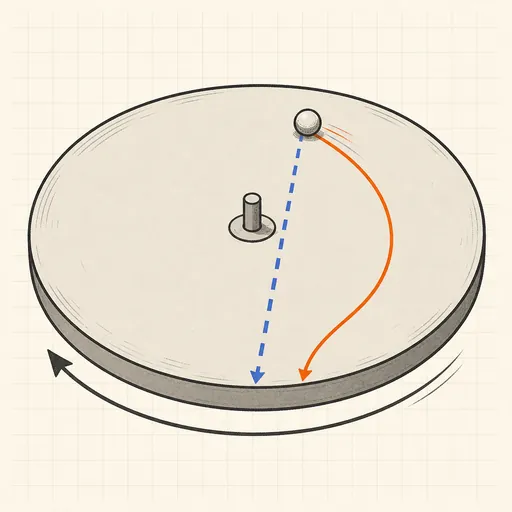
The Coriolis force confuses everyone because it is not a push — it is an artifact of watching from a rotating platform. This simulator shows the same force-free ball twice, side by side: in the inertial frame it rolls dead straight across a spinning disk, while in the co-rotating frame the identical motion bends into a curve. Set the rotation rate (positive for the northern hemisphere, negative for the southern), the launch speed and direction, and overlay the Coriolis and centrifugal pseudo-force arrows to see the “force” that exists only in the rotating view. Scenario presets tell the classic stories: artillery corrections, why cyclones spin opposite ways in the two hemispheres, and why your draining sink does not care about any of this.
Runs 100% in your browser — simulations are computed locally on your device.
Read the full guide to this tool
Notes
- In the rotating frame the apparent acceleration is −2Ω×v (Coriolis) plus Ω²r (centrifugal). Both vanish the moment you describe the motion from the inertial frame — hence “pseudo-forces.”
- The deflection is always at right angles to the velocity: rightward when the platform turns counterclockwise (northern hemisphere), leftward when it turns clockwise (southern).
- Scale is everything: cyclones curve because air travels for days across hundreds of kilometres, while water spends seconds in a sink where the Coriolis acceleration is roughly a ten-millionth of gravity — the toilet-swirl legend does not survive the arithmetic.
- The ball here slides friction-free on a flat disk; real geophysical flows add pressure gradients and friction, but the deflection mechanism is exactly the one on screen.
- Runs 100% in your browser — simulations are computed locally on your device.
Related tools
Buoyancy Tank
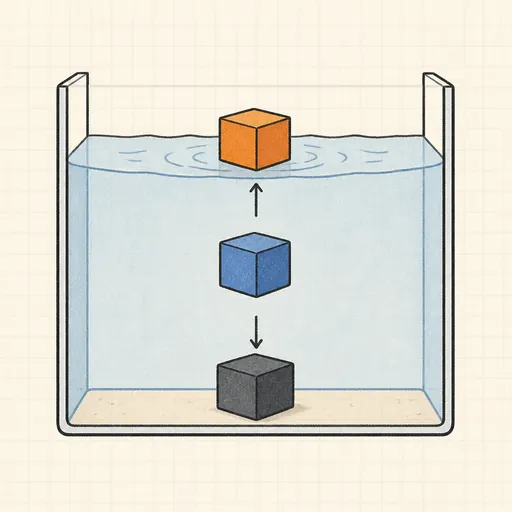
Drop blocks of different density into water and watch Archimedes decide what floats, sinks or hovers.
Double Pendulum
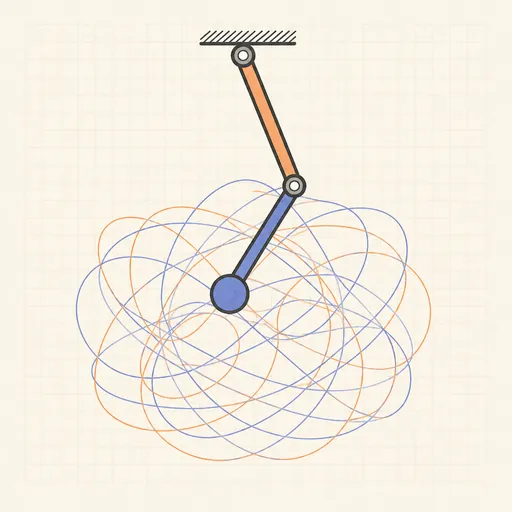
Swing a chaotic double pendulum and split it into a rainbow swarm to watch nearby starts diverge.
Falling-Sand Playground
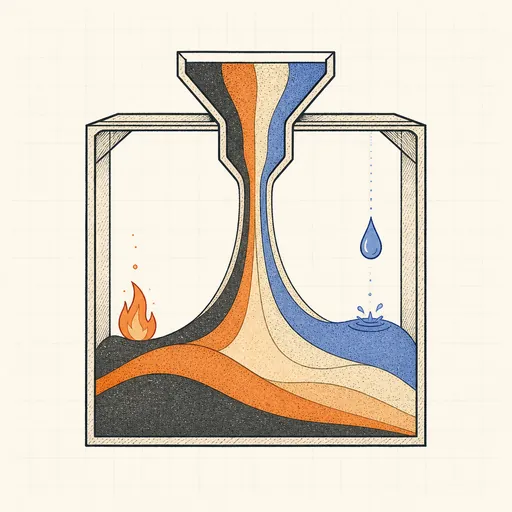
Paint sand, water, oil, fire and more and watch them pour, settle, burn and react pixel by pixel.
Fluid Flow Simulator
Stir glowing dye through a real-time GPU fluid simulation.
Galaxy Collision Simulator
Smash two spiral galaxies together and watch tidal tails and bridges form.
Hear the Shape of a Drum
Draw any drum and hear its true vibration modes — then meet two different drums that sound exactly the same.