Langton's Ant, Explained
After reading this you can trace Langton's ant by hand for a few dozen steps, predict roughly when its chaotic phase ends, and explain why a two-line rule produces a straight highway that no one has yet proven must appear.
What it is, and the one thing to watch
Langton's ant is a machine that lives on an infinite grid of square cells. Every cell is either white or black. The ant sits on one cell and faces one of four directions: north, east, south or west. At each step it reads the colour under it, follows two rules, and moves one cell. That is the whole system.
The rules were written by Christopher Langton in 1986:
- On a white cell: flip it to black, turn 90 degrees right, step forward one cell.
- On a black cell: flip it to white, turn 90 degrees left, step forward one cell.
Start on an all-white grid. For the first few hundred steps the ant makes small symmetric shapes. Then the trail grows tangled and looks random for thousands of steps. Then, near step 10,000, the mess ends. The ant starts producing a repeating diagonal structure that runs off to infinity. That structure is called the highway, and it is the thing to watch. The lesson of the ant is that a fixed, deterministic, memoryless rule can spend a long time looking chaotic and still settle into strict order.
When this model is useful, and when it is not
Use Langton's ant to see three ideas made concrete. First, emergence: complex behaviour with no complex rule behind it. Second, transient chaos: a system can look random for a bounded time and then become periodic. Third, computational universality: with the right starting pattern of coloured cells, an arrangement of ants and colours can compute anything a computer can, so no shortcut formula can predict every ant's fate.
Do not read it as a model of a real ant, or of biology, or of any physical process. It is a toy that isolates one mathematical point. It says nothing quantitative about diffusion, foraging or self-assembly. If you want a genuinely random walker, that is a different object, covered by the Random Walk Explorer. If you want richer local rules on a grid, see Conway's Game of Life.
The rule as a small state machine
You can write the update precisely. Let the ant have position (x, y) and a heading d \in \{0, 1, 2, 3\} meaning north, east, south, west. Let C(x, y) be the colour, 0 for white and 1 for black. One step is:
Here C(x,y) = 0 gives d' = d + 1, a right turn. C(x,y) = 1 gives d' = d - 1, a left turn. After turning, flip the cell with C(x,y) \leftarrow 1 - C(x,y), then step forward in direction d'. The move added to position for each heading is:
Every symbol matters, so read them: d' is the new heading after the turn, and the four pairs are the steps for north, east, south, west in that order. The system is fully deterministic. Given the grid and the ant state, the next state is fixed. There is no randomness anywhere.
One useful invariant: the ant's parity. Each step changes x + y by exactly 1, so the ant alternates between the two colours of an imaginary checkerboard. This forces certain symmetries in the early patterns and is why the first hundred-odd steps look so tidy.
A worked trace from the demo start
The demo starts with a single ant on an all-white grid, facing north, at the origin. Follow the first eight steps. Since every cell is white until the ant touches it, the first several moves are all right turns.
First eight steps on white cells
- At
(0,0), facing north, cell white. Turn right to east, flip(0,0)black, move to(1,0). - At
(1,0), facing east, white. Turn right to south, flip black, move to(1,-1). - At
(1,-1), facing south, white. Turn right to west, flip black, move to(0,-1). - At
(0,-1), facing west, white. Turn right to north, flip black, move to(0,0). - Back at
(0,0), now black. Turn left from north to west, flip white, move to(-1,0). - At
(-1,0), white. Turn right to north, flip black, move to(-1,1). - At
(-1,1), white. Turn right to east, flip black, move to(0,1). - At
(0,1), white. Turn right to south, flip black, move to(0,0).
After eight steps the ant is back at the origin, and five cells are black. Notice step 5: the first time the ant meets a black cell, it turns the other way. That single reversal is what breaks the tidy square and, thousands of steps later, feeds the chaos.
Keep going by hand and the picture stays roughly symmetric until about step 500. From there the trail loses its symmetry and the black region grows in a lumpy, unpredictable-looking blob. This is the chaotic phase, and it lasts until close to step 10,000.
The highway, and its period of 104
Somewhere near step 10,000 (the exact step depends on nothing but the fixed rule, so it is always the same number for the same start), the ant stops filling the blob and begins a repeating cycle. Every 104 steps the local pattern of black and white repeats exactly, shifted two cells along a diagonal. That is the highway.
Because each 104-step block moves the ant a fixed 2 cells diagonally, the ant's speed along the highway is constant. In 104 steps it advances 2 cells in x and 2 in y, a diagonal displacement of 2\sqrt{2} \approx 2.828 cells. So the ant covers about 2.828 / 104 \approx 0.0272 diagonal cells per step once the highway locks in.
The change of slope at the marker is the whole story in one line. Before it, the ant wanders inside a growing blob and its distance from the origin grows slowly and irregularly. After it, distance grows in a perfectly straight line forever.
Reading the results without fooling yourself
What counts as the "end" of chaos is the first step of the highway, not the moment the pattern merely looks calmer. The highway is defined by exact period-104 repetition, so you confirm it by checking that the ant's local configuration at step n matches step n + 104 shifted by (2,2). Eyeballing is not enough; the blob has quiet spells before the true highway starts.
Two counts are worth tracking. The number of black cells rises unevenly during the chaotic phase, then during the highway it grows by a fixed amount every 104 steps. The ant's distance from the origin, plotted above, is the cleaner signal, because its slope changes sharply and stays changed.
| Quantity | Chaotic phase | Highway phase |
|---|---|---|
| Approximate step range | 0 to ~10,000 | ~10,000 onward |
| Distance vs step | slow, jagged, sublinear | linear, slope ~0.0272 |
| Period | none observed | exactly 104 |
| Diagonal shift per period | not applicable | (2, 2) cells |
Common mistakes
Do not expect the highway if you start on a random or non-empty grid. The step-10,000 result and the period of 104 are properties of the single all-white start with one ant. Change the initial colours and the ant can enter a completely different long-lived pattern, or an entirely new highway, or run far longer before settling.
A second mistake is treating the highway as proven. It is not. That every all-white start eventually produces an unbounded highway is called the highway conjecture, and after decades it remains open. What is proven is weaker and elegant: the ant's trajectory is always unbounded. It can never stay trapped in a finite region forever. That theorem (Bunimovich and Troubetzkoy, 1992) does not force a highway; it only forbids an eternal bounded loop.
A third trap is direction conventions. Swap "turn right on white" for "turn left on white" and you get the mirror image, which is fine. But mix up screen-up with grid-north and your hand trace will diverge from the tool. Fix one convention, such as north = up, and keep it.
A fourth: with several ants sharing a grid, the result is not the sum of separate ants. Ants read and flip the same cells, so two ants can collide, cancel, or trigger patterns neither would reach alone. Small changes in spacing can change everything.
Related tools
Langton's ant sits among other simple rules with surprising output. For grid rules that breed moving structures, try Elementary Cellular Automata, where Rule 30 looks random and Rule 110 is Turing-complete like the ant. For a system that also grows a perfectly ordered fractal from a trivial local rule, see the Abelian Sandpile. If you want the classic example of a bounded parameter that flips between order and chaos, the Logistic Map Bifurcation shows the transition as a picture, and the Lorenz Attractor shows deterministic chaos in continuous time.
Frequently asked questions
Why does the ant start building a highway around step 10,000?
No one knows a reason in the sense of a proof. For the single all-white start the exact step is fixed by the deterministic rule and is the same every run. It is one specific number that falls out of the dynamics; it is not tuned or averaged.
Is the highway period really 104?
Yes, for the standard start. The local pattern repeats every 104 steps while translating by 2 cells diagonally. That gives a constant diagonal speed of about 2\sqrt{2}/104 \approx 0.0272 cells per step.
Has anyone proved the highway always appears?
Not from the all-white start in general. The proven fact is only that the ant's path is always unbounded, so it cannot loop forever inside a finite box. Whether every start forces a highway is still an open conjecture.
What does "Turing-complete" mean here?
With cleverly arranged coloured cells, configurations of the ant can simulate logic gates and, in principle, any computation. A consequence is that no general shortcut can decide every ant's long-term fate; you often have to run it.
Does changing the starting colours break the pattern?
It can. The step-10,000 onset and the period of 104 belong to the empty-grid start. Different initial colours can produce longer transients, different highways, or other behaviour, which is part of why the ant is studied.
Related tools
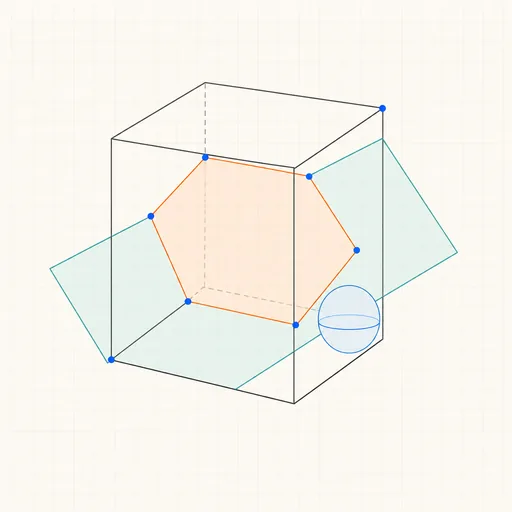
3D Geometry Board
Points, lines, planes, spheres and polyhedra on an orbiting camera — slice solids with planes, unfold nets, drop the Dandelin spheres into a cone and drag everything.
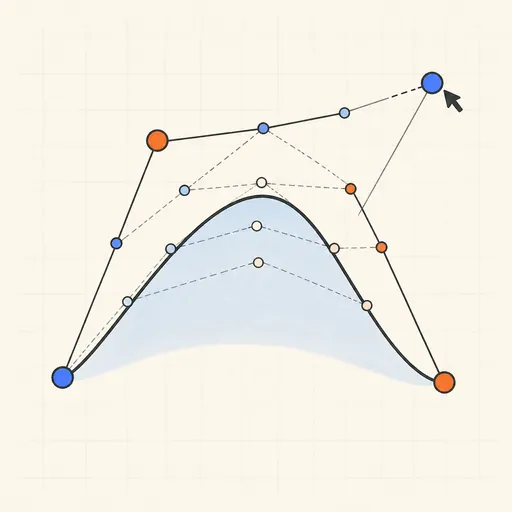
Bézier Curve Playground
Drag control points and watch De Casteljau’s algorithm construct a Bézier curve step by step.
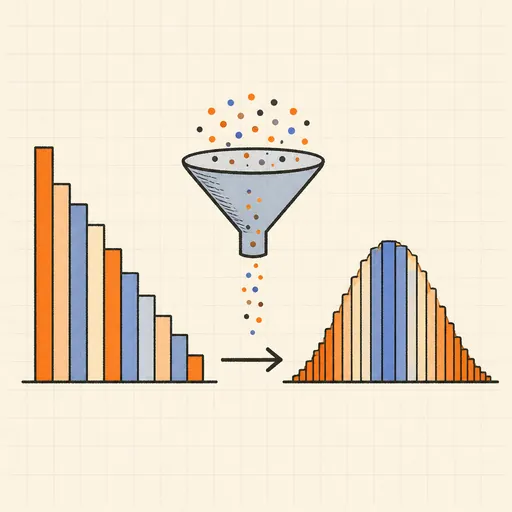
Central Limit Theorem Demo
Sample from any lopsided distribution and watch the averages pile up into a bell curve.
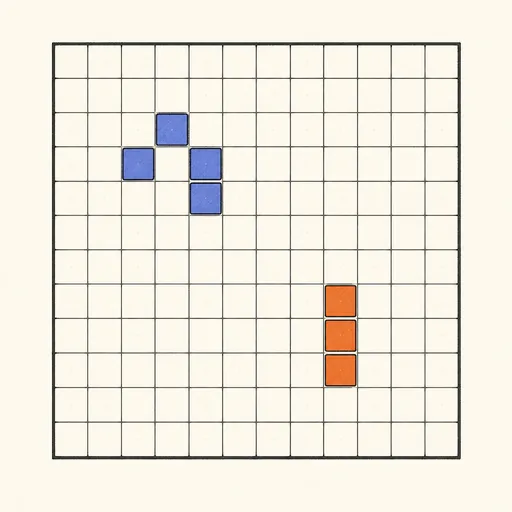
Conway’s Game of Life
Paint cells and watch Conway’s cellular automaton breed gliders, guns and oscillators.
Dynamic Geometry Board
Construct with points, lines, circles and transformations, then drag anything — the construction stays true, and a checker tells you which relations are theorems.
Fantasy Map Generator
Roll a seed and get a continent: coastlines, mountains, rivers, biomes and named towns, ready for your campaign.