The Einstein Monotile, Explained
After reading this you will understand what "aperiodic" really means, how a single tile can force a pattern that never repeats, and how the substitution rules in this toy build honest hat and spectre tilings instead of a looping wallpaper.
What the einstein problem is
Pick up one bathroom tile and copy it a few thousand times. In almost every case you can slide the whole layout sideways by some fixed distance and land exactly back on itself. That sliding symmetry is called a period, and a tiling that has one is periodic. A square grid repeats every 1 unit. A brick wall repeats every 2 bricks. Hexagons repeat too.
The einstein question, from the German ein Stein meaning "one stone," asked the opposite. Is there a single tile shape that can cover the infinite plane, but only in ways that never repeat? No translation, no matter how large, should ever map the finished tiling onto itself.
Roger Penrose reached two tiles in the 1970s with his famous kite and dart, and later two rhombi. You can grow that older pair in the Penrose Tiling Generator. The one-tile case stayed open for about fifty years. In March 2023 David Smith, a retired print technician, spotted a 13-sided shape now called the hat, and with Craig Kaplan, Chaim Goodman-Strauss and Joseph Myers proved it forces aperiodicity. Two months later the same team found the spectre, which needs no mirror images at all.
Periodic, non-periodic, and aperiodic
These three words are easy to confuse, and the difference is the whole point.
- Periodic
- The tiling has at least one translation symmetry. A square grid slides onto itself by any whole number of units.
- Non-periodic
- One particular arrangement happens to have no translation symmetry. Any tile can do this by accident: lay squares in a deliberately crooked spiral and you get a non-periodic layout of a periodic tile.
- Aperiodic
- The tile shape forbids every periodic arrangement. There is no crooked trick and no clever trick. Every single way the hat fits together, out of infinitely many, lacks any translation symmetry.
A square is not aperiodic even though you can arrange it non-periodically, because it also admits periodic arrangements. The hat is aperiodic because it admits none. That is a far stronger claim, and proving it is what took fifty years.
Aperiodic tilings still look locally repetitive. Any finite patch you see, say a cluster of 50 hats, appears again and again elsewhere in the tiling, infinitely often. What never repeats is the whole. This "same locally, never globally" property is exactly what makes the pictures hypnotic.
The shape: a polykite in the [3.4.6.4] grid
The hat is not drawn freehand. Start with the Laves tiling labelled [3.4.6.4], a grid whose faces are kites. Each kite has two short edges and two long edges meeting at angles of 60, 90, 120 and 90 degrees. Glue eight of these kites edge to edge and you get the hat. Because it is built from kites, it belongs to a family called polykites.
The hat sits inside a continuous family written \text{Tile}(a,b), where a and b set the lengths of the two edge types. Most members of that family are aperiodic. The spectre is the specific balanced member \text{Tile}(1,1), where both edge lengths are equal. That equality is what lets the spectre tile without any reflected copies.
How the tiling is actually built: substitution
You cannot place tiles one at a time and hope aperiodicity appears. Instead this toy uses the substitution system from the discovery papers, the same method that proves aperiodicity in the first place.
Group the hats into four kinds of clusters called metatiles, labelled H, T, P and F. There is a fixed rule that replaces each metatile with a small patch of the four metatiles, scaled up. Applying the rule once is called an inflation step. Applying it again replaces every new metatile in turn, and so on. Each slider level in the tool runs one more inflation.
The counts of each metatile grow by a fixed matrix. Writing the counts as a vector (H, T, P, F), one inflation multiplies by the substitution matrix
Here each column tells you how many H, T, P, F metatiles one parent of that type produces. The largest eigenvalue of M is the inflation factor for metatile counts, roughly \lambda \approx 6.85 per step. The key fact for aperiodicity: that eigenvalue is irrational. A periodic tiling would force a rational scaling ratio, so an irrational inflation factor rules periodicity out.
The exact entries of the metatile matrix differ between references depending on how the four metatiles are defined and whether reflections are folded in. Treat the matrix above as the shape of the argument, not a sacred constant. What matters and never changes is that the growth ratio is irrational, near 6.85 per inflation for the hat system.
A worked inflation
Counting tiles through four inflations
The demo starts from field defaults: the hat tiling, coloured by supertile family, inflated to a small level. Follow the tile count as you raise the level. Start from a single H metatile, which itself contains 4 hats. Multiply the count vector by the growth factor each step. Using the dominant eigenvalue \lambda \approx 6.8541:
- Level 0: one seed patch, about 4 hats.
- Level 1: 4 \times 6.854 \approx 27 hats.
- Level 2: 27 \times 6.854 \approx 188 hats.
- Level 3: 188 \times 6.854 \approx 1289 hats.
- Level 4: 1289 \times 6.854 \approx 8834 hats.
Every one of those 8834 hats is placed by the rule, not by a random or repeating fill. Pan across the patch and you will find the same local clusters over and over, yet the arrangement of clusters never lines up with a shifted copy of itself.
The mirror question and the spectre
The hat has one awkward feature. To tile the plane with it you must use both the tile and its mirror image, and the mirrored copies appear about once in every seven tiles. Some argued that counting a shape and its reflection as "one tile" is a loophole, since in the real world a physical tile and its flip are two different objects.
The spectre answers that objection. It is a chiral aperiodic monotile: it tiles the plane aperiodically using only rotations and translations, never a reflection. Give it slightly curved edges and it cannot even accidentally match its mirror. The spectre uses a nine-metatile substitution system rather than the four-metatile H/T/P/F scheme, and this toy ports that system directly.
Explore the hierarchy
The most instructive thing to change is the colouring. Colour by orientation and you see how many rotated poses each tile takes. Colour by supertile family and the hidden H/T/P/F grouping lights up: clusters of hats that share a parent metatile take the same colour, and those clusters themselves nest inside larger same-coloured regions. That nesting is the substitution hierarchy made visible.
Common misunderstandings
The word "aperiodic" causes most of the trouble. A non-repeating arrangement of squares is not an einstein, because squares also admit repeating arrangements. Aperiodicity is a property of the shape forbidding periodicity, not of one lucky layout.
A second mistake is expecting global irregularity. The hat tiling is highly ordered. It has statistical regularity, a fixed long-run ratio of the four metatiles, and local patches that recur endlessly. It simply refuses to have a single translation symmetry.
A third: the patch you see is finite. The tool inflates a seed a fixed number of steps, so it is exact but bounded. The proof of aperiodicity concerns the infinite plane. Panning to the edge of a finite patch is not evidence of anything about the true tiling.
Related tools
For the older two-tile aperiodic classic, grow the Penrose Tiling Generator, whose inflation factor is the golden ratio. To see aperiodic-feeling structure emerge from a solver rather than a fixed rule, try Wave Function Collapse. For tilings that live in curved space where new symmetries become possible, open the Hyperbolic Tiling Explorer. And for a gentler tiling toy where random rotations weave continuous curves, see Truchet Tiles. If you want a fractal built by a substitution-like rule with an exact dimension, the Hilbert Curve Explorer is a good companion.
Frequently asked questions
Why is it called an einstein?
From the German ein Stein, "one stone" or "one tile." The pun on the physicist's name is deliberate and old, long predating the 2023 discovery.
Does the hat really never repeat?
Correct, for the infinite tiling. No translation maps the whole tiling onto itself. Local patches do recur, and the four metatiles keep a fixed long-run ratio, but there is no global period.
What is the difference between the hat and the spectre?
The hat requires mirror-image copies, about 14% of the tiles. The spectre requires none: it is a chiral aperiodic monotile that tiles using rotations and translations alone.
Is this a real tiling or a looping texture?
It is real. Every tile is placed by the exact H/T/P/F substitution for the hat, or the nine-metatile system for the spectre, ported from the discovery team's reference code. Each slider level inflates one genuine step further.
How fast does the tile count grow?
By the dominant eigenvalue of the substitution matrix, roughly 6.85 per inflation for the hat. So four hats become about 27, then 188, then 1289, then 8834 across four steps.
Related tools
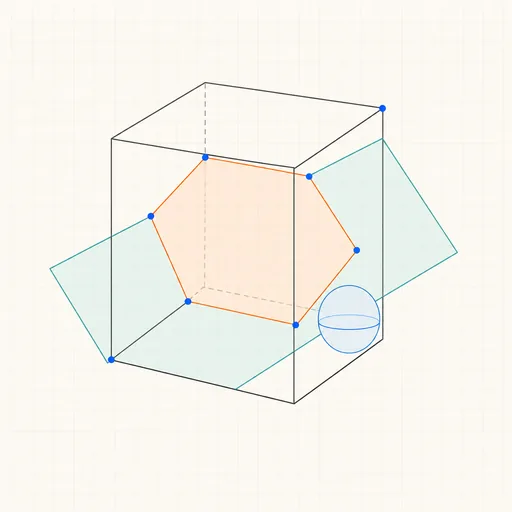
3D Geometry Board
Points, lines, planes, spheres and polyhedra on an orbiting camera — slice solids with planes, unfold nets, drop the Dandelin spheres into a cone and drag everything.
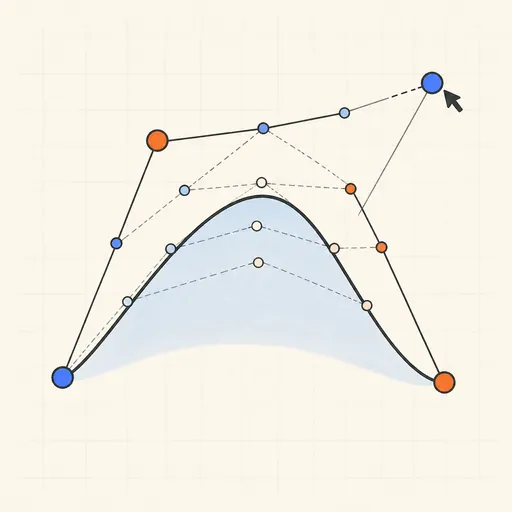
Bézier Curve Playground
Drag control points and watch De Casteljau’s algorithm construct a Bézier curve step by step.
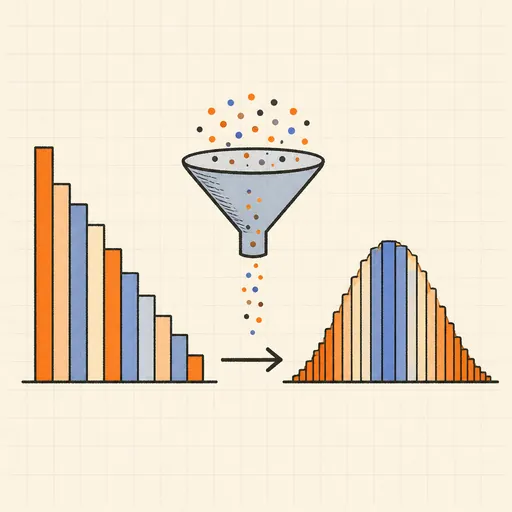
Central Limit Theorem Demo
Sample from any lopsided distribution and watch the averages pile up into a bell curve.
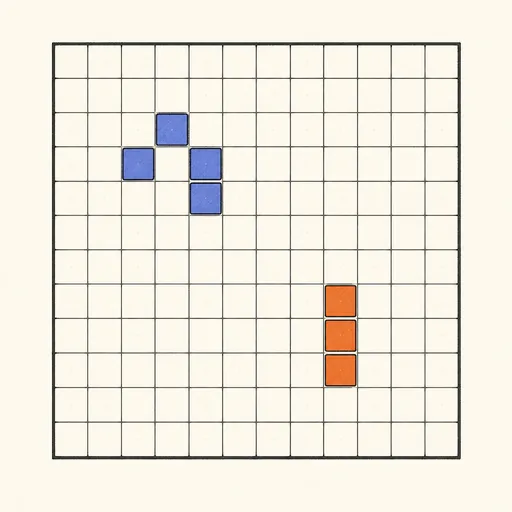
Conway’s Game of Life
Paint cells and watch Conway’s cellular automaton breed gliders, guns and oscillators.
Dynamic Geometry Board
Construct with points, lines, circles and transformations, then drag anything — the construction stays true, and a checker tells you which relations are theorems.
Fantasy Map Generator
Roll a seed and get a continent: coastlines, mountains, rivers, biomes and named towns, ready for your campaign.