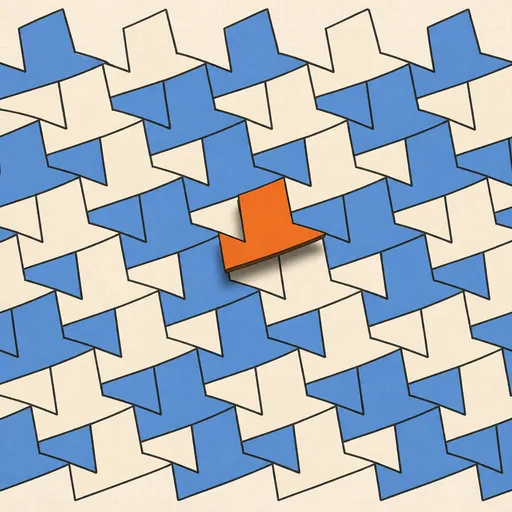
Einstein Monotile
For over half a century mathematicians asked whether a single tile could force a pattern that never repeats — an “einstein” (German for “one stone”). Penrose got it down to two tiles in the 1970s; the one-tile case stayed open until March 2023, when hobbyist David Smith and collaborators found the “hat.” This toy builds genuine hat and spectre tilings with the exact substitution rules from the discovery papers: metatiles are recursively inflated and subdivided, so what you pan and zoom across is honest aperiodic structure, not a looping wallpaper. Colour tiles by orientation or by supertile family to expose the hidden hierarchy, and highlight the mirrored hats — the spectre, found months later, needs no mirror images at all.
Runs 100% in your browser — simulations are computed locally on your device.
Read the full guide to this tool
Notes
- Aperiodic means more than non-repeating: the hat can tile the plane, but *only* non-periodically — no translation ever maps the tiling onto itself. The proof groups every tiling into H, T, P and F metatiles that themselves form a forced substitution hierarchy.
- The hat uses reflected copies (about one tile in seven); critics called that a loophole, so in May 2023 the same team produced the spectre, a “chiral aperiodic monotile” that tiles aperiodically using rotations alone.
- Tiles here are placed by the H/T/P/F substitution system for the hat and the nine-metatile system for the spectre, both ported from the discovery team’s reference code — each slider level inflates the patch one substitution step further, so the patch is finite but exact.
- The hat is a polykite — eight kites from the [3.4.6.4] Laves grid — and belongs to a whole continuous family Tile(a,b) of aperiodic shapes; the spectre is the special member Tile(1,1).
- Runs 100% in your browser — simulations are computed locally on your device.
Related tools
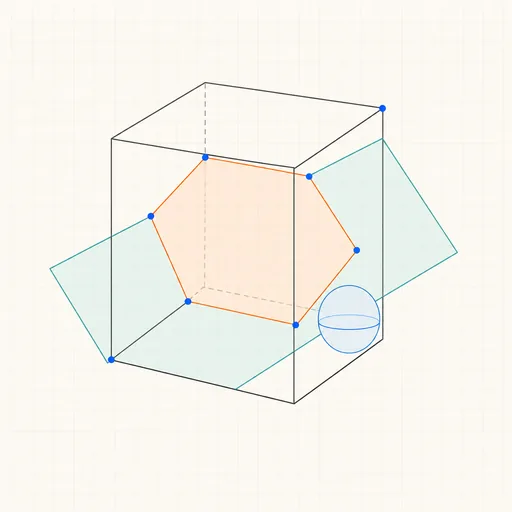
3D Geometry Board
Points, lines, planes, spheres and polyhedra on an orbiting camera — slice solids with planes, unfold nets, drop the Dandelin spheres into a cone and drag everything.
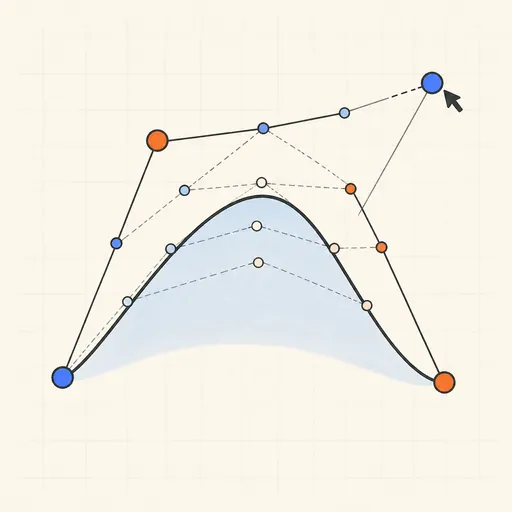
Bézier Curve Playground
Drag control points and watch De Casteljau’s algorithm construct a Bézier curve step by step.
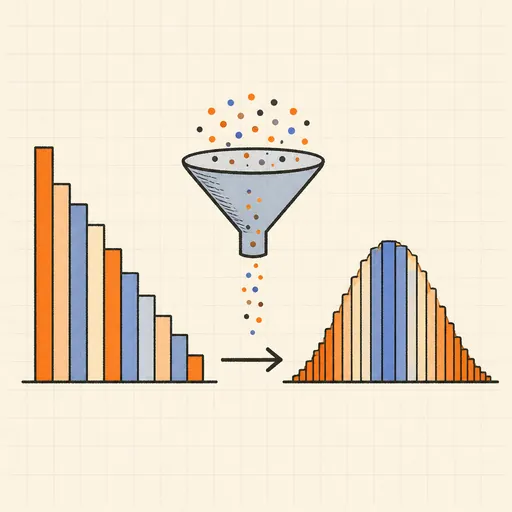
Central Limit Theorem Demo
Sample from any lopsided distribution and watch the averages pile up into a bell curve.
Conway’s Game of Life
Paint cells and watch Conway’s cellular automaton breed gliders, guns and oscillators.
Dynamic Geometry Board
Construct with points, lines, circles and transformations, then drag anything — the construction stays true, and a checker tells you which relations are theorems.
Fantasy Map Generator
Roll a seed and get a continent: coastlines, mountains, rivers, biomes and named towns, ready for your campaign.