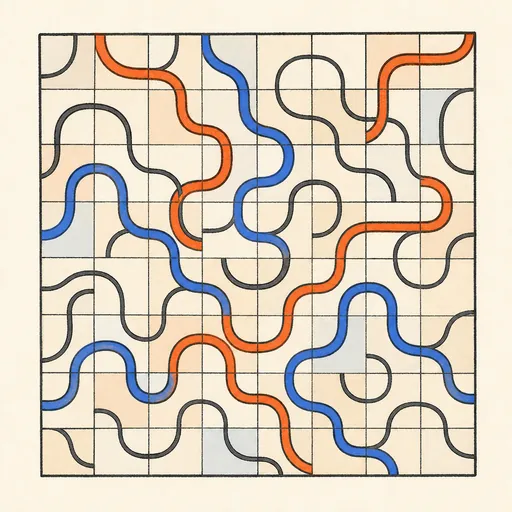
Truchet Tiles
A Truchet tile carries a simple asymmetric pattern — a diagonal, a pair of quarter-circle arcs — and the magic is that dropping copies at random rotations into a grid makes their edges line up into sprawling, connected designs. This tool tiles the canvas with a chosen motif, each cell independently rotated, so quarter-circle arcs join into winding pipes and loops, diagonals knit into mazes, and other motifs weave over and under. Pick the tile style and grid size, reshuffle the rotations for a fresh pattern, and colour the connected paths so the structure hidden in the randomness stands out. Every layout is different, yet always seamlessly connected.
Runs 100% in your browser — simulations are computed locally on your device.
Read the full guide to this tool
Notes
- Named for Sébastien Truchet, who catalogued the patterns from a single diagonally split square in 1704; Cyril Smith revived them in 1987 and added the quarter-circle version that makes flowing curves.
- The whole pattern comes from one bit of randomness per cell (which way the tile is turned), yet edges always match because every tile presents the same connection points on all four sides.
- With the quarter-circle tile the arcs join into closed loops and long meandering paths; colouring by connected component reveals a structure much like percolation clusters.
- Runs 100% in your browser — simulations are computed locally on your device.
Related tools
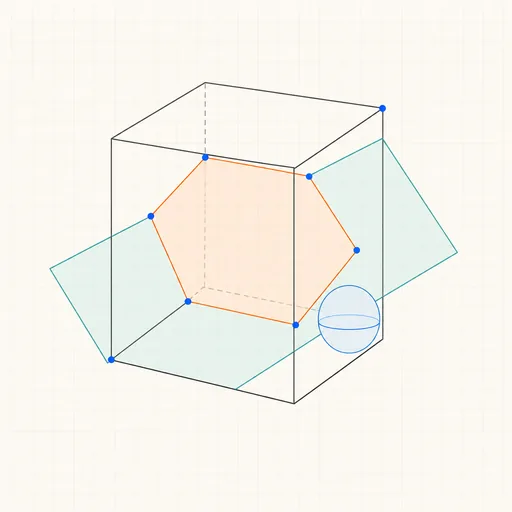
3D Geometry Board
Points, lines, planes, spheres and polyhedra on an orbiting camera — slice solids with planes, unfold nets, drop the Dandelin spheres into a cone and drag everything.
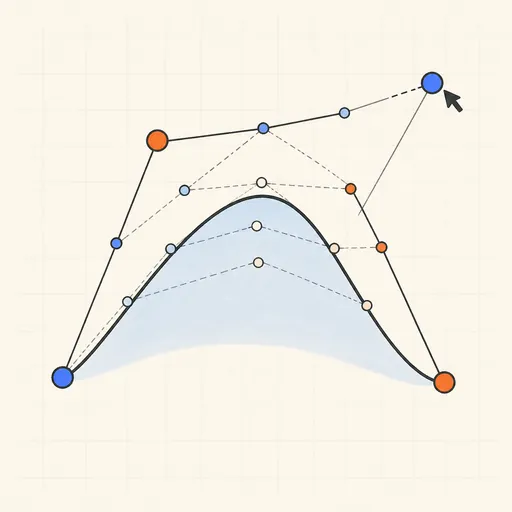
Bézier Curve Playground
Drag control points and watch De Casteljau’s algorithm construct a Bézier curve step by step.
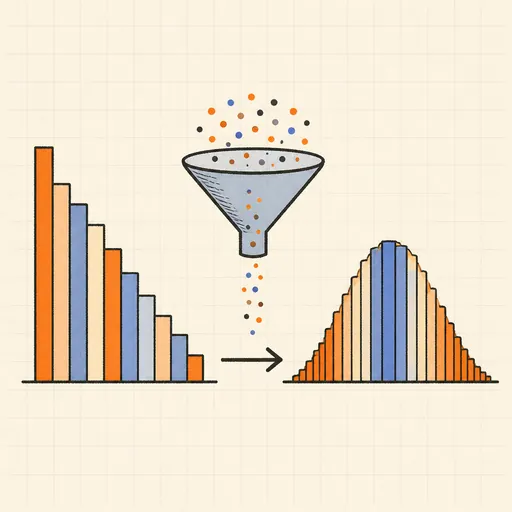
Central Limit Theorem Demo
Sample from any lopsided distribution and watch the averages pile up into a bell curve.
Conway’s Game of Life
Paint cells and watch Conway’s cellular automaton breed gliders, guns and oscillators.
Dynamic Geometry Board
Construct with points, lines, circles and transformations, then drag anything — the construction stays true, and a checker tells you which relations are theorems.
Fantasy Map Generator
Roll a seed and get a continent: coastlines, mountains, rivers, biomes and named towns, ready for your campaign.