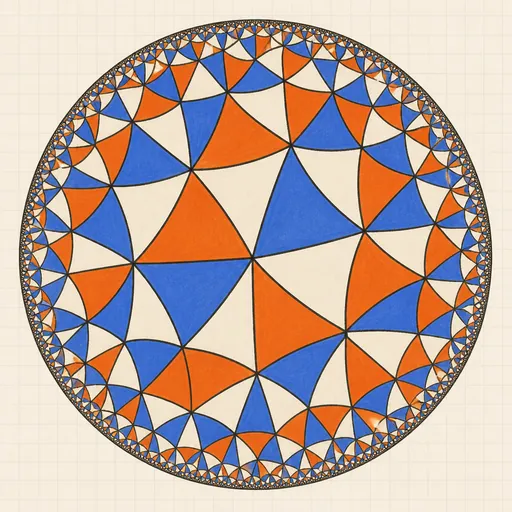
Hyperbolic Tiling Explorer
In hyperbolic geometry there is room for tilings impossible in the flat plane: five squares around a vertex, or seven triangles. This explorer draws the regular tiling {p, q} — p-sided polygons, q around each vertex — inside the Poincaré disk, generating tiles by reflecting the central polygon in its own edges, which in the disk model are arcs of circles meeting the boundary at right angles. Every tile is the same hyperbolic size; they only look smaller toward the rim, exactly the effect M. C. Escher used in his Circle Limit prints.
Runs 100% in your browser — simulations are computed locally on your device.
Read the full guide to this tool
Notes
- A regular tiling {p, q} is hyperbolic exactly when (p − 2)(q − 2) > 4; flat when it equals 4.
- Geodesics in the Poincaré disk are circular arcs hitting the boundary at right angles; reflections are circle inversions.
- All tiles are congruent in hyperbolic distance — the shrinking toward the rim is an artefact of squeezing infinite area into a disk.
- Runs 100% in your browser — simulations are computed locally on your device.
Related tools
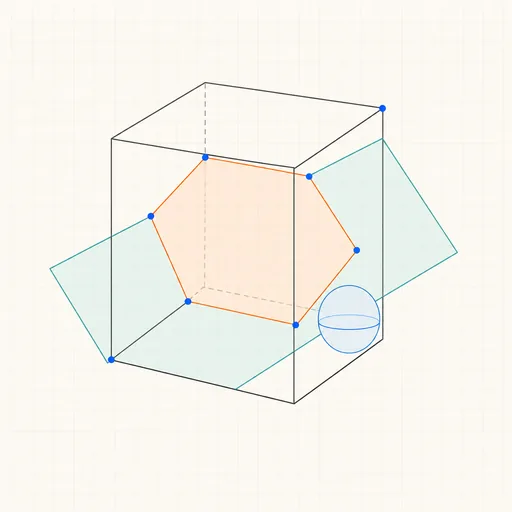
3D Geometry Board
Points, lines, planes, spheres and polyhedra on an orbiting camera — slice solids with planes, unfold nets, drop the Dandelin spheres into a cone and drag everything.
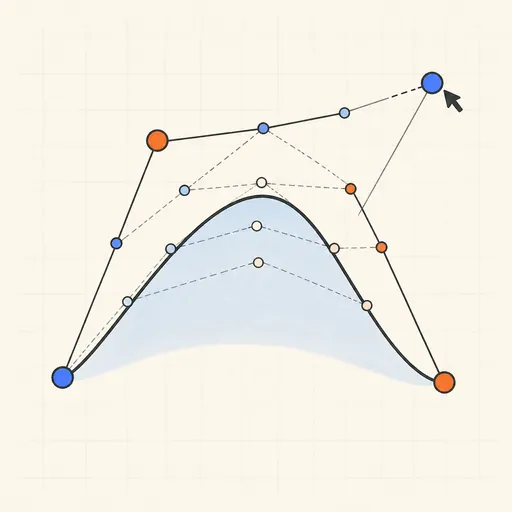
Bézier Curve Playground
Drag control points and watch De Casteljau’s algorithm construct a Bézier curve step by step.
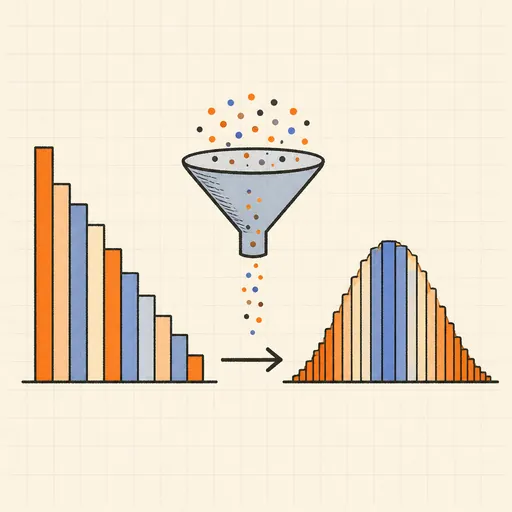
Central Limit Theorem Demo
Sample from any lopsided distribution and watch the averages pile up into a bell curve.
Conway’s Game of Life
Paint cells and watch Conway’s cellular automaton breed gliders, guns and oscillators.
Dynamic Geometry Board
Construct with points, lines, circles and transformations, then drag anything — the construction stays true, and a checker tells you which relations are theorems.
Fantasy Map Generator
Roll a seed and get a continent: coastlines, mountains, rivers, biomes and named towns, ready for your campaign.