Domino Run, Explained
After reading this you will know why a line of falling dominoes settles to one steady speed, how to predict that speed from spacing and tile height, and why packing them too close or too far both kill the wave.
A row of standing dominoes is the cleanest chain reaction you can build on a table. Tip the first tile and a falling front races down the line at a speed you did not choose. You pushed once, gently, yet the wave arrives at the far end just as fast as it left the near end. That fixed speed is the whole story, and it comes from simple rigid-body mechanics: each domino is a bar that rotates about its bottom edge, falls under gravity, and slaps its neighbour into the same motion.
The simulation on the tool page lets you set the spacing, tile height and tile thickness, add a curve, and re-stand the run. This guide explains the physics behind what you see, works a numeric example you can reproduce with the demo defaults, and lists the mistakes that stop a run dead.
What a domino run actually is
Think of one domino as a thin rigid bar of height h and thickness t, standing on its short edge. It can only do one thing: rotate about the bottom front edge, the pivot. Its centre of mass sits at height h/2, offset from the pivot.
Standing upright, the centre of mass sits slightly behind the pivot, so the tile is stable. To topple it you must rotate it past the balance point, the angle where the centre of mass passes directly over the pivot. That critical tilt angle is
Here t is thickness and h is height. For a tile with t = 8 mm and h = 48 mm, \theta_c = \arctan(8/48) = \arctan(0.1667) \approx 9.46^\circ. Past that angle gravity does the rest. Below it the tile rocks back and stands up again. This is why a domino needs a real nudge, not a touch: you must supply the energy to lift the centre of mass over the pivot.
When this model helps and when it misleads
Use the domino run as a picture of a travelling front: a disturbance that moves at a fixed speed carrying a fixed amount of energy, refuelled locally at each step. Nerve impulses, flame fronts and some chemical reaction waves share this structure. The domino chain is the mechanical version you can watch tile by tile.
Do not read it as a model of information travelling instantly. The wave speed is set by physics, not by how hard you push. Do not treat it as frictionless either. Real tiles bounce, slide and sometimes stand back up, and the sandbox keeps only the parts that matter for the wave: rotation, gravity and one collision per neighbour.
A domino can knock over a neighbour up to about 1.5 times its own linear size. If each tile is 1.5 times the one before, the chain amplifies energy at every step. A run of 13 growing tiles turns a fingertip push on a 5 mm tile into the crash of a tile taller than a person.
The physics of one falling tile
Once a tile is past \theta_c, treat it as a rigid rod pivoting about one end. The equation of motion for the tilt angle \theta measured from vertical is
Here g = 9.81 m/s² is gravity, h is the tile height, and \ddot{\theta} is the angular acceleration. The factor 3/(2h) comes from the moment of inertia of a uniform rod about its end, I = \tfrac{1}{3}mh^2. The tile speeds up as it falls, because \sin\theta grows from near zero toward 1 at \theta = 90^\circ.
The angular speed at any angle follows from energy. Dropping the centre of mass from angle \theta_c to angle \theta gives
A tile falling from upright (\theta_c \approx 0) to flat (\theta = 90^\circ) with h = 48 mm reaches \dot{\theta} = \sqrt{(3 \cdot 9.81 / 0.048)(1 - 0)} \approx \sqrt{613} \approx 24.8 rad/s at its tip. The tip, at radius h, moves at about 24.8 \times 0.048 \approx 1.19 m/s when it strikes. That impact is what topples the next tile.
Why the wave settles to one speed
Each tile does two things: it falls through a small angle, then hands its motion to a neighbour a distance d away. After a few tiles the system forgets the starting push and locks into a repeating cycle. Every tile falls the same way, every collision transfers the same energy, so the front advances by the spacing d in the same time interval each step. That fixed step-per-time is the constant wave speed.
A useful estimate for the front speed v at close-to-optimal spacing scales as
where d is spacing, h is height, and C is a dimensionless factor near 0.5 that depends on how the collision passes energy. The key fact is the square-root dependence on gh: taller tiles give a faster wave, and the speed does not depend on the launch push at all.
To make the wave faster, do not push harder. Increase the tile height or widen the spacing toward its limit. Both raise v; the push only decides whether the wave starts.
A worked example using the demo defaults
Predicting the wave speed for a standard run
Use the demo defaults: height h = 48 mm, thickness t = 8 mm, spacing d = 25 mm, gravity g = 9.81 m/s².
- Balance angle: \theta_c = \arctan(8/48) = 9.46^\circ = 0.165 rad.
- Angular speed as the tip sweeps down. When the falling tile has rotated to the angle where it contacts the next tile, roughly \theta \approx \arcsin(d/h) = \arcsin(25/48) \approx 31.4^\circ.
- At that contact angle, \dot{\theta} = \sqrt{(3\cdot 9.81/0.048)(\cos 9.46^\circ - \cos 31.4^\circ)} = \sqrt{613 \cdot (0.9864 - 0.8535)} = \sqrt{81.5} \approx 9.03 rad/s.
- Time for one tile to reach that contact angle from release is roughly \Delta t \approx \theta_{contact}/\bar{\dot\theta}. Using an average angular speed near 4.9 rad/s over 0.548 rad gives \Delta t \approx 0.112 s.
- Front speed: v = d/\Delta t = 0.025/0.112 \approx 0.22 m/s.
So the demo run advances at roughly 0.22 m/s, about 22 cm per second. A run of 40 tiles spans 40 \times 25 = 1000 mm, so the wave crosses it in about 1.0/0.22 \approx 4.5 seconds. Watch the counter in the simulation and you should see a number in this range once the front settles.
Reading the run in the simulation
Two quantities tell you the state of the run. The first is the front position, the index of the newest falling tile. Plot it against time and a settled wave gives a straight line: equal tiles per second. The slope is the wave speed.
The second quantity is the impact angular speed of each tile. In a healthy run it repeats the same value tile after tile. If it drops step by step, the wave is dying: each collision passes on less than it received.
Common mistakes that stall a run
Most failed runs come from spacing, not from a weak push.
- Packed too close
- If d is much smaller than the thickness plus a small gap, a tile hits its neighbour before it has built up speed, and the collision cannot lift the next tile past \theta_c. The wave stalls. Below about d = 10 mm for a 48 mm tile the run rarely completes.
- Spread too far
- A tile of height h can only reach a neighbour within horizontal distance h. In practice contact is lost near d \approx 1.5\,t + 0.9\,h. Past that the falling tile lands flat on the table and touches nothing.
- Blaming the push
- A common error is to hit the leader harder to speed up a slow run. The wave speed is fixed by d and h. A harder push only changes how the very first tile falls; by tile five the memory of it is gone.
On a curve, the effective spacing along the outside of the bend is larger than along the inside. Set spacing for the outer path or the wave will miss a tile on the widest turn even though the straight sections work.
Related simulations
If the travelling front idea interests you, the Standing Waves on a String tool shows a different wave behaviour, resonance rather than a moving front. For a chain of coupled masses that wobble instead of topple, try the Soft-Body Jelly and Cloth Simulator, both built on spring-mass physics. For rigid-body motion where tiny changes in the start lead to wildly different paths, the Double Pendulum is the natural next step, and Orbit Sandbox shows the same sensitivity in gravity.
Frequently asked questions
Why does the wave move at a constant speed?
Because each tile repeats the same fall and the same collision. After a few tiles the run enters a steady cycle, advancing by one spacing d in a fixed time. Equal distance in equal time is constant speed. The push at the start only affects the first few tiles.
Does hitting the first domino harder make the wave faster?
No. The settled speed depends on spacing and tile height through v \approx C\sqrt{gh}\,(d/h). A harder push changes the launch of tile one, but the front forgets it within a few tiles.
How much bigger can each domino be than the last?
A tile can topple a neighbour up to about 1.5 times its own linear size. Chaining that ratio grows the tiles fast: a run of 13 tiles each 1.5 times the previous ends about 1.5^{12} \approx 130 times taller than the first, so a fingertip push can end in a large crash.
What sets the fastest possible spacing?
A falling tile of height h can only reach a neighbour within horizontal distance h. Practical contact is lost near d \approx 0.9\,h. For a 48 mm tile that is about 43 mm, and speed peaks a little before that limit.
Why do the very close tiles refuse to fall?
A tile packed tight against its neighbour strikes it before building enough angular speed to lift it past the balance angle \theta_c. Without that energy the next tile rocks and stands back up, and the wave stops.
Related tools
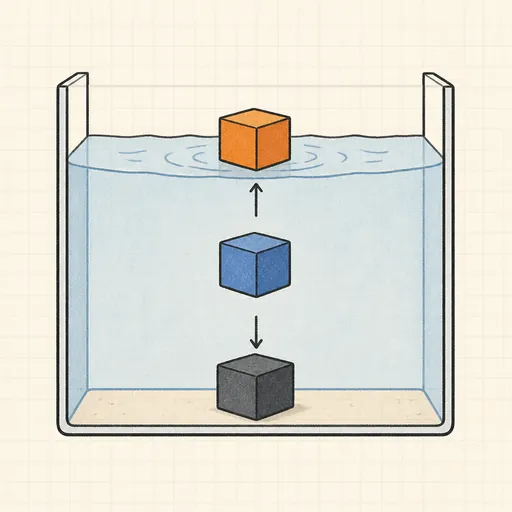
Buoyancy Tank
Drop blocks of different density into water and watch Archimedes decide what floats, sinks or hovers.
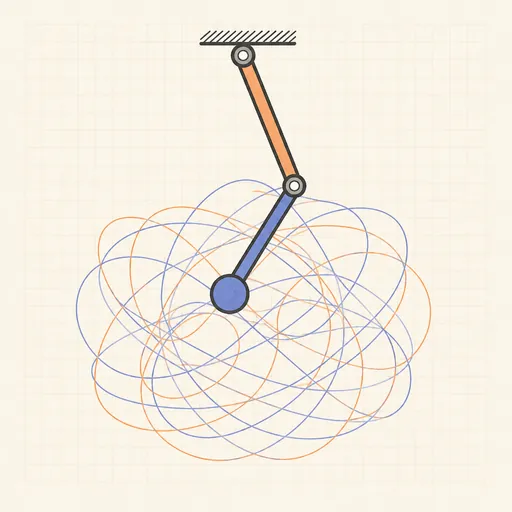
Double Pendulum
Swing a chaotic double pendulum and split it into a rainbow swarm to watch nearby starts diverge.
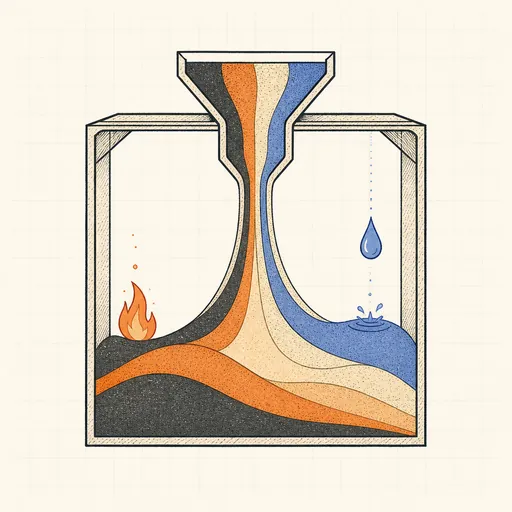
Falling-Sand Playground
Paint sand, water, oil, fire and more and watch them pour, settle, burn and react pixel by pixel.
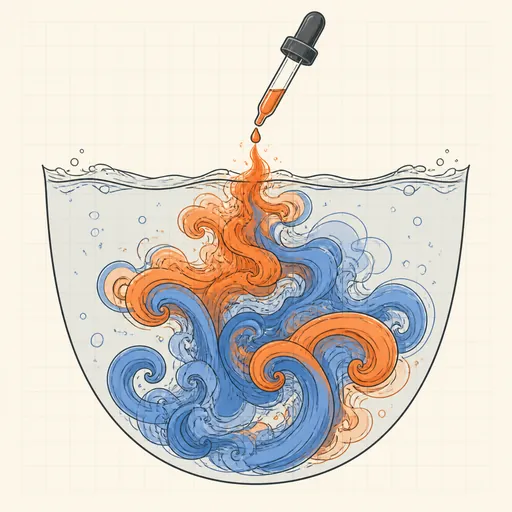
Fluid Flow Simulator
Stir glowing dye through a real-time GPU fluid simulation.
Galaxy Collision Simulator
Smash two spiral galaxies together and watch tidal tails and bridges form.
Hear the Shape of a Drum
Draw any drum and hear its true vibration modes — then meet two different drums that sound exactly the same.