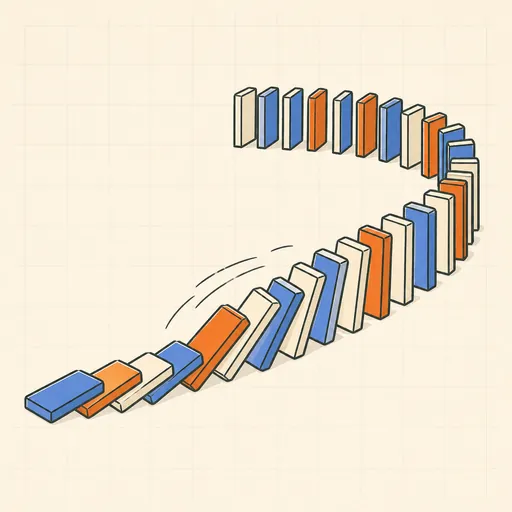
Domino Run
A row of dominoes is the simplest chain reaction: tip the first and each falling tile hands its momentum to the next. This sandbox lets you place a line of standing tiles, then knock the leader over and watch the toppling front travel down the run under simple rigid-body physics — each domino is a rotating bar that falls under gravity, strikes its neighbour and passes on the push. Drag the spacing to find the sweet spot: pack them too close and the wave stalls, spread them too far and a falling tile misses the next entirely. You can add curves, change the tile proportions and re-stand the whole run with one button, watching the speed of the falling wave settle to a steady value.
Runs 100% in your browser — simulations are computed locally on your device.
Read the full guide to this tool
Notes
- Each domino topples about its bottom edge; it must rotate past its balance point (when its centre of mass passes over the pivot) before gravity finishes the fall, which is why a tile needs a real nudge, not a touch, to go over.
- The toppling wave moves at a roughly constant speed set by the spacing and tile height, not by how hard you hit the first one — a travelling front, like a nerve impulse or a flame.
- A domino can topple a neighbour about 1.5 times its own size, so a chain of growing dominoes amplifies a tiny first push into a huge final crash — an exponential energy cascade.
- Runs 100% in your browser — simulations are computed locally on your device.
Related tools
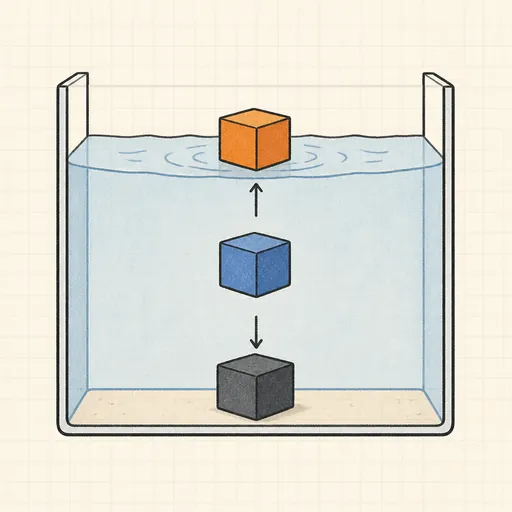
Buoyancy Tank
Drop blocks of different density into water and watch Archimedes decide what floats, sinks or hovers.
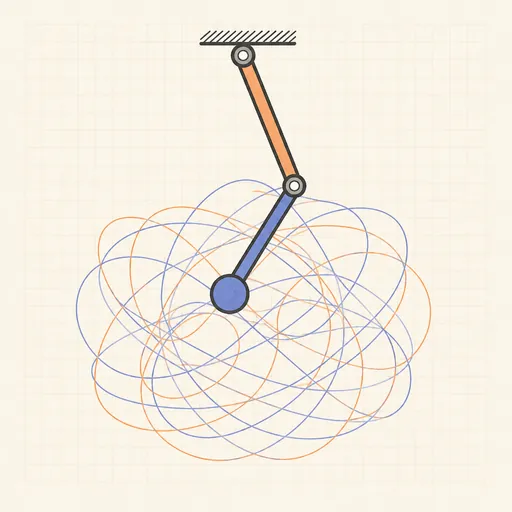
Double Pendulum
Swing a chaotic double pendulum and split it into a rainbow swarm to watch nearby starts diverge.
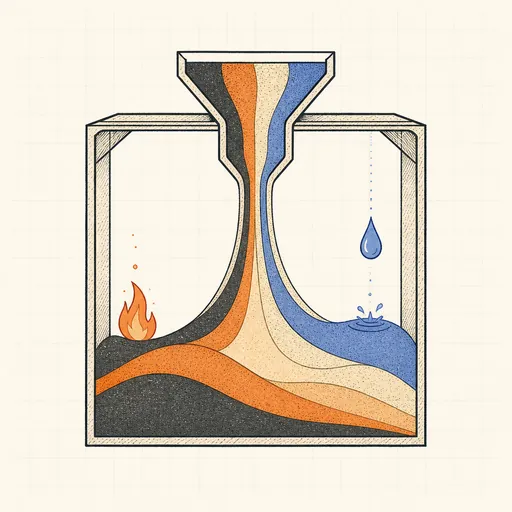
Falling-Sand Playground
Paint sand, water, oil, fire and more and watch them pour, settle, burn and react pixel by pixel.
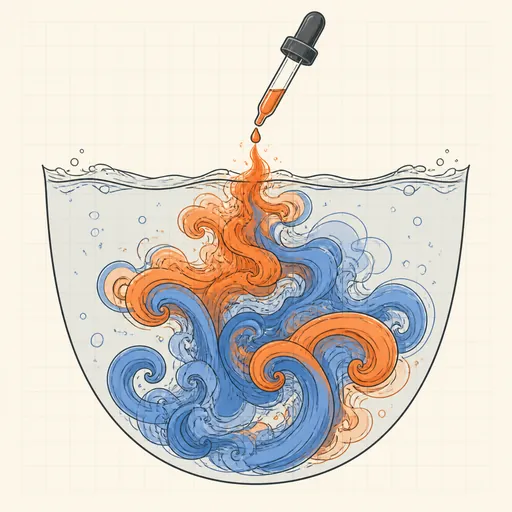
Fluid Flow Simulator
Stir glowing dye through a real-time GPU fluid simulation.
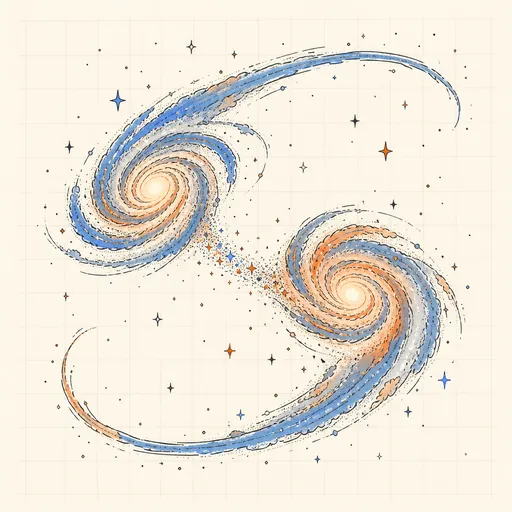
Galaxy Collision Simulator
Smash two spiral galaxies together and watch tidal tails and bridges form.
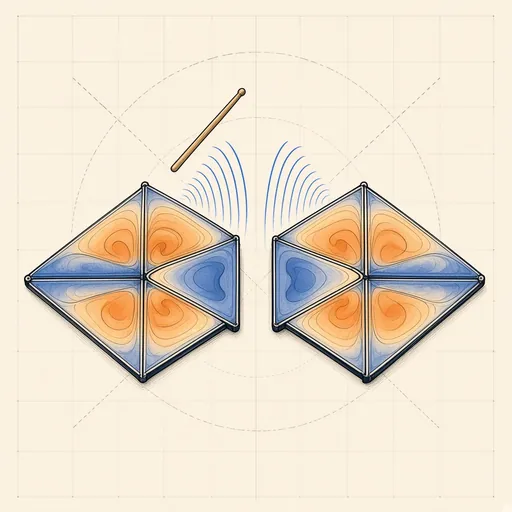
Hear the Shape of a Drum
Draw any drum and hear its true vibration modes — then meet two different drums that sound exactly the same.