Penrose Tilings, Explained
After reading this you will know how two rhombi cover the plane without ever repeating, how recursive subdivision by the golden ratio builds a Penrose tiling, and how to check the deflation counts against real numbers.
What a Penrose tiling is
A Penrose tiling covers the whole infinite plane with copies of just two rhombus shapes. The surprising part is that no matter how you slide the finished pattern, it never lands exactly on itself. It has no repeating unit cell. Ordinary tilings of squares, triangles or hexagons do repeat: shift a square grid by one square and it looks identical. A Penrose tiling refuses that. It is aperiodic.
The two tiles are rhombi with equal side length. One is fat, with corner angles of 72^{\circ} and 108^{\circ}. The other is thin, with angles of 36^{\circ} and 144^{\circ}. Every one of those angles is a multiple of 36^{\circ}, which is one tenth of a full turn. That is the source of the tiling's five-fold and ten-fold flavour. You cannot build a periodic tiling with true five-fold symmetry, yet these tiles carry it everywhere.
Here is the hook. In 1982 Dan Shechtman measured an aluminium-manganese alloy and saw a diffraction pattern with sharp ten-fold spots. Sharp spots mean long-range order. Ten-fold symmetry was supposed to be impossible in a crystal. The resolution was that the atoms sat on a three-dimensional analogue of a Penrose tiling. The mathematics came first, the matter followed, and Shechtman won the 2011 Nobel Prize in Chemistry.
When this model is worth your time
Reach for a Penrose tiling when you want the cleanest example of order without periodicity. It shows that "no repeating cell" and "no structure" are completely different statements. The tiling is rigidly determined and yet non-periodic.
It is also the friendliest doorway into quasicrystals. If you want to understand why a solid can produce sharp diffraction peaks at forbidden angles, the tiling gives you a picture you can draw by hand.
Do not read atomic reality straight off the toy. The generator draws an ideal, defect-free tiling in two dimensions. Real quasicrystals are three-dimensional, contain phason defects, and only approximate the perfect matching rules. The tiling explains the symmetry of the diffraction pattern, not the full physics of any specific alloy.
The golden ratio and the two triangles
The engine behind the tiling is not the rhombi themselves but two triangles you get by cutting them in half. These are the Robinson triangles. Both are isosceles.
- Thick (acute) Robinson triangle
- Angles 36^{\circ}, 72^{\circ}, 72^{\circ}. Half of a fat rhombus.
- Thin (obtuse) Robinson triangle
- Angles 36^{\circ}, 36^{\circ}, 108^{\circ}. Half of a thin rhombus.
Everything hinges on the golden ratio:
Here \varphi is the positive solution of \varphi^2 = \varphi + 1. In the thick triangle the ratio of the long side to the short side is exactly \varphi. When you draw a point that splits a side in the ratio 1 : \varphi and connect it, each triangle breaks into smaller Robinson triangles of the same two kinds. That step is called deflation, and it is the whole algorithm.
The subdivision rule, step by step
One deflation replaces every triangle with smaller ones, using cuts placed by the golden ratio. The counts are fixed:
- Each thick triangle splits into two thick plus one thin.
- Each thin triangle splits into one thick plus one thin.
Write T_n for the number of thick triangles and H_n for the number of thin ones after n deflations. The rule above gives a pair of linear recurrences:
The symbol T_n counts thick triangles and H_n counts thin triangles at depth n. Each new thick triangle comes from two per old thick plus one per old thin, and each new thin from one per old thick plus one per old thin. The matrix of this map is \begin{bmatrix}2 & 1\\ 1 & 1\end{bmatrix}, whose larger eigenvalue is \varphi^2 \approx 2.618. So the tile count multiplies by about 2.618 every step, and the ratio T_n / H_n settles toward \varphi.
Reproducing the demo: six deflations from a single thick triangle
The demo seeds one thick triangle and applies the deflation rule at the default depth. Start with T_0 = 1, H_0 = 0 and run the recurrences.
- Depth 0:
T = 1,H = 0. Total1. - Depth 1:
T = 2(1)+0 = 2,H = 1+0 = 1. Total3. - Depth 2:
T = 2(2)+1 = 5,H = 2+1 = 3. Total8. - Depth 3:
T = 2(5)+3 = 13,H = 5+3 = 8. Total21. - Depth 4:
T = 2(13)+8 = 34,H = 13+8 = 21. Total55. - Depth 5:
T = 2(34)+21 = 89,H = 34+21 = 55. Total144. - Depth 6:
T = 2(89)+55 = 233,H = 89+55 = 144. Total377.
The counts are Fibonacci numbers: 1, 2, 3, 5, 8, 13, 21, 34, 55, 89, 144, 233, 377. That is no accident. The Fibonacci recurrence and the golden ratio are the same story told two ways. Check the ratio at depth 6: 233 / 144 = 1.6181, already within 0.0001 of \varphi.
| Depth | Thick T | Thin H | Total | T / H | Total / prev |
|---|---|---|---|---|---|
| 0 | 1 | 0 | 1 | - | - |
| 1 | 2 | 1 | 3 | 2.000 | 3.000 |
| 2 | 5 | 3 | 8 | 1.667 | 2.667 |
| 3 | 13 | 8 | 21 | 1.625 | 2.625 |
| 4 | 34 | 21 | 55 | 1.619 | 2.619 |
| 5 | 89 | 55 | 144 | 1.618 | 2.618 |
| 6 | 233 | 144 | 377 | 1.618 | 2.618 |
Reading the pattern you get
Once the triangles pair back into rhombi, look for the recurring vertex figures. Where five fat rhombi meet point to point you get a sun. Where five thin rhombi share a point you get a star. These, along with named figures like the "ace", "deuce", "jack", "queen" and "king", are the only ways the tiles can legally meet. Their local five-fold symmetry is what your eye reads as order.
Yet the global pattern is aperiodic. A clean way to feel this is the ratio you just computed. In a periodic tiling the ratio of two tile types is always a simple rational, because the unit cell fixes it. Here the limiting ratio is \varphi, an irrational number. A single repeating cell can never produce an irrational tile ratio, so no such cell exists.
Another local property has a global consequence. Every finite patch you can find anywhere in the tiling appears infinitely often, and it recurs at a bounded spacing. This is repetitivity. So the tiling looks the same everywhere at the level of patches, while never repeating exactly. Local sameness and global difference sit side by side.
Common mistakes
If your tiles overlap or leave gaps after a deflation, the split point on one edge is on the wrong side. The golden cut is directional: swap which endpoint the short piece touches and the mismatch usually clears.
Three errors show up again and again.
- Confusing aperiodic with random. The tiling has zero freedom once the seed and rules are fixed. Every tile position is forced. It is deterministic and non-periodic, not disordered.
- Cutting by 1/2 instead of by \varphi. Halving a Robinson triangle does not give Robinson triangles. The whole scheme collapses unless the cut sits at the golden proportion, so a long piece of length \varphi pairs with a short piece of length
1. - Ignoring matching rules when assembling by hand. The two rhombi alone can tile the plane periodically if you allow any orientation. The aperiodicity only appears when you enforce edge-matching (the arrows or notches). Deflation builds a legal tiling automatically, which is why the generator uses it.
Related tools
Penrose tilings sit at the crossing of symmetry, recursion and the golden ratio, so several other toys pair naturally with this one. For non-flat tilings that also escape the ordinary grid, try the Hyperbolic Tiling Explorer. To meet the golden ratio in a growing biological pattern, open Phyllotaxis, where the golden angle packs seeds into Fibonacci spirals. The self-similar shrinking of deflation echoes the classic fractal built by chance in the Chaos Game, and it shows up again in the colored triangles of Pascal's Triangle mod n. For randomized tiling patterns without matching rules, see Truchet Tiles, and for a different kind of grid-solving that snaps possibilities into one pattern, look at Wave Function Collapse.
Frequently asked questions
Why can a crystal not have five-fold symmetry?
The crystallographic restriction theorem says a periodic lattice in two or three dimensions can only carry 2-, 3-, 4- or 6-fold rotational symmetry. Five-fold and ten-fold are excluded because no repeating lattice can be invariant under a 72^{\circ} turn. Penrose tilings sidestep the theorem by dropping periodicity while keeping long-range order.
How many distinct Penrose tilings are there?
Uncountably many, and no finite region distinguishes them: any bounded patch you see in one appears in all the others. There is exactly one tiling up to local indistinguishability of patches, yet uncountably many that differ only in the far-off distance.
Why do Fibonacci numbers appear in the tile counts?
The deflation matrix \begin{bmatrix}2 & 1\\ 1 & 1\end{bmatrix} is the square of the Fibonacci matrix \begin{bmatrix}1 & 1\\ 1 & 0\end{bmatrix}. Iterating it produces Fibonacci numbers, and their ratio tends to \varphi, which is why the tile totals ran 1, 3, 8, 21, 55, 144: every second Fibonacci number.
Is the generator drawing an exact Penrose tiling?
Inside the region shown, yes. Deflation produces a legal tiling that obeys the matching rules exactly. The only limitation is the finite window and the finite depth. The mathematical tiling extends over the whole infinite plane.
What is the difference between a Penrose tiling and a quasicrystal?
The tiling is a purely geometric two-dimensional object. A quasicrystal is a real solid whose atoms sit in an aperiodic arrangement, usually the three-dimensional cousin of a Penrose tiling. The tiling models the ordered, non-periodic positions that give a quasicrystal its sharp, five-fold diffraction pattern.
Related tools
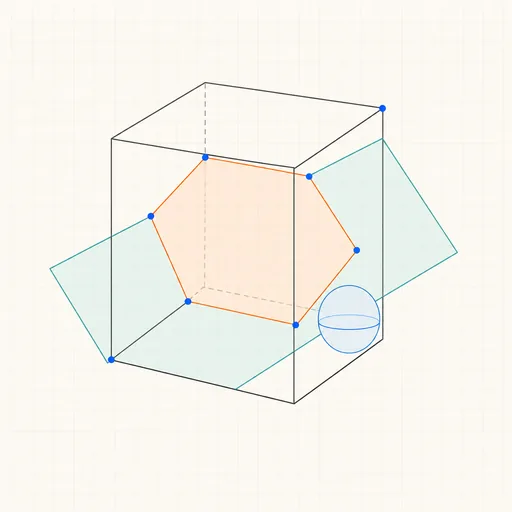
3D Geometry Board
Points, lines, planes, spheres and polyhedra on an orbiting camera — slice solids with planes, unfold nets, drop the Dandelin spheres into a cone and drag everything.
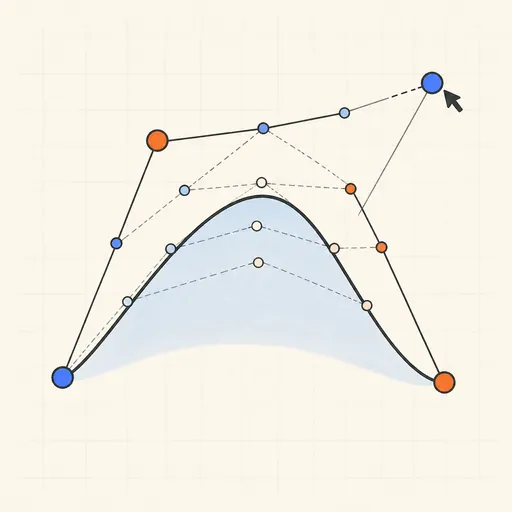
Bézier Curve Playground
Drag control points and watch De Casteljau’s algorithm construct a Bézier curve step by step.
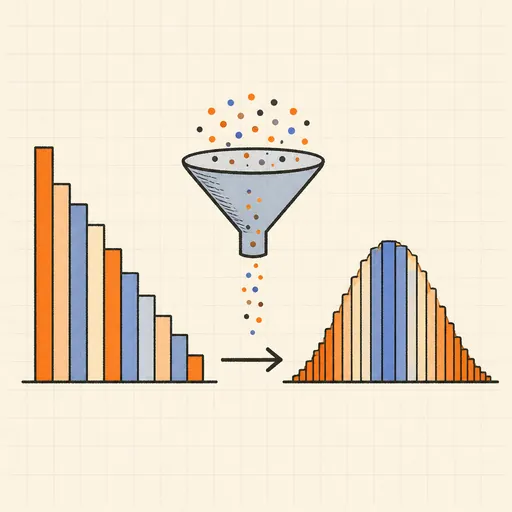
Central Limit Theorem Demo
Sample from any lopsided distribution and watch the averages pile up into a bell curve.
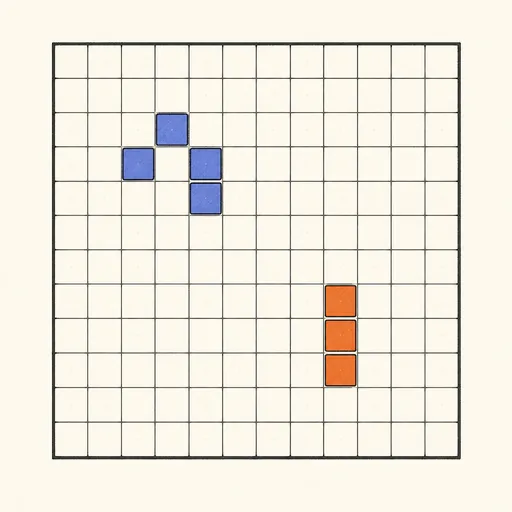
Conway’s Game of Life
Paint cells and watch Conway’s cellular automaton breed gliders, guns and oscillators.
Dynamic Geometry Board
Construct with points, lines, circles and transformations, then drag anything — the construction stays true, and a checker tells you which relations are theorems.
Fantasy Map Generator
Roll a seed and get a continent: coastlines, mountains, rivers, biomes and named towns, ready for your campaign.