The Magnus Effect, Explained
After reading this you can predict which way a spinning ball bends, estimate how far backspin carries a golf drive past the vacuum parabola, and reproduce the simulator's numbers by hand.
What the Magnus effect is
Throw a ball with no spin and it follows a plain arc set by gravity and drag. Give it spin and it curves sideways. A soccer free kick bends around the wall. A golf drive with backspin hangs in the air and lands well past where a spinless ball would drop. A baseball curveball breaks down and away. All of these come from the same cause: the Magnus force.
A spinning ball drags a thin layer of air with its surface. On the side where the surface moves with the oncoming air, the flow speeds up. On the other side it slows down. The wake behind the ball gets deflected to one side, and by Newton's third law the ball is pushed the other way. That sideways push is the Magnus force, and it always acts perpendicular to both the spin axis and the velocity.
The single hook to hold onto: the ball is pushed toward the side that is turning into the airflow. Backspin (top surface moving forward) pushes up, so the ball lifts. Topspin pushes down, so the ball dives. Sidespin pushes sideways, so the ball curves.
When this model applies, and when it does not
The simulator models a smooth sphere flying through still air under three forces: gravity, quadratic drag, and Magnus lift. That covers the qualitative behavior of every spinning-ball sport surprisingly well. It is the right tool when you want to see why backspin extends carry, or how much sidespin you need to bend a kick around a wall.
It is the wrong tool when the details of the surface dominate. Real golf balls have dimples that trip the boundary layer and roughly double the range compared to a smooth sphere. Baseballs have seams that make the break depend on orientation. Above a critical speed a smooth sphere hits a drag crisis where its drag coefficient drops from about 0.47 to 0.1. This model uses a fixed C_d = 0.47 and ignores all of that. Treat the numbers as honest physics for a smooth ball, not as a match to a launch monitor.
The model also assumes constant spin. Real spin decays over a long flight because the air resists it. For a flight of a few seconds this is a small correction, so the constant-spin curve is a good first approximation.
The forces and the formula
Three forces act on the ball. Gravity points straight down with magnitude mg. Drag opposes velocity and grows with the square of speed. The Magnus force sits perpendicular to both spin and velocity.
Here \rho is air density (about 1.225 kg/m³ at sea level), C_d is the drag coefficient (0.47 for a sphere), A = \pi R^2 is the cross-sectional area, and \vec{v} is the velocity. The factor |\vec{v}|\,\vec{v} makes the force grow as speed squared while pointing backward along the path.
Here R is the radius, \vec{\omega} is the spin vector in radians per second, and \times is the cross product. The cross product is what makes the force perpendicular to both spin and velocity, and its magnitude is |\vec{\omega}||\vec{v}|\sin\theta where \theta is the angle between them. For backspin the axis is horizontal and across the flight, so the force points up.
The lift coefficient hiding inside this is the spin parameter S = R\omega / |\vec{v}|, the ratio of surface speed to flight speed. The simulator caps it at 0.5 because real lift stops rising once the surface outruns the flow by that much.
Divide by mass m to get acceleration, then step forward in small time slices. There is no closed-form answer once drag is quadratic, so the simulator integrates numerically.
A worked golf drive
Load the golf preset (the demo defaults) and check the physics by hand. Take launch speed 70 m/s, launch angle 12°, backspin 3000 rpm, mass 0.0459 kg, radius 0.0214 m, air density 1.225 kg/m³.
Sizing the two air forces at launch
- Cross-sectional area: A = \pi (0.0214)^2 = 1.439 \times 10^{-3} m².
- Spin in rad/s: \omega = 3000 \times 2\pi / 60 = 314.2 rad/s.
- Drag force at launch: \tfrac{1}{2}(1.225)(0.47)(1.439\times10^{-3})(70)^2 = 2.03 N. Compare with weight mg = 0.0459 \times 9.81 = 0.450 N. Drag is about 4.5 times the ball's weight at launch.
- Spin parameter: S = R\omega/v = 0.0214 \times 314.2 / 70 = 0.096, below the
0.5cap. - Magnus force at launch: \tfrac{1}{2}(1.225)(1.439\times10^{-3})(0.0214)(314.2)(70) = 0.415 N, close to the ball's own weight.
So at the moment of launch, backspin lift nearly cancels gravity. That is why the ball climbs on a shallow line and stays airborne far longer than a spinless drive. As the ball slows, both drag and Magnus shrink together (both scale with speed), and gravity finally wins.
Running the full integration gives roughly a 3.6 s flight, a peak height near 27 m, and a carry of about 150 m for this smooth ball. The vacuum parabola for the same launch would carry v^2\sin(2\times12°)/g = 70^2 \times 0.407 / 9.81 = 203 m but peak at only (70\sin 12°)^2/(2g) = 4.5 m. Backspin trades a lower, longer vacuum shot for a higher, air-fought one that still beats a drag-only flight.
Explore spin direction
The clearest thing a static picture cannot show is how changing the spin rate reshapes the whole flight. Move the slider and watch the curve swing from a diving topspin arc to a lofting backspin one.
Reading the trajectory and readouts
The simulator draws your spin flight against two references. The vacuum parabola is the no-air ideal: a symmetric arc that peaks halfway through. The drag-only flight is the same launch with drag but no spin: shorter and front-loaded, dropping steeper than it rose. Your spin curve sits between or beyond these depending on spin direction.
Four readouts tell the story. Carry is horizontal distance to landing. Peak height and its position reveal the spin: a late, high peak means backspin lift; an early, low peak means topspin. Flight time grows with lift and shrinks with dive. Sideways deflection is zero for pure back or top spin and grows with sidespin.
| Spin type | Peak height | Peak timing | Carry | Sideways |
|---|---|---|---|---|
| Backspin | higher | later | longer | none |
| Topspin | lower | earlier | shorter | none |
| Sidespin | same | same | slightly shorter | large |
Common mistakes
Do not expect these carries to match a real golf launch monitor. A smooth sphere at these settings carries about 150 m; a dimpled ball reaches 250 m or more because dimples cut drag and boost lift. The shape of the effect is right, the magnitude for real balls is not.
A few traps catch people:
- Confusing spin direction. Backspin lifts, topspin dives. The mnemonic: the ball moves the way the front of it is spinning. A ball with topspin has its front surface rolling downward, so it dives.
- Ignoring air density. Drop density from
1.225to0.95(roughly Denver's thinner air) and both drag and Magnus fall by about 22%. Balls fly farther and curve less. That is a real effect at altitude, not a model quirk. - Cranking spin expecting endless lift. The lift coefficient caps at
0.5. Past the spin that reaches R\omega/v = 0.5, adding rpm does nothing in this model, matching how real lift saturates. - Forgetting that drag and Magnus both scale with speed. They shrink together as the ball slows, which is why a curveball breaks most sharply near the plate: the sideways force never grows, but the ball has more time to react as it decelerates.
Related simulators
The Magnus force is a cross product, and so is the sideways push behind two other classic puzzles. The Coriolis Effect shows how a straight roll looks curved from a spinning frame, another velocity-cross-rotation deflection. The Gyroscope Precession tool explores how a spinning wheel responds sideways to a torque, the rotational cousin of this idea. For the air itself, the Fluid Flow Simulator lets you watch a wake deflect around an obstacle. If you want gravity without air, the Orbit Sandbox traces pure Newtonian arcs.
Frequently asked questions
Why does a golf ball fly farther in air than in vacuum?
Only because of backspin. At launch the Magnus lift (about 0.42 N in the worked example) nearly matches the ball's weight (0.45 N), so the ball resists falling and stays airborne long enough to travel far. Remove the spin and drag alone makes air strictly worse than vacuum.
Which way does backspin push the ball?
Up. The top surface of a backspinning ball moves in the direction of flight, dragging air over the top faster, deflecting the wake downward, and pushing the ball up. Topspin does the reverse and pushes the ball down.
Why do curveballs break hardest near the plate?
The sideways force scales with speed, so it is actually largest right after release. The break looks sharpest late because the ball has been accumulating sideways displacement the whole way, and by the plate it has slowed enough that the same force bends the remaining path more per meter traveled.
Does altitude really change the curve?
Yes. Both drag and Magnus force are proportional to air density. Denver's air is roughly 22% thinner than sea level, so both forces drop by about 22%. Balls carry farther (less drag) and curve less (less Magnus). This is why home run totals rise and breaking pitches flatten at altitude.
What does the spin parameter mean physically?
It is S = R\omega/v, the ratio of the ball's surface speed to its flight speed. At S = 0.096 in the golf example, the surface is moving at about 10% of the flight speed. Lift grows with this ratio until the model caps it at 0.5, where real lift curves flatten out.
Related tools
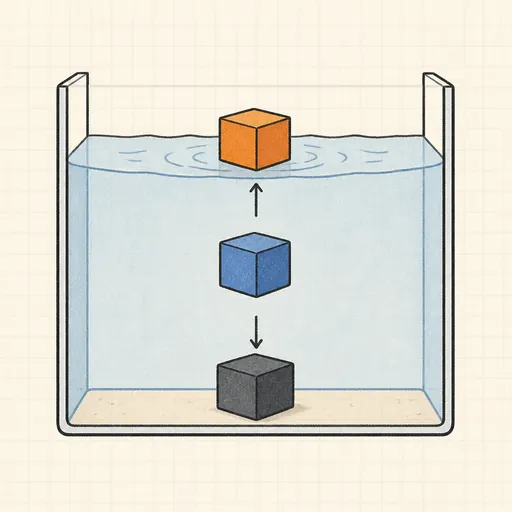
Buoyancy Tank
Drop blocks of different density into water and watch Archimedes decide what floats, sinks or hovers.
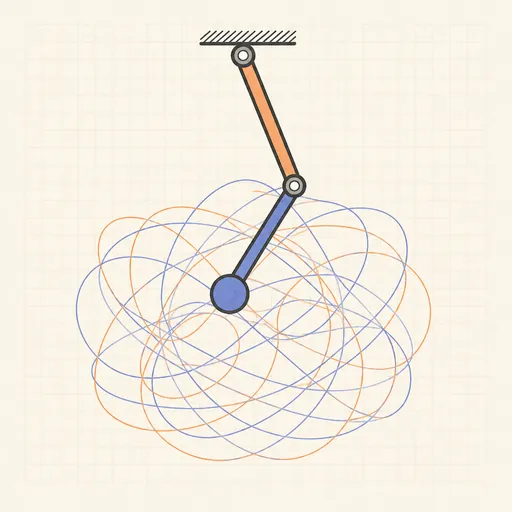
Double Pendulum
Swing a chaotic double pendulum and split it into a rainbow swarm to watch nearby starts diverge.
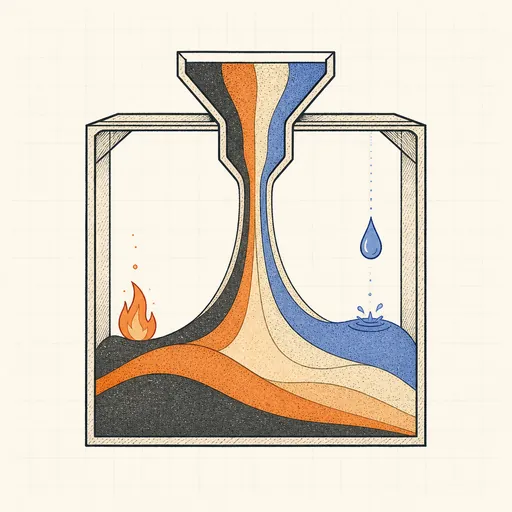
Falling-Sand Playground
Paint sand, water, oil, fire and more and watch them pour, settle, burn and react pixel by pixel.
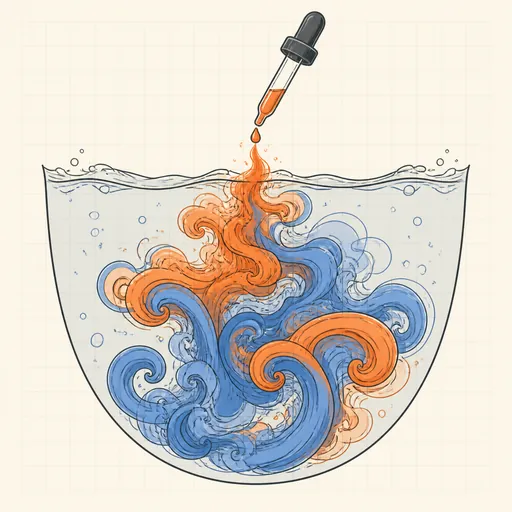
Fluid Flow Simulator
Stir glowing dye through a real-time GPU fluid simulation.
Galaxy Collision Simulator
Smash two spiral galaxies together and watch tidal tails and bridges form.
Hear the Shape of a Drum
Draw any drum and hear its true vibration modes — then meet two different drums that sound exactly the same.