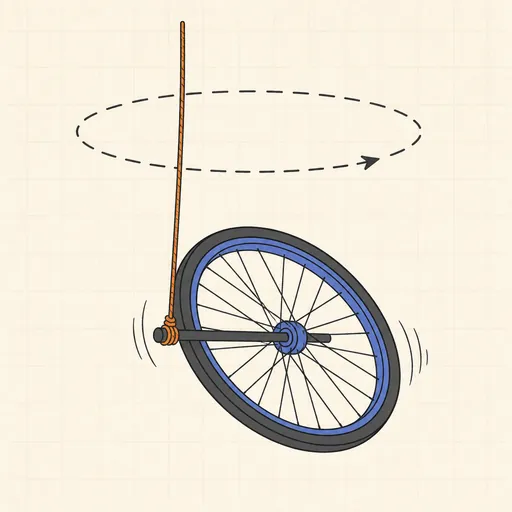
Gyroscope Precession
Hang a spinning disk on a pivoted axle and gravity does something deeply unintuitive: instead of falling, the axle swings sideways in a slow circle. This simulator integrates the full equations of a heavy symmetric top with fourth-order Runge–Kutta and draws the result in a rotatable 3D view: the spinning disk, the angular momentum arrow L, and the gravity torque arrow that always points sideways to L — which is exactly why the axle circles. Sliders set the spin rate, disk mass and radius, gravity and starting tilt; drag the spin slider mid-flight to “spin up” the rotor and watch the precession slow to match the fast-top formula Ω = mgr/(Iω). At low spin the tip path grows nutation loops and cusps — the wobble textbooks usually skip.
Runs 100% in your browser — simulations are computed locally on your device.
Read the full guide to this tool
Notes
- Torque changes angular momentum: τ = dL/dt. The gravity torque is horizontal, perpendicular to the axle, so it swings L sideways without changing its length — the axle chases its own angular momentum in a circle.
- The fast-top precession rate Ω = mgr/(Iω) falls as spin rises: a faster gyroscope precesses more slowly, which is why a dying top wobbles faster and faster before it clatters down.
- Released from rest the axle first dips, then recovers: that oscillation of tilt is nutation, and the tip traces cusps or loops depending on the spin. High spin shrinks the loops until the motion looks like pure precession.
- The model is an ideal rigid symmetric top: a uniform disk on a massless, frictionless pivoted axle with no air drag, so energy and both momentum constants are conserved and the precession never decays.
- Runs 100% in your browser — simulations are computed locally on your device.
Related tools
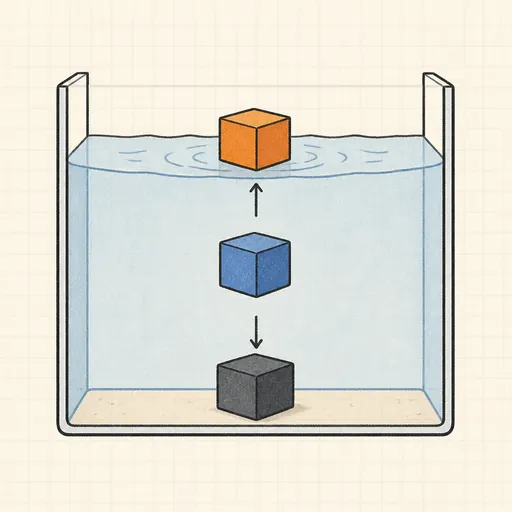
Buoyancy Tank
Drop blocks of different density into water and watch Archimedes decide what floats, sinks or hovers.
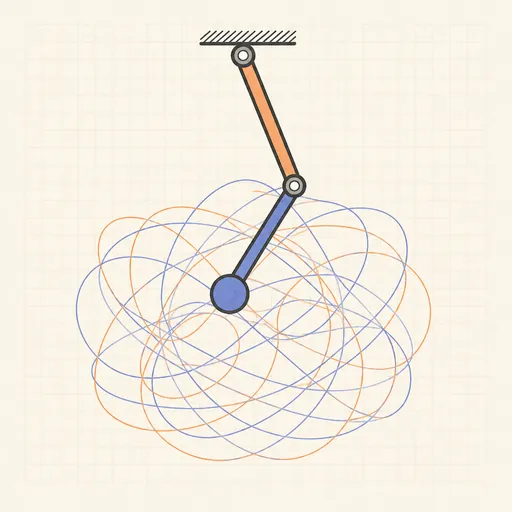
Double Pendulum
Swing a chaotic double pendulum and split it into a rainbow swarm to watch nearby starts diverge.
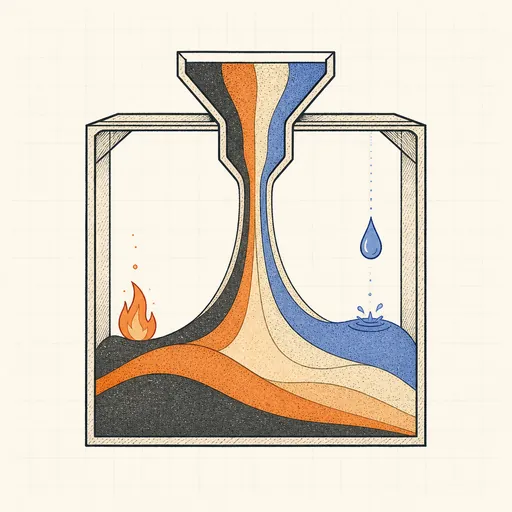
Falling-Sand Playground
Paint sand, water, oil, fire and more and watch them pour, settle, burn and react pixel by pixel.
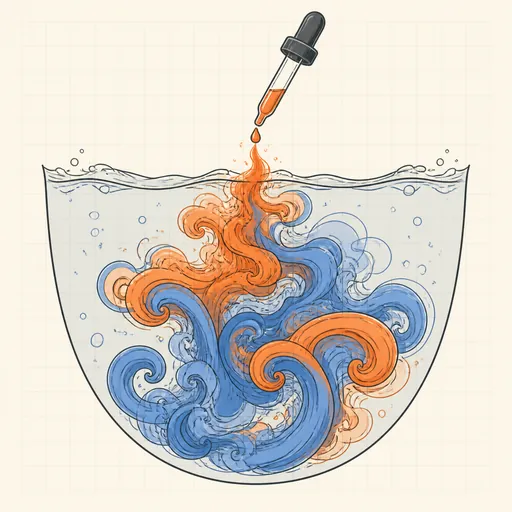
Fluid Flow Simulator
Stir glowing dye through a real-time GPU fluid simulation.
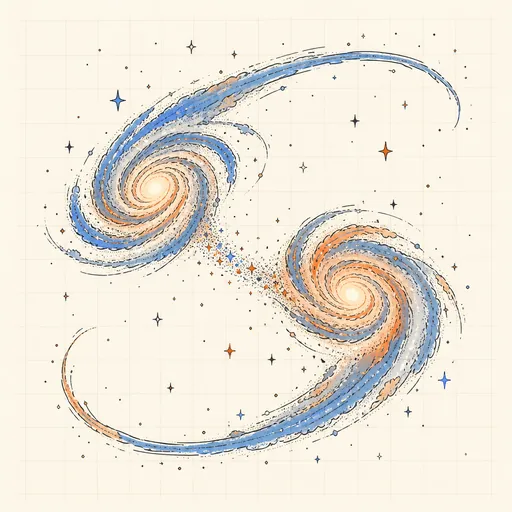
Galaxy Collision Simulator
Smash two spiral galaxies together and watch tidal tails and bridges form.
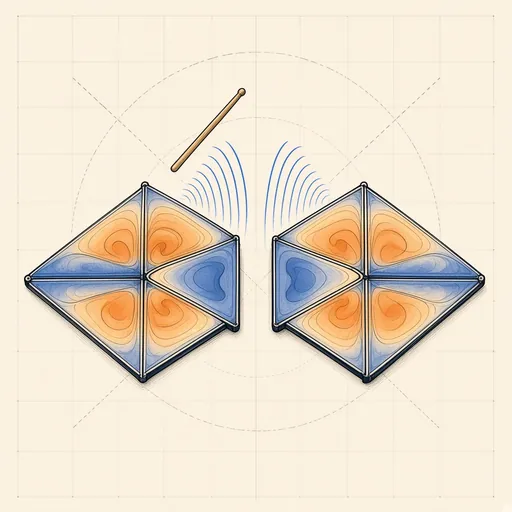
Hear the Shape of a Drum
Draw any drum and hear its true vibration modes — then meet two different drums that sound exactly the same.