Gyroscope Precession, Explained
After reading this you will know why a spinning wheel on a string circles sideways instead of falling, how to compute the precession rate from spin and mass, and how to spot the small wobble called nutation that most textbooks skip.
What precession is and one hook example
Hang a bicycle wheel on a rope tied to one end of its axle. Set it still and it flops down at once. Now spin the wheel hard and hang it the same way. It does not fall. The free end of the axle swings around in a slow horizontal circle, staying almost level, going nowhere down. That slow circling is precession.
The move looks like magic because your intuition says gravity should pull the wheel down. Gravity does pull down. The subtlety is what a downward pull does to something that already carries a large sideways-pointing angular momentum. Instead of tipping the wheel over, the torque steers its spin axis sideways. The simulator draws three arrows so you can watch this directly: the spin axis, the angular momentum vector \mathbf{L} that lies along it, and the gravity torque \boldsymbol{\tau} that always points at a right angle to both the axle and the vertical.
The key law fits on one line: torque equals the rate of change of angular momentum. Because the torque here is horizontal and perpendicular to \mathbf{L}, it rotates \mathbf{L} without lengthening it. The axle chases its own angular momentum in a circle.
When this model applies and when it does not
The simulator integrates an ideal heavy symmetric top: a uniform disk on a massless, frictionless, pivoted axle, with no air drag. That model is a good match for a fast, well-balanced gyroscope over a few seconds, and for a spinning top before friction bites.
It is a poor match once dissipation matters. A real top slows down because the pivot rubs and the air drags. As spin falls, the precession speeds up (you will see why below), the top leans further over, and it eventually clatters to the floor. None of that happens in this simulator, because energy and both momentum constants are conserved exactly. Treat the tool as a clean laboratory for the geometry of precession and nutation, not as a forecast of how long your desk toy will last.
The model is deliberately frictionless. If you want to see chaos and sensitive dependence on starting conditions instead of steady circling, the Double Pendulum is the companion piece: same Runge-Kutta engine, wildly different behavior.
The formula and the intuition behind it
Start with the fundamental relation for any rotating body under a torque:
Here \boldsymbol{\tau} is the torque about the pivot and \mathbf{L} is the angular momentum. Gravity acts at the disk's center of mass, a distance r from the pivot along the axle. Its torque has magnitude mgr\sin\theta, where m is the disk mass, g is gravity, and \theta is the tilt of the axle from vertical. That torque points horizontally, perpendicular to the axle.
For a fast top the angular momentum is dominated by the spin: L \approx I\omega, where I is the moment of inertia about the spin axis and \omega is the spin rate. The horizontal torque turns this horizontal component of \mathbf{L} at the steady precession rate:
Read the fraction slowly. The numerator mgr is the falling tendency: heavier disk, stronger gravity, longer axle all make it circle faster. The denominator I\omega is the spin stiffness: the faster the wheel spins, the more sluggish the precession. Note that \theta has canceled out. To leading order the precession rate does not depend on how far the axle tilts. For a uniform disk of radius a, the moment of inertia about its spin axis is I = \tfrac{1}{2}ma^2.
The formula \Omega = mgr/(I\omega) is the fast-top approximation. It assumes spin dominates. At low spin the true motion adds a nodding wobble, and the average precession is a little different. Trust the formula when I\omega is much larger than \sqrt{mgrI}, and expect visible loops when it is not.
A worked example using the demo defaults
Precession rate for a spinning disk
Take round default values: mass m = 1 kg, disk radius a = 0.1 m, axle length to center of mass r = 0.1 m, gravity g = 9.81 m/s², spin \omega = 60 rad/s.
- Moment of inertia: I = \tfrac{1}{2}ma^2 = 0.5 \times 1 \times 0.1^2 = 0.005 kg·m².
- Spin angular momentum: L = I\omega = 0.005 \times 60 = 0.3 kg·m²/s.
- Gravity torque at level (\theta = 90^\circ): \tau = mgr = 1 \times 9.81 \times 0.1 = 0.981 N·m.
- Precession rate: \Omega = \tau / L = 0.981 / 0.3 \approx 3.27 rad/s.
- Period of one full circle: T = 2\pi/\Omega \approx 6.283 / 3.27 \approx 1.92 s.
So the axle should sweep one lap in about 1.92 seconds while the disk itself spins at 60 rad/s, roughly 9.5 turns per second. The wheel spins about 18 times for every one slow precession lap. That ratio, spin fast and circle slow, is the visual signature of a healthy gyroscope.
How the precession rate responds to spin
Because \Omega is inversely proportional to \omega, doubling the spin halves the precession rate. Hold the demo disk fixed and vary only the spin. The table below uses mgr = 0.981 N·m and I = 0.005 kg·m² from the worked example.
| Spin ω (rad/s) | L = Iω (kg·m²/s) | Ω = mgr/(Iω) (rad/s) | Lap time (s) |
|---|---|---|---|
| 20 | 0.1 | 9.81 | 0.6405 |
| 40 | 0.2 | 4.905 | 1.281 |
| 60 | 0.3 | 3.27 | 1.921 |
| 120 | 0.6 | 1.635 | 3.842 |
| 240 | 1.2 | 0.8175 | 7.685 |
This is why a dying top wobbles faster and faster: as friction drains \omega, the rate \Omega climbs. In the simulator there is no friction, so you get the reverse by dragging the spin slider up mid-flight. Spin the rotor up and watch the slow lap stretch out toward the value the formula predicts.
Reading nutation, cusps and loops
The fast-top formula hides a second motion. When you release the axle from rest, it does not glide straight into a level circle. It first dips, dropping in tilt, then rises back, and repeats. That nodding of the tilt angle \theta is nutation. Combined with the sideways precession, the axle tip draws a scalloped path.
The shape of the scallop depends on the spin. Watch the tip trace in the 3D view:
- Cusps
- At moderate spin the tip momentarily stops and reverses at the top of each dip, drawing sharp points like the edge of a scallop shell. This is the classic released-from-rest case.
- Loops
- At lower spin the tip overshoots and curls into little loops before moving on.
- Smooth circle
- At high spin the dips shrink to nothing and the path flattens into the clean circle the fast-top formula describes.
Energy explains the nod. Released from rest, the axle has no sideways speed, so it must fall a little to trade height for the precession motion the torque is building. It overshoots, climbs back, and the excess sloshes between tilt and precession. The higher the spin, the smaller the height it needs to give up, so the loops shrink toward zero.
Common mistakes
Three errors trip up most first-time readers.
- Expecting the wheel to fall. The whole point is that a horizontal torque changes the direction of \mathbf{L}, not the vertical position of the disk. Draw the torque arrow and watch it point sideways, never down.
- Thinking faster spin means faster circling. The opposite is true. Faster spin means a larger I\omega in the denominator, so a slower precession. Check the table: doubling \omega from 60 to 120 rad/s cuts \Omega from 3.27 to 1.635 rad/s.
- Confusing spin, precession and nutation. Three separate motions run at once. Spin is the fast turn of the disk about its own axle. Precession is the slow circling of that axle. Nutation is the small nodding up and down superimposed on the circle. In the demo they run at roughly 60, 3.27 and a still faster nod rate respectively.
Related simulators
Precession sits inside a family of rotation and motion demos on this site. To feel rotation from the inside, spin up the Coriolis Effect, where a straight roll becomes a curve in a turning frame. For spin bending motion through a fluid instead of steering angular momentum, see the Magnus Effect. A close cousin of gyroscopic stability keeps a riderless bicycle upright in the Bicycle Stability model. And for smooth Newtonian circling of a different kind, the Orbit Sandbox draws ellipses and slingshots from gravity alone.
Frequently asked questions
Why does a spinning gyroscope not fall over?
Because gravity's torque points sideways, perpendicular to the spin axis and to the vertical. By \boldsymbol{\tau} = d\mathbf{L}/dt, that sideways torque rotates the angular momentum vector without changing its length or lowering the disk. The axle circles instead of dropping. A non-spinning wheel has almost no angular momentum for the torque to steer, so it simply falls.
Does a heavier or larger disk change the precession rate?
Both do, in opposite directions. Rate is \Omega = mgr/(I\omega) with I = \tfrac{1}{2}ma^2, so the mass cancels: doubling m doubles both torque and inertia, leaving \Omega unchanged. Radius does not cancel. Doubling the disk radius a quadruples I while leaving the torque fixed, so \Omega drops to one quarter.
What is nutation and why do textbooks skip it?
Nutation is the small nodding of the tilt angle that rides on top of the steady precession. Introductory texts drop it because the fast-top formula ignores it, and because it vanishes as spin rises. This simulator keeps the full equations, so at low spin you can watch the cusps and loops the shortcut hides.
Why does a dying top wobble faster before it falls?
Friction slowly drains the spin \omega. Since \Omega is proportional to 1/\omega, the precession rate climbs as spin falls. The ideal simulator has no friction, so it never decays. To see the effect, drag the spin slider down and watch the circling accelerate.
Does the tilt angle affect how fast it precesses?
To leading order, no. The \sin\theta in the torque cancels the \sin\theta in the horizontal component of angular momentum, so the fast-top rate is independent of tilt. Nutation and higher-order corrections do depend on \theta, so at low spin the lap time varies slightly through each nod.
Related tools
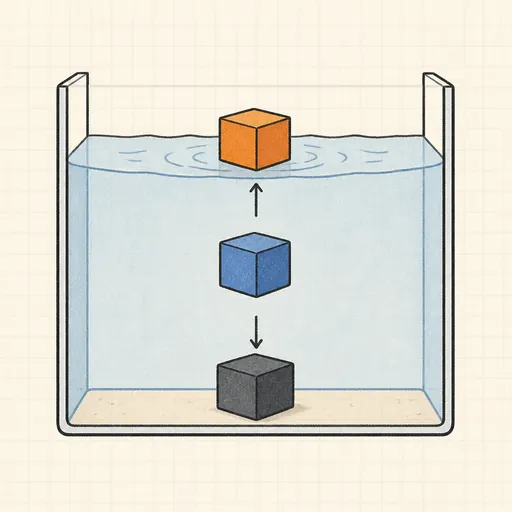
Buoyancy Tank
Drop blocks of different density into water and watch Archimedes decide what floats, sinks or hovers.
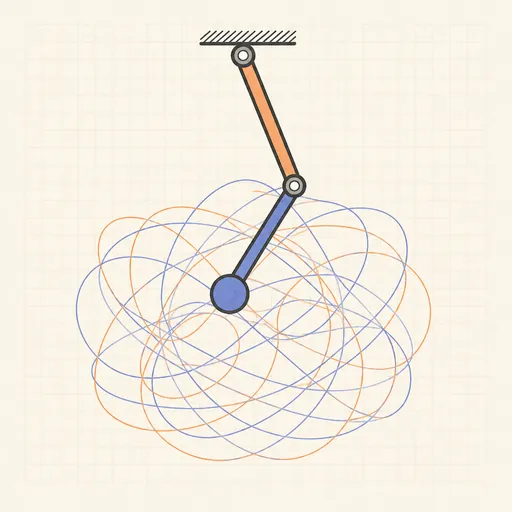
Double Pendulum
Swing a chaotic double pendulum and split it into a rainbow swarm to watch nearby starts diverge.
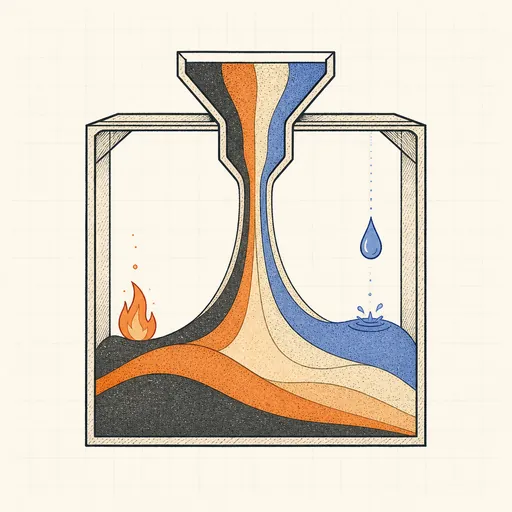
Falling-Sand Playground
Paint sand, water, oil, fire and more and watch them pour, settle, burn and react pixel by pixel.
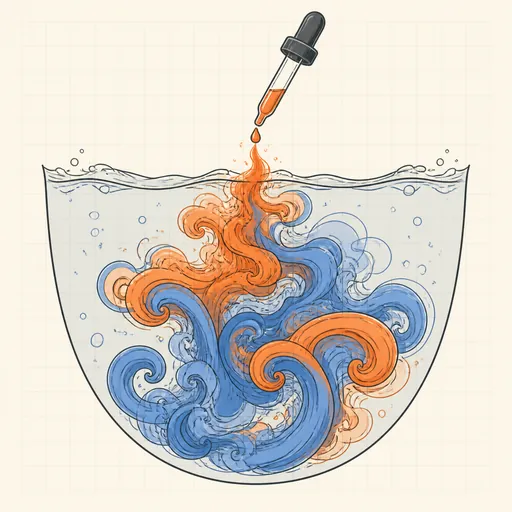
Fluid Flow Simulator
Stir glowing dye through a real-time GPU fluid simulation.
Galaxy Collision Simulator
Smash two spiral galaxies together and watch tidal tails and bridges form.
Hear the Shape of a Drum
Draw any drum and hear its true vibration modes — then meet two different drums that sound exactly the same.