The Brachistochrone: Curve of Fastest Descent
After reading this you will know why a bead slides down a sagging cycloid faster than down any straight ramp, how to derive that curve from Snell's law, and how to reproduce the race times the tool shows.
The question and the surprising answer
Fix two points in a vertical plane. Point A sits higher, point B lower and off to the side. Bend a frictionless wire from A to B and release a bead from rest at A. Which shape of wire gets the bead to B in the least time?
The straight line is the shortest path, so the naive guess is that it is also the fastest. It is not. Johann Bernoulli posed this problem as a public challenge in June 1696. The answer is the cycloid, the curve traced by a point on the rim of a wheel rolling along a flat surface. Turn that curve upside down and hang it between A and B, and a bead beats the straight ramp every time.
The reason is a trade. The cycloid dives steeply near A, so the bead gains speed early. It travels a longer path, but it spends most of that path moving fast. The word itself, brachistochrone, comes from Greek for "shortest time".
The problem was solved within a year by Newton, Leibniz, l'Hôpital, and both Bernoulli brothers. Newton, sent the challenge anonymously, reportedly solved it overnight and mailed back an unsigned answer. Johann recognized the author "as the lion is known by its claw".
What sets the descent time
Only gravity acts along the frictionless wire, so energy is conserved. A bead that has dropped a vertical distance y below the start has speed
Here g \approx 9.81 metres per second squared and y is measured downward from the release point. The speed depends only on how far the bead has fallen, never on the shape of the path. That is why a steep early drop pays off: it buys speed that the bead keeps using for the rest of the trip.
The total time is the path length divided by speed, integrated along the curve. If the curve is written as y(x), a small arc has length \sqrt{1 + (y')^2}\,dx, so
The task is to choose the whole function y(x) that makes this integral as small as possible. That is not ordinary calculus, where you pick a number. You pick a function. Solving it launched the calculus of variations, the same machinery behind least-action physics.
Bernoulli's light-ray trick and the answer
Johann Bernoulli found the shortcut. Light through a medium of varying speed bends to minimize travel time, and Snell's law says \sin\theta / v stays constant along the ray. Treat the falling bead as a light ray whose local speed is \sqrt{2gy}. Then
where \theta is the angle the path makes with the vertical. Working that condition through gives a differential equation whose solution is the cycloid, written in parametric form:
Here R is the radius of the rolling wheel and \theta is the roll angle in radians, running from 0 at the top. The constant R and the final angle \theta_B are fixed by forcing the curve to pass through B. One curve, no free parameters left once the endpoints are set.
A remarkable side property falls out of the same equations. On a cycloid, a bead released from any point reaches the bottom in the same time. That is the tautochrone property, and Huygens used it to design pendulum clocks whose period does not drift with swing amplitude.
Reproducing the demo race
Take A at the origin and B at x_B = 2, y_B = 1 (metres, measured downward), with g = 9.81. These are the tool's default endpoints. Compare four beads.
- Straight ramp. Length is \sqrt{2^2 + 1^2} = \sqrt{5} \approx 2.236 m. Constant acceleration along a slope of angle \arctan(1/2) gives a descent time of about
0.958s. - Cycloid. Solve y_B/x_B = (1-\cos\theta_B)/(\theta_B-\sin\theta_B) = 0.5 numerically. This gives \theta_B \approx 2.412 rad and R \approx 0.5729 m. The descent time is T = \theta_B \sqrt{R/g}, which comes to about
0.583s. - Circular arc through the same endpoints lands near
0.605s, close to the cycloid but not quite as fast. - Steep-then-flat path (drop nearly straight down, then run flat to B) reaches about
0.660s: better than the ramp, worse than the smooth curves.
The cycloid wins. It beats the straight ramp by roughly 0.375 s, a 39% cut in time, even though its arc is longer than the straight line.
An interactive to feel the trade-off
The single idea worth playing with is how steeply the curve should dive. A gentle sag barely beats the ramp. A sag deeper than the cycloid overshoots and loses time again. The optimum is one exact shape.
Reading the race and its numbers
Three quantities are worth watching as the beads run.
- Finish time
- The headline number. The cycloid's time T = \theta_B \sqrt{R/g} depends only on the endpoints and gravity, never on the bead's mass. A heavy bead and a light bead tie exactly.
- Early speed lead
- Watch the first third of the race. The cycloid bead is already ahead because it dropped fastest at the start. By the time all beads are level with B, the cycloid bead has been fast for longest.
- Path length versus time
- The cycloid arc for these endpoints is about
2.35m, longer than the straight2.236m, yet it finishes first. Distance is not the thing being minimized. Time is.
The chart below traces the cycloid itself. Notice how the tangent is vertical at the start (angle to the horizontal is 90 degrees), then eases toward flat near the bottom.
Common mistakes and honest limits
Several intuitions break here, and the toy model itself hides real physics.
The straight line is the shortest path but not the fastest. Confusing "shortest" with "quickest" is the exact trap the problem sets. Length and time are different quantities, and only one of them is being minimized.
A second slip is thinking a steeper curve always helps. It does up to a point. Dive too aggressively and the bead runs a needlessly long path across the bottom, losing the time it saved. The cycloid is the single balance point, as the U-shaped time curve in the widget shows.
Now the limits of the toy. The simulation assumes no friction and no rolling. A real ball on a track loses energy to friction and spends some of its drop turning that energy into spin, so its measured times are longer than the ideal numbers above. The frictionless cycloid is still the theoretical optimum, but you should not expect a marble on a plastic track to hit 0.583 s exactly. The model tells you the shape to aim for, not the stopwatch reading you will get.
Finally, the cycloid is optimal only when the bead starts from rest and moves under uniform gravity. Give it an initial push, or change the force law, and the optimal curve changes too.
Related tools
The brachistochrone is one curve you can generate by rolling a circle. To draw the whole family of looping roulettes, roll one gear inside or outside another in the Spirograph. The calculus of variations that solves it is the study of differential equations as geometry: see a first-order equation as a field of slopes in the Slope Field Explorer, and watch numerical integrators approximate such solutions in Euler vs Runge–Kutta. For another famous least-time and least-action system, the Three-Body Choreographies trace orbits that extremize action. And for a chain of rolling circles that redraws any shape, try Fourier Epicycles.
Frequently asked questions
Why is a curved path faster than a straight one?
Because speed depends only on how far the bead has fallen, v = \sqrt{2gy}. A curve that drops steeply at the start reaches high speed early and keeps it. The extra path length is more than paid back by the higher average speed. For the default endpoints the cycloid finishes in about 0.583 s versus 0.958 s for the ramp.
Does the bead's mass or weight change the answer?
No. Gravity accelerates all masses equally, so the time T = \theta_B\sqrt{R/g} has no mass in it. A steel bead and a glass bead tie. Only friction, which the model ignores, would separate them.
What is the difference between the brachistochrone and the tautochrone?
They are the same curve, the cycloid, seen two ways. Brachistochrone means it gives the fastest descent between two fixed points. Tautochrone means a bead released from any point on it reaches the bottom in the same time. Huygens used the second property to build accurate pendulum clocks.
Is the cycloid always the shape, whatever the endpoints?
The optimal curve is always a piece of some cycloid, but which piece depends on the endpoints. The radius R and the final roll angle \theta_B are set by requiring the curve to pass through B. If B is far to the side and only slightly lower, the curve can dip below B and rise back up to it.
Why did this problem matter to mathematics?
It asked you to optimize over a whole function rather than a single number. Solving it created the calculus of variations, which later became the language of least-action mechanics, optics and much of modern physics.
Related tools
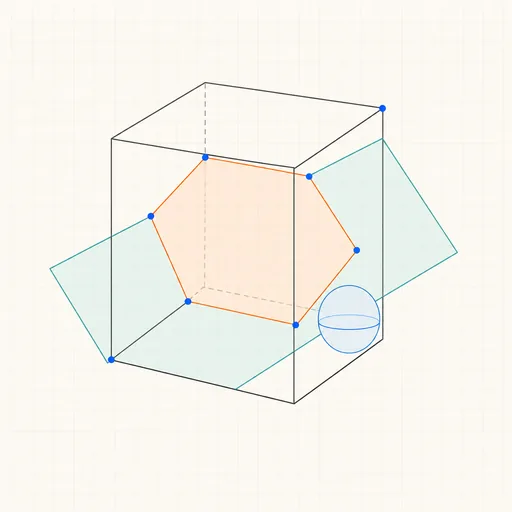
3D Geometry Board
Points, lines, planes, spheres and polyhedra on an orbiting camera — slice solids with planes, unfold nets, drop the Dandelin spheres into a cone and drag everything.
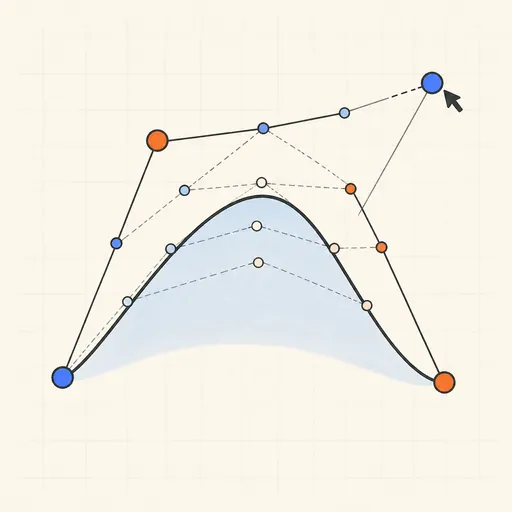
Bézier Curve Playground
Drag control points and watch De Casteljau’s algorithm construct a Bézier curve step by step.
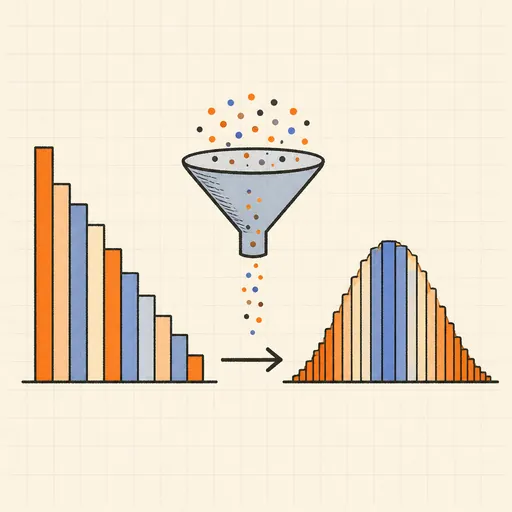
Central Limit Theorem Demo
Sample from any lopsided distribution and watch the averages pile up into a bell curve.
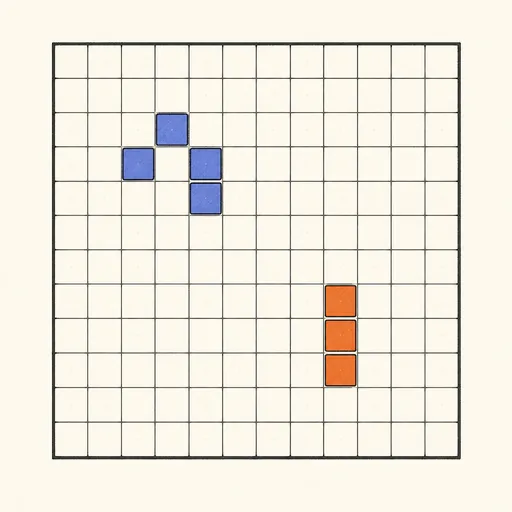
Conway’s Game of Life
Paint cells and watch Conway’s cellular automaton breed gliders, guns and oscillators.
Dynamic Geometry Board
Construct with points, lines, circles and transformations, then drag anything — the construction stays true, and a checker tells you which relations are theorems.

Fantasy Map Generator
Roll a seed and get a continent: coastlines, mountains, rivers, biomes and named towns, ready for your campaign.