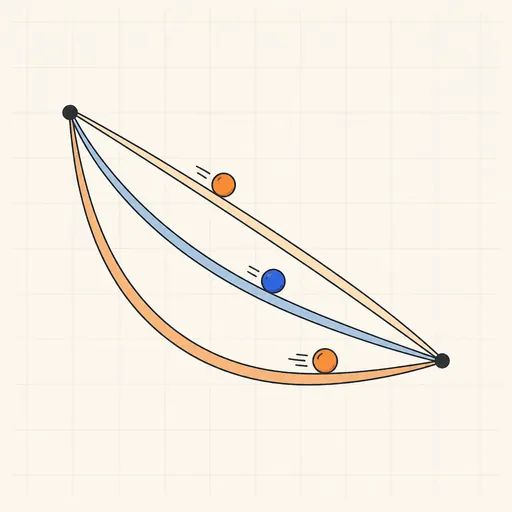
Brachistochrone Race
Which slide gets a bead from A to B fastest under gravity? Not the straight line: the answer, found by Bernoulli in 1696, is the cycloid — the curve traced by a point on a rolling wheel. This race animates beads sliding without friction down a straight ramp, a circular arc, a steep-then-flat path and the cycloid, with a timer for each. The cycloid dives steeply to pick up speed early, then flattens out — trading path length for velocity in exactly the optimal way.
Runs 100% in your browser — simulations are computed locally on your device.
Read the full guide to this tool
Notes
- The cycloid x = R(θ − sin θ), y = R(1 − cos θ) is the brachistochrone — the curve of fastest descent.
- It is also the tautochrone: beads released anywhere on it reach the bottom at the same moment.
- The problem launched the calculus of variations, the mathematics behind least-action physics.
- Runs 100% in your browser — simulations are computed locally on your device.
Related tools
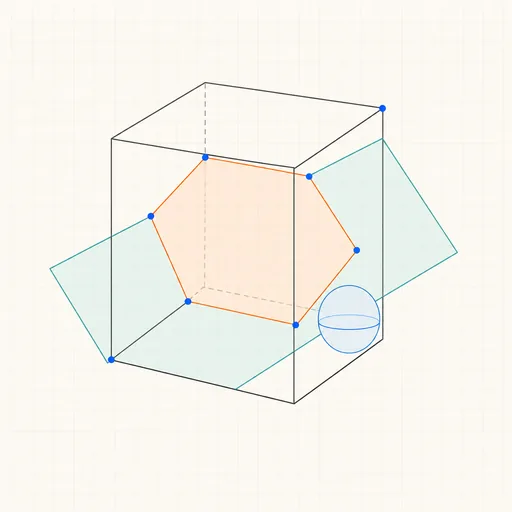
3D Geometry Board
Points, lines, planes, spheres and polyhedra on an orbiting camera — slice solids with planes, unfold nets, drop the Dandelin spheres into a cone and drag everything.
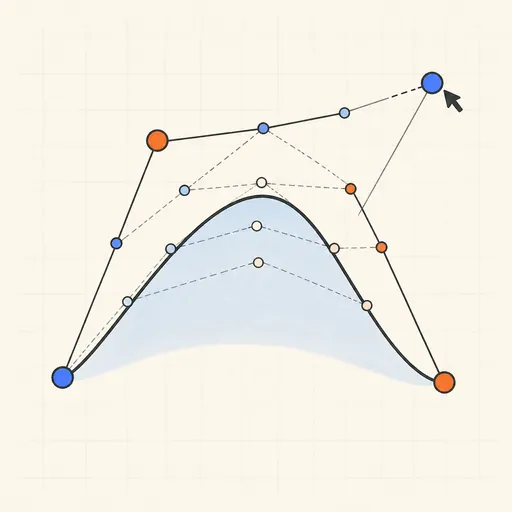
Bézier Curve Playground
Drag control points and watch De Casteljau’s algorithm construct a Bézier curve step by step.
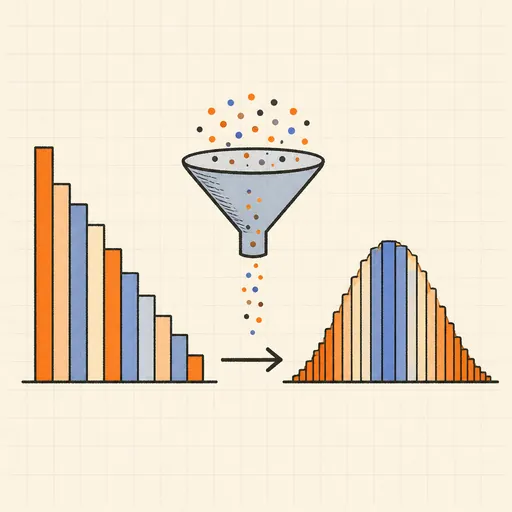
Central Limit Theorem Demo
Sample from any lopsided distribution and watch the averages pile up into a bell curve.
Conway’s Game of Life
Paint cells and watch Conway’s cellular automaton breed gliders, guns and oscillators.
Dynamic Geometry Board
Construct with points, lines, circles and transformations, then drag anything — the construction stays true, and a checker tells you which relations are theorems.

Fantasy Map Generator
Roll a seed and get a continent: coastlines, mountains, rivers, biomes and named towns, ready for your campaign.