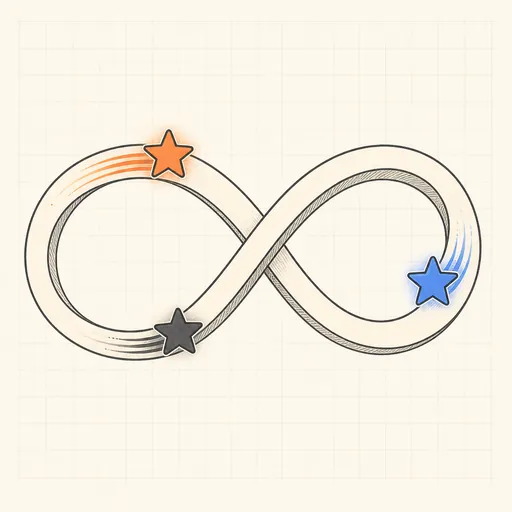
Three-Body Choreographies
The three-body problem has no general closed-form solution, but it hides a handful of exact periodic solutions of startling beauty. This tool integrates three equal masses under Newtonian gravity and starts them on famous "choreographies" — orbits where the bodies chase each other around a single shared curve. The most famous is the figure-eight, discovered numerically by Moore in 1993 and proved to exist by Chenciner and Montgomery in 2000, in which three stars trace the same figure-eight forever. Pick a preset, watch the bodies weave with their trails, then nudge the launch slightly and see the delicate orbit dissolve into chaotic scattering, the generic fate of three gravitating bodies.
Runs 100% in your browser — simulations are computed locally on your device.
Read the full guide to this tool
Notes
- A choreography is a periodic n-body orbit in which every body follows the same closed curve, evenly spaced in time; the figure-eight is the simplest and most stable known example for three equal masses.
- These orbits are measure-zero islands of order in a sea of chaos: an arbitrarily small change to the initial positions or velocities almost always leads to exponential divergence and eventual ejection of one body.
- The energy and angular momentum are conserved by a symplectic integrator here, which is what keeps a delicate periodic orbit from spiralling apart through numerical drift over many loops.
- Runs 100% in your browser — simulations are computed locally on your device.
Related tools
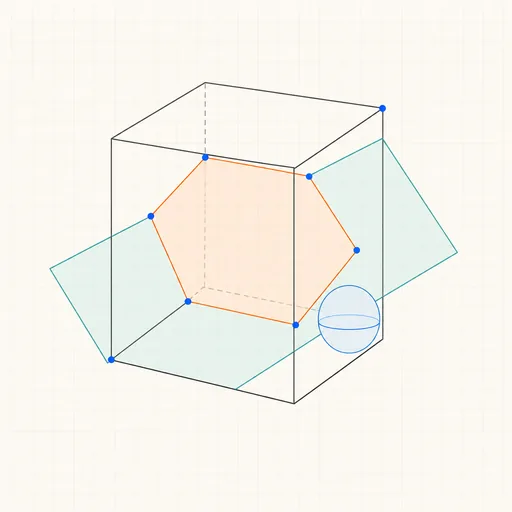
3D Geometry Board
Points, lines, planes, spheres and polyhedra on an orbiting camera — slice solids with planes, unfold nets, drop the Dandelin spheres into a cone and drag everything.
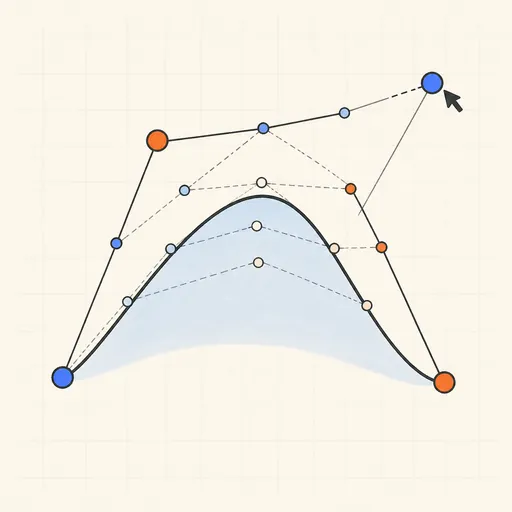
Bézier Curve Playground
Drag control points and watch De Casteljau’s algorithm construct a Bézier curve step by step.
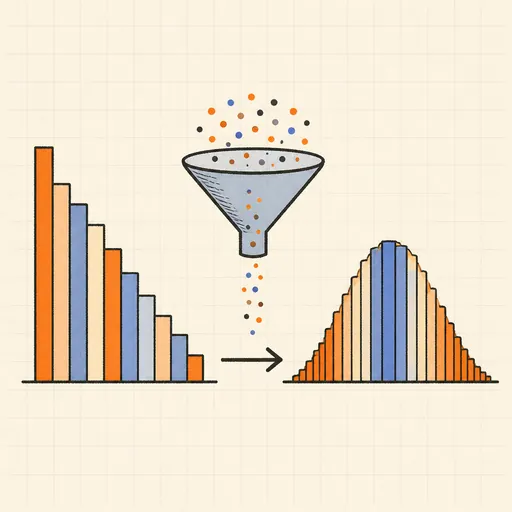
Central Limit Theorem Demo
Sample from any lopsided distribution and watch the averages pile up into a bell curve.
Conway’s Game of Life
Paint cells and watch Conway’s cellular automaton breed gliders, guns and oscillators.
Dynamic Geometry Board
Construct with points, lines, circles and transformations, then drag anything — the construction stays true, and a checker tells you which relations are theorems.
Fantasy Map Generator
Roll a seed and get a continent: coastlines, mountains, rivers, biomes and named towns, ready for your campaign.