The Abelian Sandpile, Explained
After reading this you can predict how a pile of sand grains topples on a grid, explain why the final pattern never depends on topple order, and read the fractal mandala that endless dropping builds at the centre.
What the sandpile is
Take a square grid. Each cell holds a whole number of grains. The rule is simple: any cell holding four or more grains topples. When it topples, it loses four grains and hands one grain to each of its four orthogonal neighbours (up, down, left, right). Grains that fall off the edge of the grid are lost forever.
One topple can push a neighbour to four or more grains, which then topples too. A single dropped grain can therefore trigger a chain reaction, an avalanche, that touches thousands of cells before everything settles below four again. When no cell has four or more grains, the configuration is stable and the avalanche is over.
The hook is what happens when you drop grains one at a time onto a single central cell of a large empty grid and let each avalanche finish before the next drop. After a few million grains the stable pattern is not a formless blob. It is a sharp, four-fold symmetric mandala of nested triangles and squares, self-similar across scales. Nobody designed that shape. It falls out of the topple rule alone.
Where the model helps and where it does not
The sandpile is the cleanest example of self-organised criticality, a phrase coined by Bak, Tang and Wiesenfeld in 1987. The system drives itself to a critical state with no parameter to tune. Avalanche sizes then follow a power law, so avalanches of every size appear, and the very large ones are rare but never absent.
Use it to build intuition for systems that sit at a threshold and release stress in bursts: idealised models of earthquakes, forest fires, traffic jams and neural firing all borrow this language. Use it to see how strict local rules generate global structure, and to meet a genuine discrete fractal you can compute exactly.
Real sand does not behave like this. Physical sandpiles have friction, inertia and grain shape that break the tidy power law, and careful lab experiments in the 1990s mostly failed to reproduce clean self-organised criticality. Treat the model as a mathematical object that teaches a mechanism, not as a description of a beach.
The topple rule and the abelian property
Write the height of cell (i,j) as z_{i,j}. The topple condition and its effect are:
Here z_{i,j} is the grain count at the toppling cell, and each of its up-to-four neighbours n gains one grain. A cell on the edge has fewer than four neighbours, so some of the four grains simply leave the grid. That leakage at the boundary is what lets the pile ever stabilise.
The word abelian names the deep fact. Suppose several cells are unstable. You could topple them in any order you like: leftmost first, or the tallest first, or at random. The stable configuration you reach is identical every time, and so is the number of times each cell topples. Only the total grain count and the starting heights matter, not the schedule.
The reason is that toppling cell A never removes the reason cell B was unstable. Toppling only adds grains to neighbours, so if B had four grains, it still has at least four after A topples. Unstable cells stay unstable until they topple themselves, so no order can cheat another cell out of its topple. The commuting of these operations is exactly the algebra that gives abelian groups their name.
A worked avalanche
Dropping one grain onto three
Start with a single cell holding 3 grains and all neighbours at 0. This is the demo's default: feed grains into the centre of an empty grid. Watch the fourth grain arrive.
- Centre now holds
4. It is unstable, so it topples: centre drops to0, and the four neighbours (N, E, S, W) each rise to1. - No cell has four or more grains. The avalanche stops after exactly one topple. The pattern is a small plus sign:
0in the middle,1on each arm.
Now keep feeding the centre. After the centre reaches 4 again and topples, and its neighbours in turn reach 4 and topple, the counts spread outward. The table below traces the centre cell's height as you drop grains one at a time onto it, resetting after each avalanche.
| Grains dropped total | Centre height after drop | Topples triggered |
|---|---|---|
| 1 | 1 | 0 |
| 2 | 2 | 0 |
| 3 | 3 | 0 |
| 4 | 0 | 1 |
| 5 | 1 | 0 |
| 16 | 0 | 9 |
The drop that finally pushes the pile past its threshold sets off a larger cascade. By the time the sixteenth grain lands, a single drop already causes nine separate topples across several cells. This growth of avalanche size with pile density is the whole story in miniature.
The identity pile and the number 2n squared
Two facts make the sandpile a favourite of mathematicians. First, the stable configurations on a fixed grid that are recurrent (reachable again and again by adding grains) form a finite abelian group under the operation "add pilewise, then let it topple to stable". Second, that group has an identity element, and the identity is itself a startling fractal image you can compute.
Here is a concrete number you can check. If you place 2n grains on every cell of a grid, then topple to stable, then add that same all-2n pile again and stabilise, the result of subtracting cleverly yields the group identity. The identity for the full plane is dominated by height 2, sprinkled with characteristic patches of 0, 1 and 3. On a square this identity is exactly reproducible: run the same computation and you get the same picture to the last grain, because the whole process is deterministic and abelian.
Reading the growing mandala
When you feed N grains into one point and stabilise, the sand settles into a rough disk. Its radius grows in proportion to \sqrt{N}, because the grains spread over a roughly circular area and area scales as radius squared. Drop four times as many grains and the pattern doubles in width.
The heights that survive are only 0, 1, 2 and 3, since anything at 4 would still be toppling. Colour the four values and the mandala appears: a bright square core, triangular rays reaching to the corners, and self-similar detail that looks the same when you zoom in. The pattern is a true fractal in the sense that its boundary and internal texture repeat across scales as N grows.
The large-scale limit of the single-source sandpile has been proved to converge to a fixed fractal image (work by Levine, Pegden and Smart, around 2013). The triangular and square patches correspond to exact rational slopes in the limiting shape. The picture on your screen is a finite snapshot of that limit.
Explore the avalanche size distribution
The signature of criticality is the avalanche size histogram. Plot how often an avalanche of size s (the number of topples it causes) occurs, on log-log axes, and you get a straight line over several decades: a power law P(s) \sim s^{-\tau} with an exponent near \tau \approx 1.2 for the two-dimensional pile.
The absence of a bump in that plot is the point. A normal distribution has a peak, a typical value. A power law has none: the mean avalanche size keeps creeping up as you add more grid, because rare giant avalanches carry real weight. That scale-free behaviour is what "critical" means here.
Common mistakes
Watch for these traps when you run or reason about the pile.
- Expecting the order to matter
- It does not. If your hand-computed final pile differs from a friend's, one of you made an arithmetic slip, not a valid alternative outcome. The abelian property guarantees a unique stable state.
- Forgetting boundary loss
- Grains that topple off the edge vanish. On an infinite grid the pile would grow forever from a constant source. On a finite grid it can reach a true steady state because the edges bleed grains away.
- Reading four colours as "temperature"
- Heights
0to3are grain counts, not intensities to be smoothly interpolated. The sharp boundaries between patches are exact, not blurry. - Confusing this with Conway's Life
- Life uses a birth-and-death rule on live and dead cells and can run forever. The sandpile always halts after finitely many topples for any finite input, because the total off-grid loss is bounded.
Related tools
If the topple rule pulled you in, other grid automata reward the same attention. Conway's Game of Life is the classic two-state cellular automaton, and Elementary Cellular Automata show how even a one-dimensional rule can produce complexity. Langton's Ant builds order from a two-rule wandering agent, much as the pile builds order from local toppling.
For fractals of other kinds, try the Mandelbrot Explorer and the Chaos Game, which grows a Sierpiński triangle from random jumps. To measure the fractal you are looking at, the Box-Counting Dimension Lab reads a dimension off a log-log slope, the same technique used on the avalanche histogram above. For more power laws and heavy tails, the Random Walk Explorer includes Lévy flights.
Frequently asked questions
Why is it called abelian?
Because the topple operations commute. Toppling cell A then cell B gives the same result as B then A, and the recurrent stable states form an abelian group under grain addition. The name honours that group structure, which is exactly the property of abelian (commutative) groups in algebra.
Does the pile always stop toppling?
Yes, for any finite starting pile on a finite grid. Each topple sends grains toward the boundary where some are lost, so the total on the grid cannot grow without bound. A standard argument shows the number of topples is finite and the same regardless of order.
Why does dropping on one spot make a fractal?
The topple rule enforces exact rational slopes in the limiting height field, and those slopes carve the plane into triangular and square patches that repeat at every scale. The convergence to a fixed fractal limit as grain count grows is a proved theorem, not just a visual impression.
What exponent does the avalanche power law have?
For the two-dimensional pile the avalanche size distribution scales roughly as s^{-1.2}, though the precise value and even whether a single clean exponent exists remain debated because of finite-size effects and multiple ways to measure "size".
How many grains do I need to see the mandala?
Structure appears within a few thousand grains, but the crisp nested detail needs hundreds of thousands to millions. Radius grows as \sqrt{N}, so a million grains gives a pattern about 500 cells across.
Related tools
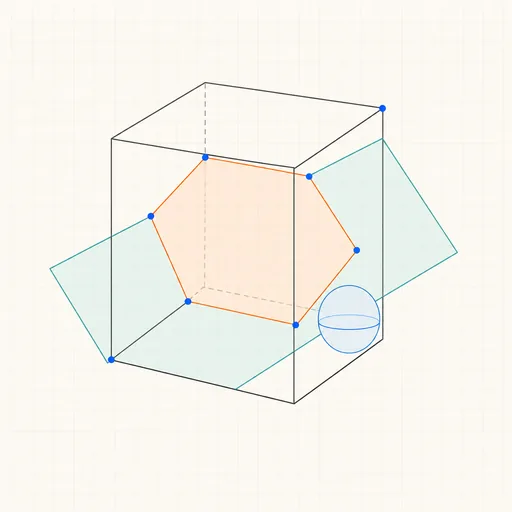
3D Geometry Board
Points, lines, planes, spheres and polyhedra on an orbiting camera — slice solids with planes, unfold nets, drop the Dandelin spheres into a cone and drag everything.
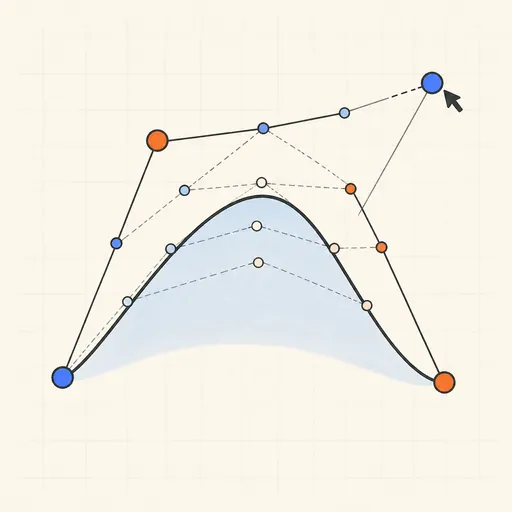
Bézier Curve Playground
Drag control points and watch De Casteljau’s algorithm construct a Bézier curve step by step.
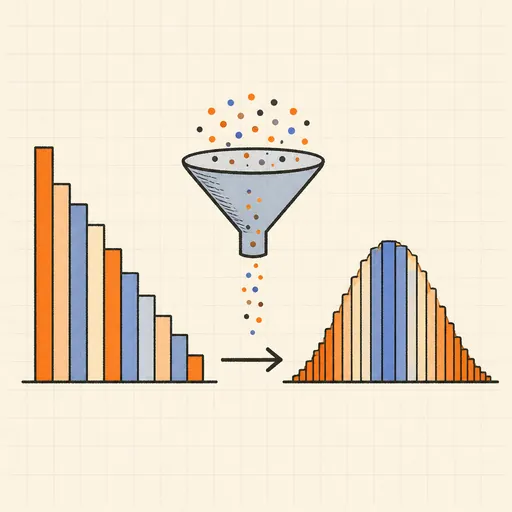
Central Limit Theorem Demo
Sample from any lopsided distribution and watch the averages pile up into a bell curve.
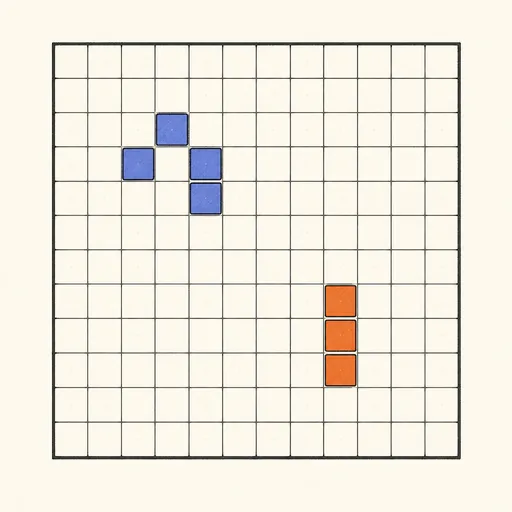
Conway’s Game of Life
Paint cells and watch Conway’s cellular automaton breed gliders, guns and oscillators.
Dynamic Geometry Board
Construct with points, lines, circles and transformations, then drag anything — the construction stays true, and a checker tells you which relations are theorems.
Fantasy Map Generator
Roll a seed and get a continent: coastlines, mountains, rivers, biomes and named towns, ready for your campaign.