Gaussian Mixture & EM
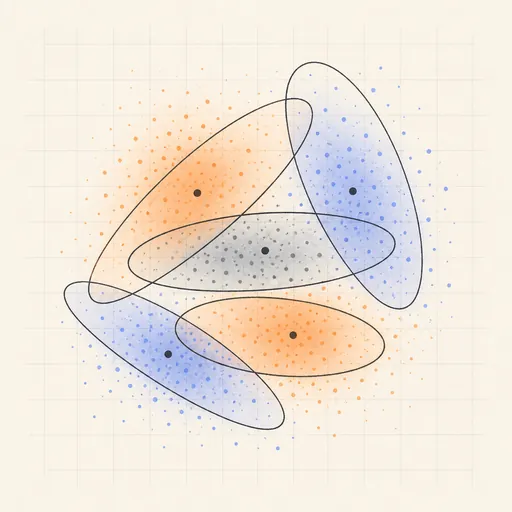
A Gaussian mixture model explains data as k overlapping Gaussian bells, each with its own weight, mean and covariance, and fits them with the EM algorithm. Pick a preset — well-separated, overlapping, or elongated diagonal clusters — or click to add points, choose k and a covariance type (full or spherical), and step through EM: the E-step blends every point’s colour by its responsibilities (soft membership probabilities), and the M-step slides the mean markers and reshapes the 1σ and 2σ ellipses to match the weighted data. A mini-chart tracks the log-likelihood rising monotonically until convergence. On the elongated preset, flip the k-means comparison toggle to see hard, round assignments slice the tilted clusters apart while full-covariance EM hugs them.
Runs 100% in your browser — models are trained and computed locally on your device.
Read the full guide to this tool
Notes
- E-step: responsibility rᵢₖ = πₖ N(xᵢ | μₖ, Σₖ) / Σⱼ πⱼ N(xᵢ | μⱼ, Σⱼ). M-step: each weight, mean and covariance is re-estimated from the data weighted by those responsibilities.
- Every EM iteration provably increases (or keeps) the log-likelihood, so the curve is monotone — but only to a local maximum, and the answer depends on the initialization, just like k-means.
- k-means is the limit of EM with spherical covariances shrunk to zero: responsibilities harden to nearest-mean assignment. Full covariances are what let GMM fit tilted, elongated clusters.
- A component can collapse onto a single point, sending the likelihood to infinity; this demo adds a small regularizer to each covariance diagonal to prevent that.
- Runs 100% in your browser — models are trained and computed locally on your device.
Related tools
Distribution Sketcher
Sketch the shape of a probability density — or paste raw data — and search 16 distributions for the ones that fit it best.
PCA Toy
Find the axes of maximum variance and flatten a point cloud onto them.
k-Means Clustering
Step through Lloyd’s algorithm and watch centroids chase the middles of your point clouds.
Anomaly Detection Playground
Flag outliers three different ways and see where each score breaks down.
DBSCAN Clustering
Grow density-based clusters point by point and watch noise get left behind.
Hierarchical Clustering & Dendrogram
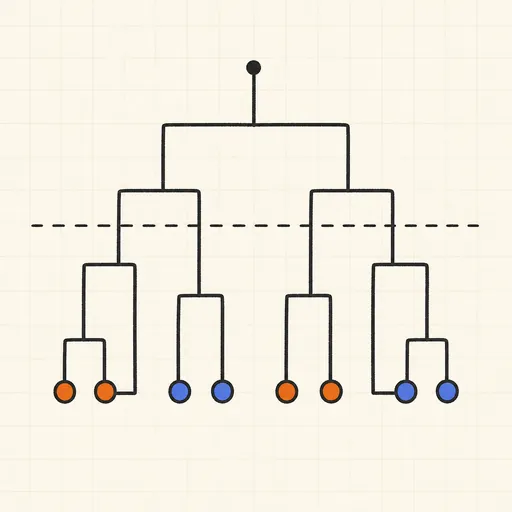
Merge points bottom-up and cut the dendrogram wherever you like.