Special Relativity, Explained
After reading this you will be able to compute how much a fast-moving ruler shrinks, how much a fast clock slows, and why the star field ahead of a near-light ship crowds into a bright blue point, all from one factor called \gamma.
What the visualizer shows
Push a ship's speed toward the speed of light and three things happen at once. The rulers laid along your path get shorter. The clocks you pass tick more slowly than your own. And the stars ahead of you bunch together, brighten, and turn blue, while the stars behind spread out, dim, and turn red.
None of these are illusions in the loose sense. They are what a careful observer with real instruments would record. The visualizer draws a lattice of rods and clocks so you can watch the geometry deform, and it prints the Lorentz factor \gamma so you can put a number on every distortion.
Here is the hook. At 0.87c the factor \gamma = 2. A meter stick flying past you measures 50 centimeters along its motion. A clock on board ticks once for every two ticks of yours. Speed the ship to 0.99c and \gamma \approx 7.09: the same meter stick shrinks to about 14 centimeters, and the entire visible sky ahead squeezes into a cone a few degrees wide.
When this model applies and when it does not
Special relativity describes motion at constant velocity in flat spacetime, with no gravity and no acceleration during the measurement. Inside that box it is exact and has been tested to many decimal places. Particle accelerators routinely run electrons at \gamma \gt 10^{4} and the beams behave exactly as the formulas say.
The model stops being the whole story once gravity matters. Near a massive body you need general relativity, where spacetime itself curves. For that flavor of distortion see Black Hole Lensing, which bends light around a mass rather than around a velocity.
The visualizer treats the ship as coasting at whatever speed you set. Turning the dial is a shortcut for "imagine you have already reached this cruising speed." Real acceleration would add its own effects, and it is the acceleration, not the speed, that breaks the twin symmetry described later.
The Lorentz factor and where it comes from
Everything in the scene is governed by one number:
Here v is the relative speed of ship and scene, and c is the speed of light, about 3.00 \times 10^{8} meters per second. The ratio \beta = v/c runs from 0 to 1. At rest \gamma = 1. As v approaches c, the denominator approaches 0 and \gamma shoots toward infinity.
Two quantities follow directly. A length L_0 measured at rest contracts along the direction of motion to
and a time interval \Delta t_0 measured on a moving clock stretches, as seen by you, to
Notice the asymmetry in how \gamma enters: lengths divide by it, times multiply by it. Both effects grow together because they share the same root. Only lengths along the motion shrink; widths across the motion are untouched. That is why the lattice in the visualizer flattens into pancakes rather than shrinking uniformly.
The Doppler shift and aberration
The color and position changes come from a different but related formula. Light from a star directly ahead arrives shifted in frequency by the relativistic Doppler factor:
For a star directly behind, flip the sign of \beta. Positions shift too. A star that sits at angle \theta from your heading in the rest frame appears at a smaller angle \theta' given by the aberration formula:
This sweep pulls stars from all directions toward the forward point. At high \beta almost the whole sky piles into a small forward circle, brightened and blue-shifted. That is the relativistic headlight effect: the space ahead gets crowded and brilliant, the space behind goes dark and red.
Reproducing the demo at 0.87c
Set the speed to the default demo value v = 0.87c, so \beta = 0.87.
- Compute \beta^2 = 0.87^2 = 0.7569.
- Then 1 - \beta^2 = 0.2431.
- Take the root: \sqrt{0.2431} = 0.4931.
- Invert: \gamma = 1/0.4931 = 2.028, close enough to the round figure 2.
- A 1-meter rod contracts to L = 1/2.028 = 0.4931 m, so about 49 cm.
- A 1-second onboard tick reads to you as \Delta t = 2.028 \times 1 = 2.028 s.
- Forward Doppler: \sqrt{(1.87)/(0.13)} = \sqrt{14.38} = 3.79, so light ahead arrives at nearly four times its emitted frequency. A yellow star at 570 nm shifts to about 150 nm, deep in the ultraviolet.
Every one of these numbers appears in the readout when you drag to the demo speed, so you can check the arithmetic against the display.
Reading the numbers off the scene
The table below traces the three effects across the speed range. Read down any column to see how fast the distortion accelerates once you pass 0.9c.
| β = v/c | γ | Rod length (of 1 m) | Forward Doppler factor |
|---|---|---|---|
| 0.10 | 1.005 | 0.995 m | 1.106 |
| 0.50 | 1.155 | 0.866 m | 1.732 |
| 0.87 | 2.028 | 0.493 m | 3.790 |
| 0.95 | 3.203 | 0.312 m | 6.245 |
| 0.99 | 7.089 | 0.141 m | 14.11 |
Common mistakes
The errors below trip up almost everyone the first time.
- Treating contraction as a squeeze in all directions
- Only the dimension along the motion shrinks. A sphere passing you at
0.87cmeasures 1 m across but 0.49 m front to back. The visualizer flattens the lattice into slabs for exactly this reason. - Confusing what you see with what is "really" there
- Length contraction is a genuine measurement of simultaneous positions, not a trick of light travel time. The Doppler and aberration effects are what your eye receives. The visualizer shows both, so keep them separate in your head.
- Thinking one clock is "actually" slow
- Time dilation is symmetric. You see the passing clock run slow, and the passing observer sees yours run slow, by the same factor 2.028 at
0.87c. Both are right, because they disagree about which events are simultaneous. - Believing you can pass c
- As \beta \to 1, \gamma \to \infty. Reaching
cwould demand infinite energy. The slider stops short for a reason.
The famous twin puzzle is not a contradiction. Time dilation is symmetric only while both observers coast. The traveling twin must accelerate to turn around, and that acceleration breaks the symmetry, so the traveler really does come home younger. The visualizer's coasting model shows the symmetric part only.
Related tools
If the aberration and lensing of light interest you, Black Hole Lensing bends starlight with gravity instead of speed, the general-relativity companion to this page. For a wider tour of physics playgrounds, spin up chaotic motion in the Double Pendulum, watch orbits form in the Orbit Sandbox, or collide star systems in the Galaxy Collision Simulator. To study how light itself behaves through glass and mirrors, the Ray Optics Bench traces rays through lenses and prisms.
Frequently asked questions
Why does the sky ahead turn into a bright point at high speed?
Aberration sweeps apparent star positions toward your heading. At 0.99c the aberration formula maps a star that sits 90 degrees off your path down to about 8 degrees ahead, so nearly the whole sky crowds into a small forward cone. The Doppler factor of 14.11 then blue-shifts and brightens that cone.
Is length contraction something you could photograph?
A single photograph mixes contraction with light travel time, which can produce an apparent rotation (the Terrell rotation) rather than a clean squeeze. Contraction itself is defined by measuring both ends at the same instant in your frame. The visualizer's lattice shows the measured contraction; treat photographs as a separate, more subtle question.
What speed gives gamma equal to 2?
Solve 2 = 1/\sqrt{1-\beta^2}. That gives 1 - \beta^2 = 0.25, so \beta = \sqrt{0.75} = 0.866. The demo rounds this to 0.87c.
Do these effects matter at everyday speeds?
Barely. At 300 m/s (a fast jet), \beta = 10^{-6} and \gamma - 1 \approx 5 \times 10^{-13}. GPS satellites, moving near 3,900 m/s and sitting higher in Earth's gravity, must correct clocks by about 38 microseconds per day, a mix of special and general relativity.
Why can the Doppler shift make forward light invisible?
At 0.87c a 570 nm yellow star shifts to about 150 nm, in the ultraviolet, which your eye cannot see. Meanwhile faint infrared and radio sources ahead shift up into the visible band, so the forward sky does not go dark, it changes which sources light it.
Related tools
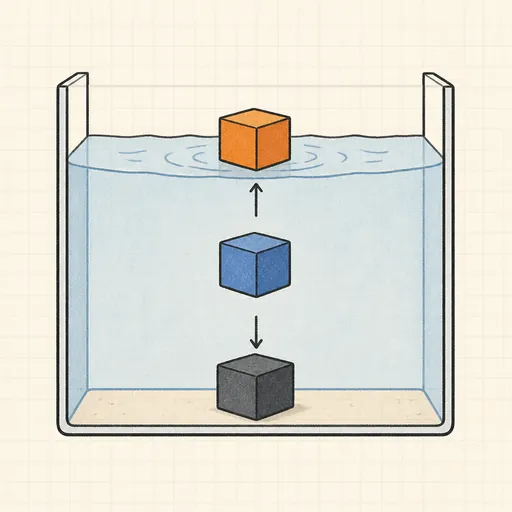
Buoyancy Tank
Drop blocks of different density into water and watch Archimedes decide what floats, sinks or hovers.
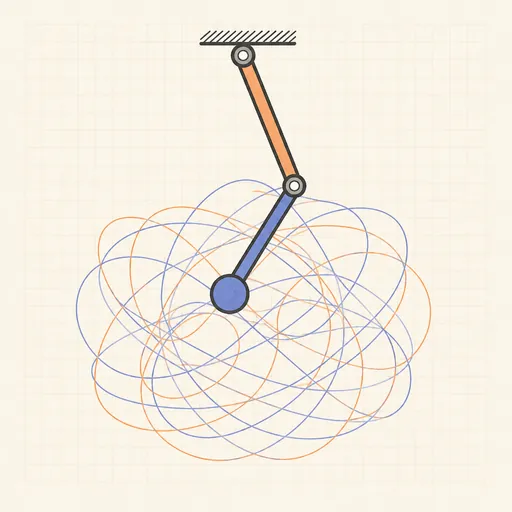
Double Pendulum
Swing a chaotic double pendulum and split it into a rainbow swarm to watch nearby starts diverge.
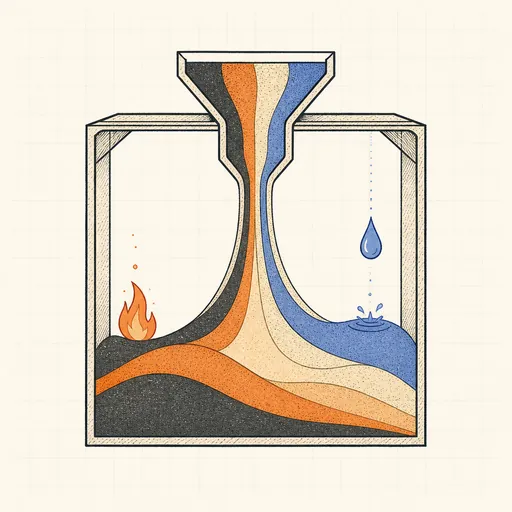
Falling-Sand Playground
Paint sand, water, oil, fire and more and watch them pour, settle, burn and react pixel by pixel.
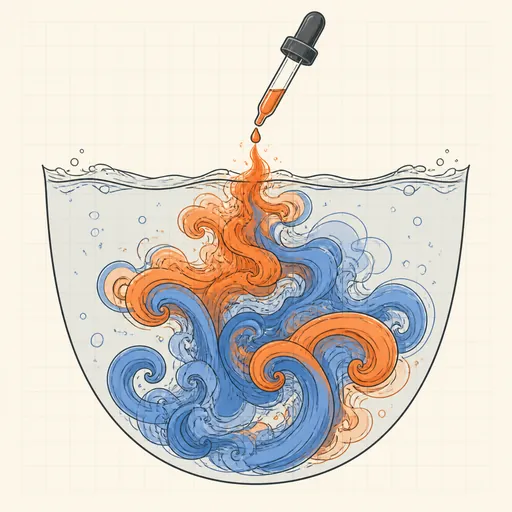
Fluid Flow Simulator
Stir glowing dye through a real-time GPU fluid simulation.
Galaxy Collision Simulator
Smash two spiral galaxies together and watch tidal tails and bridges form.
Hear the Shape of a Drum
Draw any drum and hear its true vibration modes — then meet two different drums that sound exactly the same.