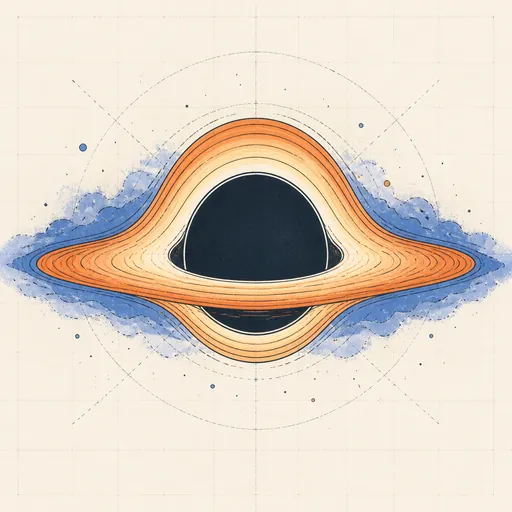
Black Hole Lensing
Every pixel fires a photon backward from the camera and integrates its path through the curved spacetime of a Schwarzschild black hole in a WebGL fragment shader. Light bends around the shadow, so the far side of the thin accretion disk (inner edge 3 rₛ, outer edge 12 rₛ) appears warped over the top and under the bottom of the hole, with a bright photon ring hugging the shadow’s edge. The disk glows white-hot inside and fades to deep orange outside, its turbulent pattern shears with Keplerian rotation as the run plays, and Doppler beaming brightens and blue-tints the side spinning toward you. A procedural starfield lenses around the shadow behind everything. Sliders set the camera inclination, zoom and disk brightness, and the current view exports as a PNG. Requires WebGL.
Runs 100% in your browser — simulations are computed locally on your device.
Read the full guide to this tool
Notes
- Light bending in Schwarzschild geometry follows u″ + u = (3/2) rₛ u² with u = 1/r — twice the Newtonian deflection, the 1.75″ at the Sun’s limb that Eddington’s 1919 eclipse expedition confirmed.
- Photons can orbit at the photon sphere, 1.5 rₛ, producing the photon ring; the shadow they leave has an apparent diameter of √27 ≈ 5.2 rₛ, exactly what the Event Horizon Telescope imaged in M87* in 2019.
- Luminet computed the first realistic picture of a lensed accretion disk in 1979, by hand and plotter; relativistic beaming scales the approaching side’s brightness by roughly the Doppler factor cubed, which is why one wing of the disk always outshines the other.
- Runs 100% in your browser — simulations are computed locally on your device.
Related tools
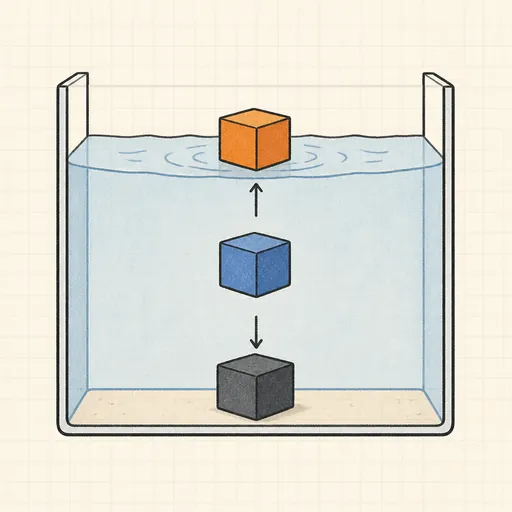
Buoyancy Tank
Drop blocks of different density into water and watch Archimedes decide what floats, sinks or hovers.
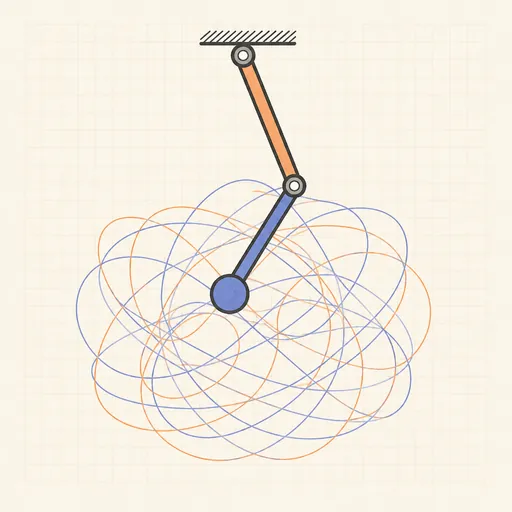
Double Pendulum
Swing a chaotic double pendulum and split it into a rainbow swarm to watch nearby starts diverge.
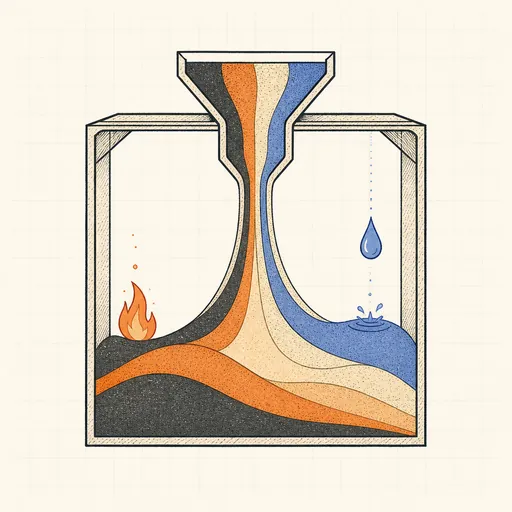
Falling-Sand Playground
Paint sand, water, oil, fire and more and watch them pour, settle, burn and react pixel by pixel.
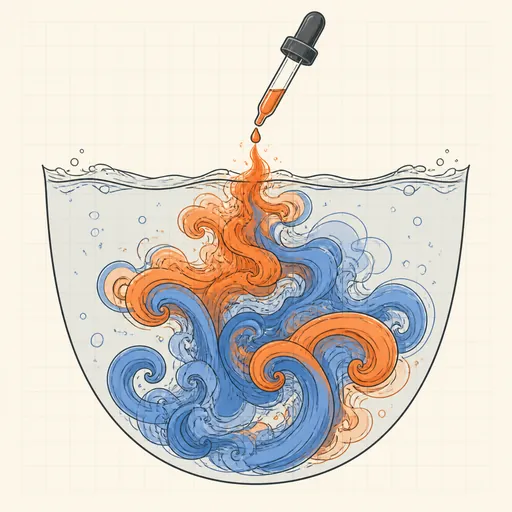
Fluid Flow Simulator
Stir glowing dye through a real-time GPU fluid simulation.
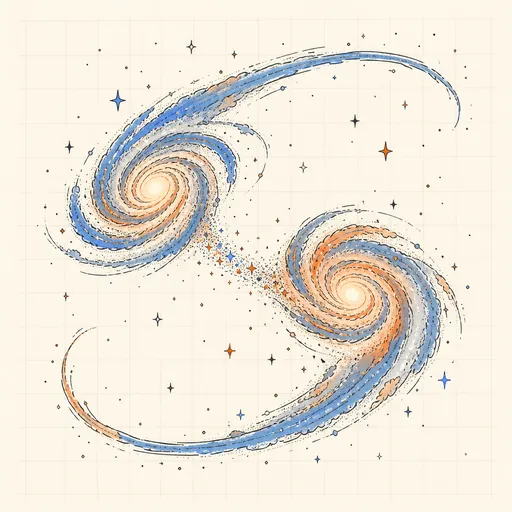
Galaxy Collision Simulator
Smash two spiral galaxies together and watch tidal tails and bridges form.
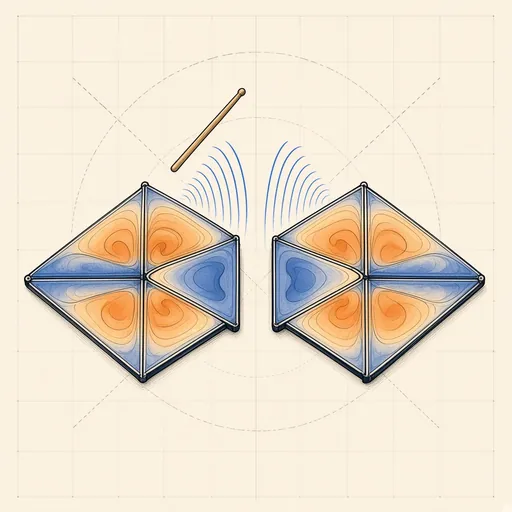
Hear the Shape of a Drum
Draw any drum and hear its true vibration modes — then meet two different drums that sound exactly the same.