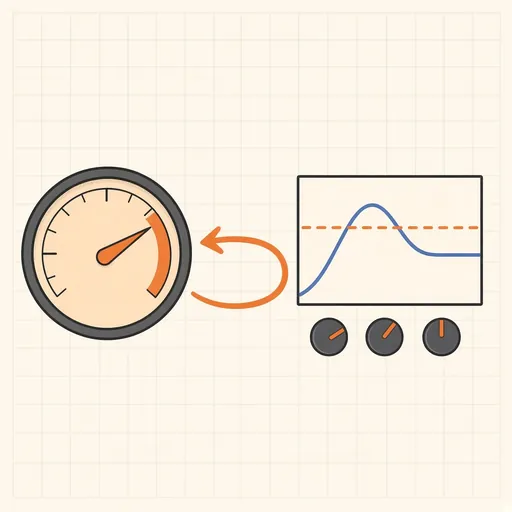
PID Controller Simulator
A PID tuning bench in your browser. Pick a process: cruise control, a water tank, an oven with dead time, a hovering drone or a DC motor. Then drag the proportional, integral and derivative gains and watch the closed loop respond live: setpoint, process variable and controller output on a scrolling chart, with the P, I and D contributions split out. Step the setpoint or hit the plant with a disturbance (a hill, an open oven door, a gust of wind) and read rise time, overshoot, settling time and steady-state error as they happen. Toggle actuator limits, integral anti-windup, derivative filtering and sensor noise to see why real controllers need them, or let the relay auto-tuner find the ultimate gain and apply Ziegler–Nichols settings for you.
Runs 100% in your browser — simulations are computed locally on your device.
Notes
- The controller is the textbook parallel form u = Kp·e + Ki·∫e dt + Kd·de/dt, evaluated every simulation step; the processes are small differential equations integrated with fourth-order Runge–Kutta.
- Proportional gain alone leaves a steady-state error on most processes; the integral term removes it but adds overshoot, and the derivative term damps the swing: the trade-off every tuning rule balances.
- Auto-tune runs an Åström–Hägglund relay experiment to find the ultimate gain Ku and period Tu, then applies the classic Ziegler–Nichols table (Kp = 0.6·Ku, Ti = Tu/2, Td = Tu/8): a starting point that is usually on the aggressive side.
- Runs 100% in your browser — simulations are computed locally on your device.
Related tools
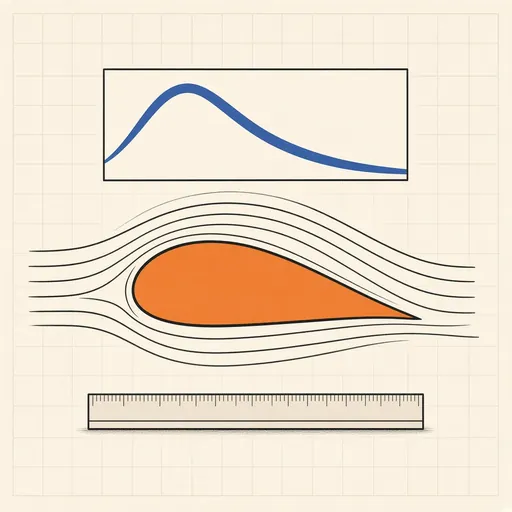
Airfoil Designer & Analyzer
Shape a NACA airfoil, see its pressure distribution and plot lift and drag polars, XFOIL-style, in the browser.
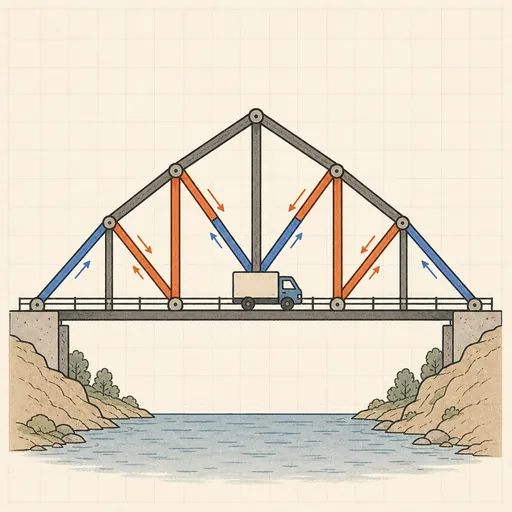
Bridge Builder & Truss Simulator
Design a truss bridge, send a truck across and watch every member strain, buckle or snap under load.
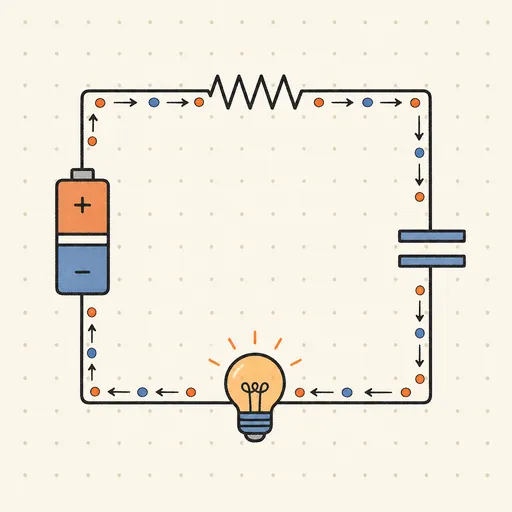
Circuit Simulator
Build analog circuits on a grid and watch current flow live — batteries, resistors, capacitors, LEDs and more.
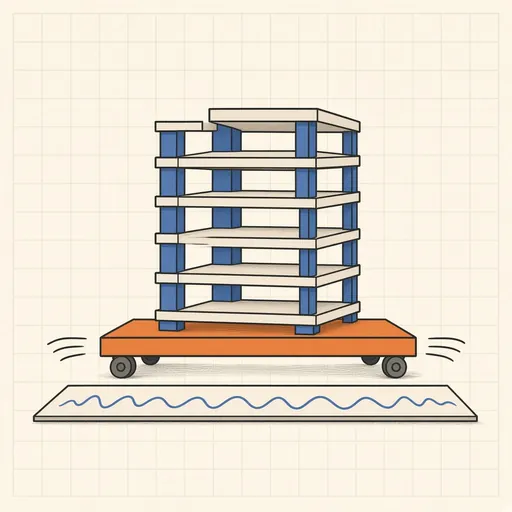
Earthquake Shake Table Simulator
Shake a multi-story building with an earthquake and watch it sway, crack or survive, with base isolation and dampers.
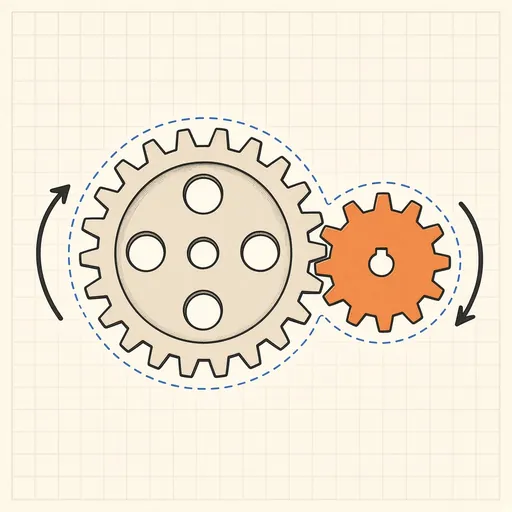
Gear Generator
Design involute spur gears, racks and planetary sets, watch them mesh and export SVG or DXF for laser cutting.
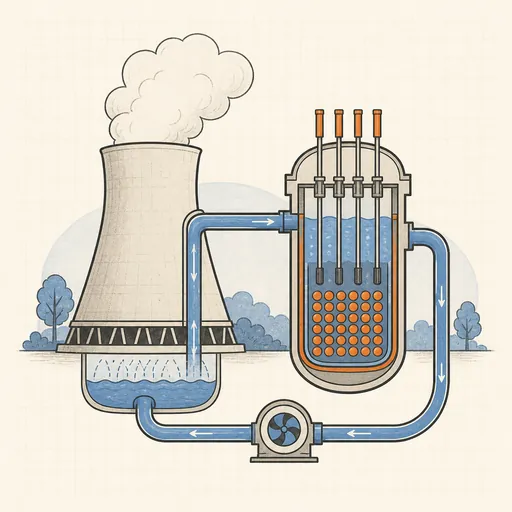
Nuclear Reactor Simulator
Run a pressurized-water reactor: pull control rods, manage xenon and temperature — or SCRAM before it overheats.