The Nuclear Reactor Simulator, Explained
After reading this you can predict how a pressurized-water reactor answers a rod pull, why the core throttles its own power surges, and why xenon-135 can lock you out of a restart for half a day.
What the simulator does and one hook
The Nuclear Reactor Simulator puts you at the controls of a simplified pressurized-water reactor (PWR). You move control rods, the core computes its own physics, and strip charts show power, reactivity, fuel and coolant temperature, and xenon concentration. The physics is not decorative. Power evolves through the point-kinetics equations with six delayed-neutron groups, temperature feeds back through Doppler and moderator coefficients, and xenon-135 builds and decays on its own clock.
Here is the hook. Pull the rods to raise power from 50% to 100%, hold them, and walk away. For the first minute the power climbs as you expect. Then it quietly stops climbing and drifts back down, even though you never touched the rods again. The core cooled itself out of the excursion: hotter fuel absorbed more neutrons. Hours later a second, slower drop arrives from xenon. Nothing in the tool scripts these dips. They fall out of the equations.
When to reach for this model, and when not
Use the simulator to build intuition about timescales. Prompt neutrons live about 10^{-4} seconds, delayed neutrons buy you seconds, Doppler feedback acts in tenths of a second, coolant feedback in tens of seconds, and xenon in hours. Seeing these layered on one screen is the point.
Do not read absolute megawatts, boron concentrations or fuel enrichment off it as engineering truth. The model is point-kinetics, meaning it treats the whole core as a single lumped value with no spatial shape. Real cores have flux tilts, local hot spots and three-dimensional xenon oscillations that a single number cannot represent. Treat every result as qualitative: right shape, right direction, right timescale, approximate magnitude.
This is a teaching model, not a licensing tool. It cannot certify a real reactor, and its numbers are tuned for clarity, not fidelity to any specific plant. Nothing here is operational guidance.
The point-kinetics equations
Reactor power n(t) and six delayed-neutron precursor concentrations C_i(t) obey a coupled set of ordinary differential equations. The power equation is:
Here \rho is reactivity (how far the core is from exactly critical, dimensionless, often quoted in pcm where 1 pcm = 10^{-5}). \beta is the total delayed-neutron fraction, about 0.0065. \Lambda is the prompt neutron generation time, about 2 \times 10^{-5} seconds. Each \lambda_i is a decay constant and C_i the matching precursor population. The precursors evolve by:
The single most important detail is the sign of \rho - \beta. While \rho \lt \beta the fast first term is negative, and power is held together by the slow delayed term. That slowness is what makes the reactor steerable. Push \rho above \beta and the reactor goes prompt critical: the fast term alone sustains growth, and power runs away in milliseconds. Operators work in units where \beta equals one dollar, and they never intend to cross one dollar.
Temperature feedback and xenon
Reactivity is not just the rods. The core adds its own feedback:
The fuel coefficient \alpha_f (Doppler) is negative, roughly -2.5 pcm per kelvin. As fuel heats, absorption resonances in uranium-238 broaden and swallow more neutrons. This acts almost instantly because it depends only on fuel temperature. The moderator coefficient \alpha_c is also negative, roughly -20 pcm per kelvin, but it acts slower because coolant takes time to heat. Both being negative is what makes the core self-stabilizing.
Xenon-135 is a separate story with its own two-step chemistry. Iodine-135 forms in fission and decays to xenon-135, which is a ferocious neutron absorber. Xenon burns off under high flux but keeps being fed by iodine. The pair follow:
Here \phi is neutron flux (proportional to power), \lambda_I \approx 2.9 \times 10^{-5} per second (iodine half-life 6.6 hours), and \lambda_X \approx 2.1 \times 10^{-5} per second (xenon half-life 9.2 hours). After a shutdown \phi falls to zero, so xenon stops burning but iodine keeps feeding it. Xenon peaks near 11 hours later, then decays away.
Reproducing the load-following demo
The demo starts the core critical at 100% power, then a step rod insertion of -150 pcm asks for a power reduction. Watch the reactivity balance settle. Using the feedback coefficients above and a steady-state condition where total \rho = 0, you can predict the new power fraction.
- Start critical: \rho = 0 at 100% power, fuel at
900K, coolant at580K. - Insert rods: \rho_{\text{rods}} = -150 pcm. Power begins to fall.
- As power drops, fuel and coolant cool. Suppose fuel falls by
40K. Doppler returns -2.5 \times (-40) = +100 pcm. - Suppose coolant falls by
2.5K. Moderator returns -20 \times (-2.5) = +50 pcm. - Total feedback +100 + 50 = +150 pcm exactly cancels the rods. The core is critical again at the lower temperature, hence at lower power.
The lesson: the rods do not set power directly. They set a temperature. Power settles wherever the negative coefficients rebuild \rho = 0. Pull -150 pcm and you buy roughly a 40 K fuel drop, which corresponds to about a 20 to 30% power reduction in this model.
Reading the strip charts
The charts scroll left to right. Read them in this order.
- Reactivity
- The driver. Any move in power lags a move here. If reactivity is flat at zero, power is steady. Positive means rising, negative means falling.
- Power
- Responds to reactivity with a delay set by the delayed neutrons. A small positive step gives a fast jump (the prompt jump) then a slow ramp.
- Fuel temperature
- Tracks power closely with a short lag. This is your Doppler feedback made visible.
- Coolant temperature
- Lags fuel by tens of seconds. Watch it approach any alarm line slowly.
- Xenon
- Moves on the hour scale. Ignore it during fast maneuvers, respect it after any large power change.
Judge a rod move by watching reactivity return to zero, not by watching power hit a target. If reactivity keeps drifting after you stop moving rods, feedback or xenon is still working, and power has not settled.
Explore: how one dollar changes everything
The gap between a controllable ramp and a runaway is the delayed fraction \beta. The widget below lets you sweep inserted reactivity across that boundary and watch the response change character.
Common mistakes
Four errors trap most first-time operators.
- Chasing power with rods. You pull to raise power, overshoot, insert to correct, and oscillate. Move rods in small steps and wait for feedback. The core has memory measured in seconds.
- Ignoring the xenon clock. After a shutdown or a large power cut, xenon keeps building for hours. If you try to restart during the peak near hour 11, the rods may not have enough worth to overcome roughly
-5400pcm of xenon. Wait it out. - Over-pulling into xenon. When xenon fights you, the tempting fix is to pull more rods to force power up. That burns xenon fast, its reactivity poison vanishes, and now you have a large positive swing plus fully withdrawn rods. This is the trap that snared Chernobyl.
- SCRAM as a routine tool. A SCRAM drops every rod and shuts you down hard, then guarantees a xenon transient that locks out restart. Use it only when a limit is truly about to break.
Related tools
If watching a lumped system respond to feedback interests you, the Circuit Simulator shows the same idea in electrical form: capacitors and inductors give current its own delay and overshoot. For a different flavor of orbital-scale timing and windows, try the Orbital Mission Planner. To feel negative feedback and failure limits in a mechanical setting, the Bridge Builder & Truss Simulator lets you load members until they buckle.
Frequently asked questions
Why can a reactor not explode like a bomb?
A bomb needs prompt supercriticality with weapons-grade material and a fast assembly. A power reactor runs at low enrichment and depends on delayed neutrons for control. Its strongest feedback, the Doppler coefficient, is negative and instant, so any power spike heats the fuel and removes reactivity within a fraction of a second. Overheating, melting and steam explosions are the real hazards, not nuclear detonation.
What is a dollar of reactivity?
One dollar equals the delayed-neutron fraction \beta \approx 0.0065. Below one dollar the reactor period is seconds and you can steer. At one dollar the prompt neutrons alone sustain the chain and the period collapses to milliseconds. Operators live well below one dollar, typically moving a few cents at a time.
Why does xenon peak after shutdown instead of during operation?
Under power, high neutron flux burns xenon almost as fast as iodine makes it. Shut down and the flux vanishes, so the burn stops but iodine keeps decaying into xenon for hours. Xenon concentration climbs until its own decay overtakes the fading iodine supply, near hour 11, then falls.
Why does power settle below target when I pull rods a fixed amount?
Rods set reactivity, and the negative temperature coefficients then adjust power until total reactivity returns to zero. A -150 pcm insertion is canceled by roughly a 40 K drop in fuel temperature, which corresponds to lower steady power, not the original level.
Is the point-kinetics model realistic?
For timescales and directions, yes. For spatial effects, no. It treats the core as one lumped point, so it cannot show flux tilts or the traveling xenon oscillations that real large cores exhibit. Use it to learn cause and effect, not to predict a specific plant.
Related tools
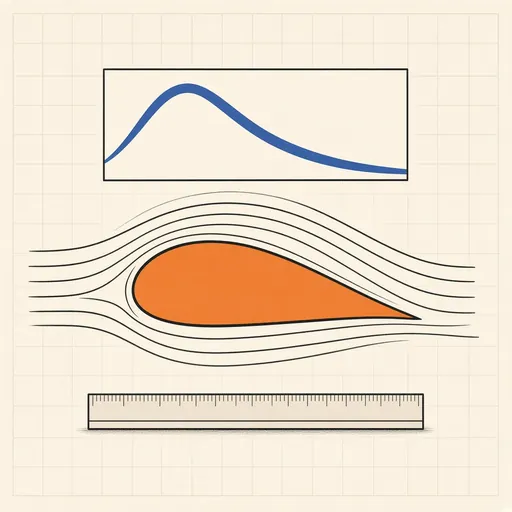
Airfoil Designer & Analyzer
Shape a NACA airfoil, see its pressure distribution and plot lift and drag polars, XFOIL-style, in the browser.

Bottle Rocket Simulator
Fill a soda-bottle water rocket, pump it up and launch it: find the water level, pressure and fins that fly highest.
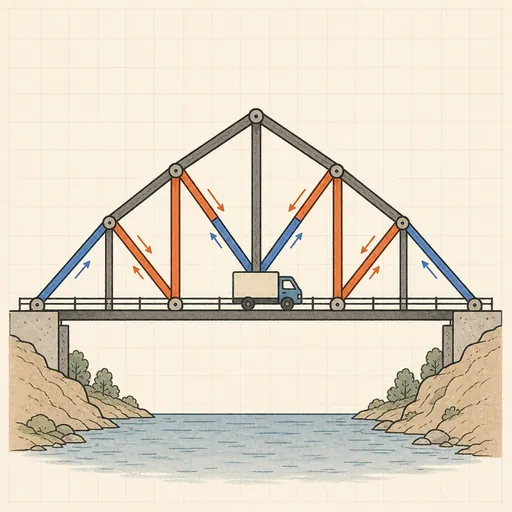
Bridge Builder & Truss Simulator
Design a truss bridge, send a truck across and watch every member strain, buckle or snap under load.
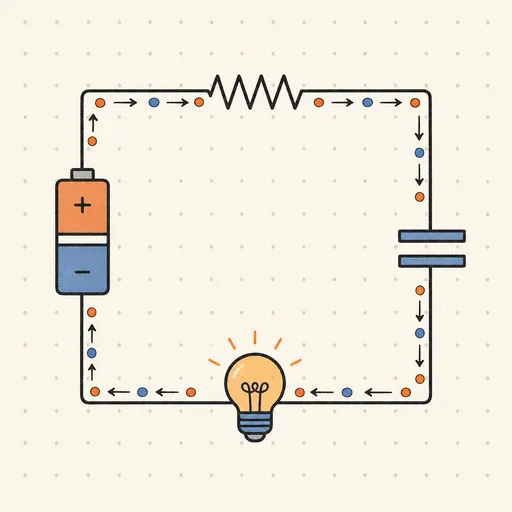
Circuit Simulator
Build analog circuits on a grid and watch current flow live — batteries, resistors, capacitors, LEDs and more.
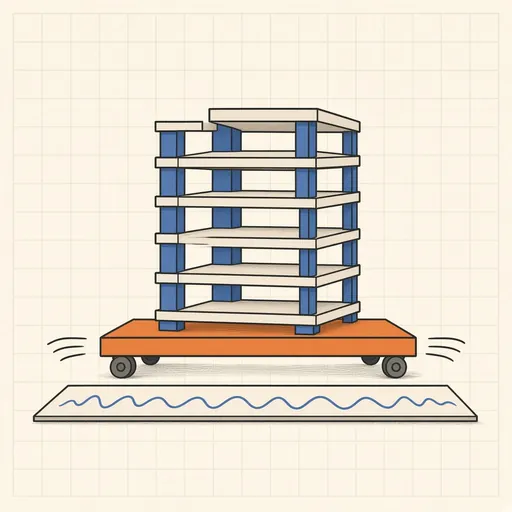
Earthquake Shake Table Simulator
Shake a multi-story building with an earthquake and watch it sway, crack or survive, with base isolation and dampers.
Gear Generator
Design involute spur gears, racks and planetary sets, watch them mesh and export SVG or DXF for laser cutting.