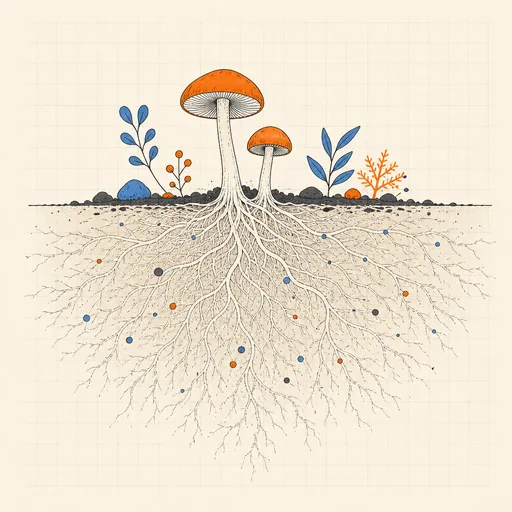
Mycelium Growth
Fungal mycelium, plant roots and leaf veins all solve the same problem — reach every corner of a region with a branching network — and all can be grown with one elegant rule. This tool uses the space-colonization algorithm of Runions, Lane and Prusinkiewicz (2007): scatter a cloud of nutrient attractors through a chosen shape, then grow from a seed node so that every attractor tugs its nearest tip toward it and each tip advances along the average pull of the attractors that can see it. Attractors within reach are absorbed, so the network fills the space and stops. Branches are stroked with a width that swells from pale filament tips to a thick amber trunk, glowing over near-black. Tune the attractor count, growth step, reach and absorb radius, switch between disk, leaf and ring shapes, click to scatter fresh nutrients for the mycelium to chase, and export a PNG.
Runs 100% in your browser — simulations are computed locally on your device.
Read the full guide to this tool
Notes
- The space-colonization algorithm (Runions, Lane & Prusinkiewicz, 2007) was created to model leaf venation and tree crowns: growth is pulled toward unoccupied space by attractors that are consumed once reached, yielding realistic, non-overlapping branching.
- Real fungi forage the same way — hyphae extend at their tips and branch, reinforcing routes that reach food and abandoning barren ones, building the vast underground networks (the "wood-wide web") that link plant roots.
- Branch thickness here follows vein order: summing the number of descendants back to the root and tapering by that count mirrors how real transport networks obey Murray’s law, with parent conduits sized to carry all their children.
- Runs 100% in your browser — simulations are computed locally on your device.
Related tools
Boids Flocking Simulator
Watch lifelike flocking emerge from three local rules with Reynolds’ boids model.
Lenia Continuous Life
Grow smooth self-organising lifeforms like the gliding Orbium in a continuous cellular automaton.
Particle Life
A few coloured species and one table of likes and dislikes — and cells, chains and chasing creatures emerge by themselves.
Slime Mould Networks
Watch millions of Physarum agents self-organise into living transport networks.
Ant Colony Pheromone Trails
Watch ants self-organise foraging highways with evaporating pheromone trails.
Evolving Creatures
See natural selection reshape a population of foraging creatures generation by generation.