Evolving Creatures
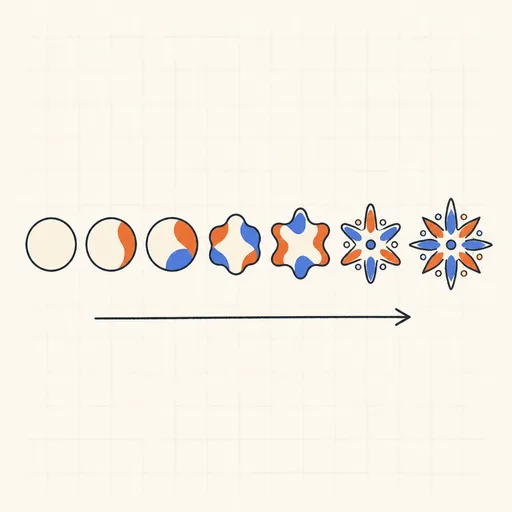
Give creatures a genome, a world with food and an energy budget, and evolution follows on its own. Each creature carries genes for maximum speed, body size, sense radius, colour, metabolism and a reproduction threshold. They wander, steer toward the nearest food they can sense, eat to gain energy and spend energy to move — bigger and faster bodies cost more, the central trade-off. Cross the reproduction threshold and a creature splits, passing on a mutated genome; run out of energy and it dies. No fitness function is imposed: whoever gathers energy fastest simply leaves more offspring, and the population’s colours and sizes visibly shift to fit the conditions. Drag the food regrow rate, mutation rate, starting population and world harshness, and watch rolling plots of population, average speed and average size track the trends while the generation and averages read out live.
Runs 100% in your browser — simulations are computed locally on your device.
Read the full guide to this tool
Notes
- Darwinian natural selection needs only three ingredients, all present here: heritable variation (mutated genomes), differential survival and reproduction, and finite resources — no goal or fitness score is coded in.
- The core trade-off is metabolic: larger, faster creatures reach food sooner but burn energy faster, so the winning body plan tracks how abundant and how costly the environment is — echoing r- versus K-selection in ecology.
- Mutation refreshes variation every generation while selection removes the least fit, so mean traits drift over many generations toward the resource environment — a reminder that evolution is a population-level statistical outcome, not a change in any single individual.
- Runs 100% in your browser — simulations are computed locally on your device.
Related tools
Boids Flocking Simulator
Watch lifelike flocking emerge from three local rules with Reynolds’ boids model.
Lenia Continuous Life
Grow smooth self-organising lifeforms like the gliding Orbium in a continuous cellular automaton.
Particle Life
A few coloured species and one table of likes and dislikes — and cells, chains and chasing creatures emerge by themselves.
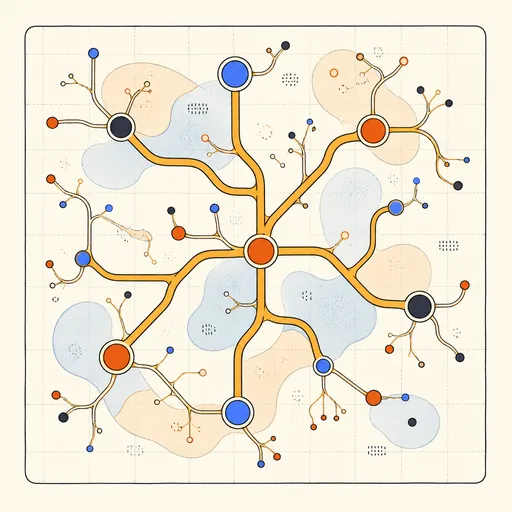
Slime Mould Networks
Watch millions of Physarum agents self-organise into living transport networks.
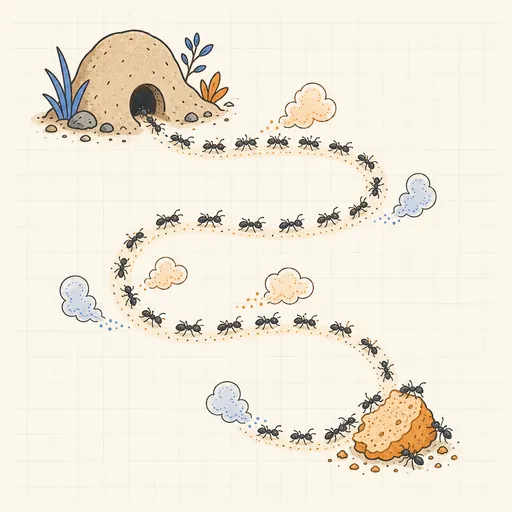
Ant Colony Pheromone Trails
Watch ants self-organise foraging highways with evaporating pheromone trails.
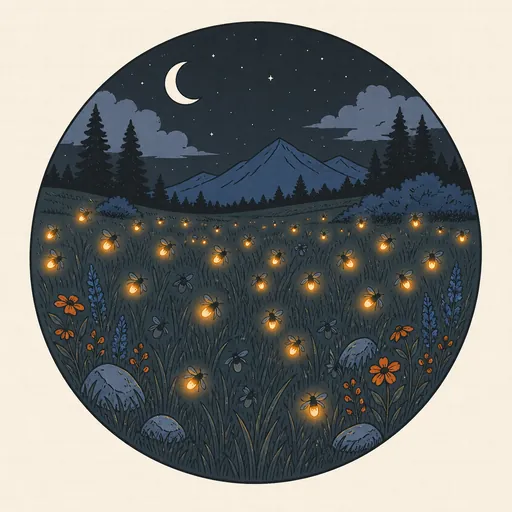
Firefly Synchronization
See a meadow of fireflies fall into spontaneous unison as pulse-coupled oscillators.