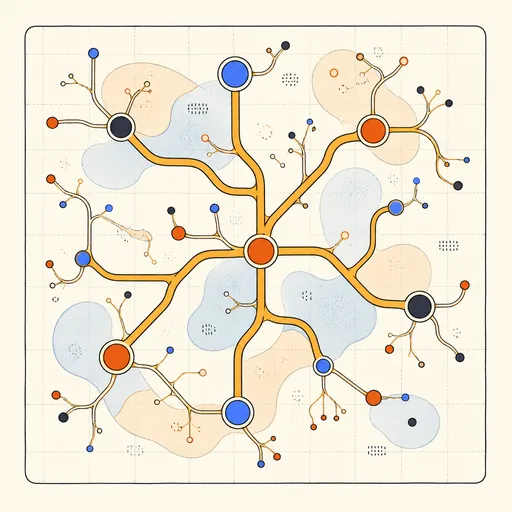
Slime Mould Networks
Physarum polycephalum, an acellular slime mould, grows efficient nutrient-transport networks with no brain and no plan. This tool runs Jeff Jones’ 2010 multi-agent model: over a hundred thousand particles crawl across a chemical trail map, each one sniffing the trail at three forward sensors, turning toward the strongest scent, stepping ahead and depositing a little trail of its own. Every tick the trail map is blurred and evaporated, so faint wandering firms up into sharp glowing veins that endlessly reconnect and prune. Drag the sensor angle and distance, turn speed, deposit amount and evaporation to shift the emergent patterns between fine mesh, bold arteries and restless reorganisation, and pick from three glow palettes. Click or drag to drop a bright attractant blob that the swarm rushes toward, reseed the agents as a ring or a random cloud, and export any frame as a PNG.
Runs 100% in your browser — simulations are computed locally on your device.
Read the full guide to this tool
Notes
- Jones’ 2010 agent model needs only local rules: each particle senses the trail at three points, steers toward the strongest, moves and deposits, while the shared trail map diffuses and decays — and transport networks emerge with no central control.
- Real Physarum solves real problems: Nakagawa’s group showed it finds the shortest path through a maze (2000), and Tero et al. (Science, 2010) grew it on a map of Tokyo where it reproduced the rail network’s efficiency and fault tolerance.
- The balance between deposition and evaporation-plus-diffusion sets everything: too little decay and the map saturates into a blob, too much and trails never build — the same stigmergic feedback that guides ant colonies.
- Runs 100% in your browser — simulations are computed locally on your device.
Related tools
Boids Flocking Simulator
Watch lifelike flocking emerge from three local rules with Reynolds’ boids model.
Lenia Continuous Life
Grow smooth self-organising lifeforms like the gliding Orbium in a continuous cellular automaton.
Particle Life
A few coloured species and one table of likes and dislikes — and cells, chains and chasing creatures emerge by themselves.
Ant Colony Pheromone Trails
Watch ants self-organise foraging highways with evaporating pheromone trails.
Evolving Creatures
See natural selection reshape a population of foraging creatures generation by generation.
Firefly Synchronization
See a meadow of fireflies fall into spontaneous unison as pulse-coupled oscillators.