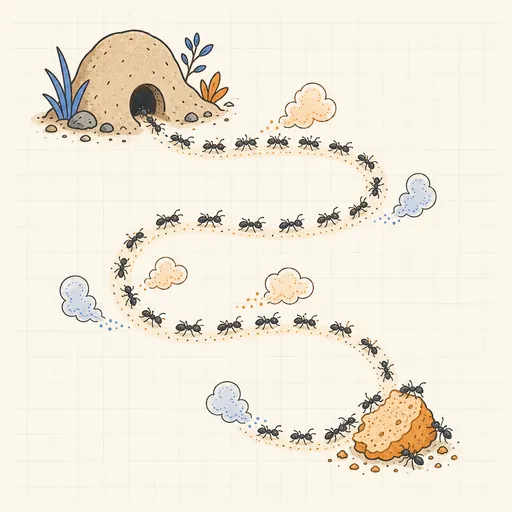
Ant Colony Pheromone Trails
Ants find food without a map or a boss by talking through the ground itself: each one lays a chemical pheromone the others can smell and follow. This colony keeps two scent fields on a grid — a "to-home" trail dropped by ants that are searching and a "to-food" trail dropped by ants carrying food back to the central nest. Every ant reads three forward sensors, steers up whichever gradient it needs, and wanders with a little momentum, while the trails slowly evaporate and blur. Click or drag to drop new food blobs, and switch the paint mode to lay down obstacles or erase them. The pheromone fields glow teal and amber over the dark earth, ants carrying food are tinted amber, and food piles shrink as they are eaten. Tune the ant count, evaporation rate, deposit amount and sensor angle and watch faint wandering firm up into sharp foraging highways, then fade once the food runs out.
Runs 100% in your browser — simulations are computed locally on your device.
Read the full guide to this tool
Notes
- The mechanism is stigmergy, named by Pierre-Paul Grassé in 1959: individuals coordinate not by talking to each other but by leaving traces in a shared environment that change how others behave.
- Deneubourg and Goss’ double-bridge experiments showed that positive feedback — more ants on a path means more pheromone means still more ants — lets a colony converge on the shortest route to food.
- Evaporation is essential, not a nuisance: it erases stale trails so the colony can abandon exhausted food and reroute, and the deposit-versus-evaporation balance decides whether trails sharpen or dissolve.
- Runs 100% in your browser — simulations are computed locally on your device.
Related tools
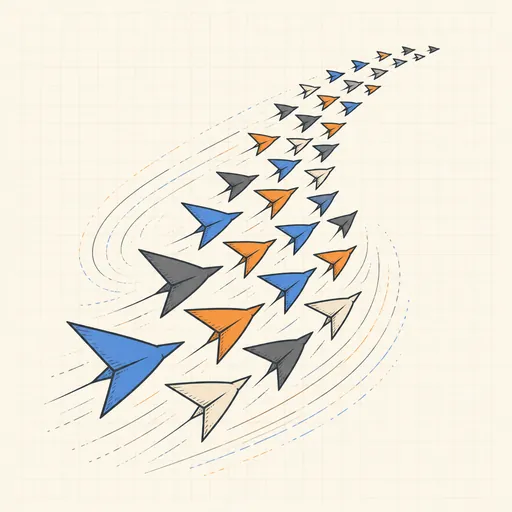
Boids Flocking Simulator
Watch lifelike flocking emerge from three local rules with Reynolds’ boids model.
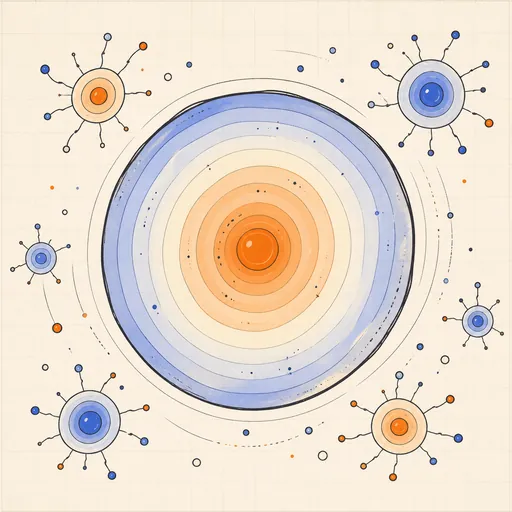
Lenia Continuous Life
Grow smooth self-organising lifeforms like the gliding Orbium in a continuous cellular automaton.
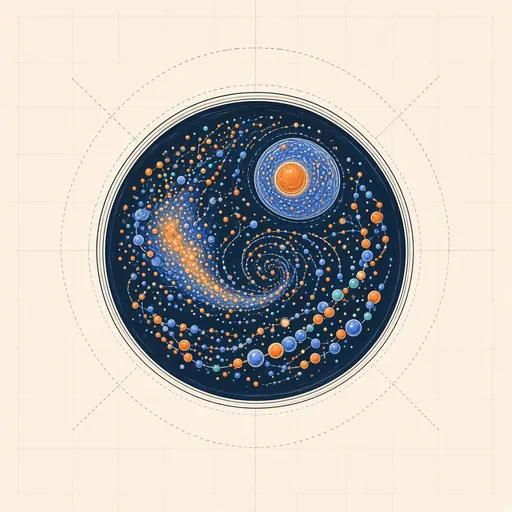
Particle Life
A few coloured species and one table of likes and dislikes — and cells, chains and chasing creatures emerge by themselves.
Slime Mould Networks
Watch millions of Physarum agents self-organise into living transport networks.
Evolving Creatures
See natural selection reshape a population of foraging creatures generation by generation.
Firefly Synchronization
See a meadow of fireflies fall into spontaneous unison as pulse-coupled oscillators.