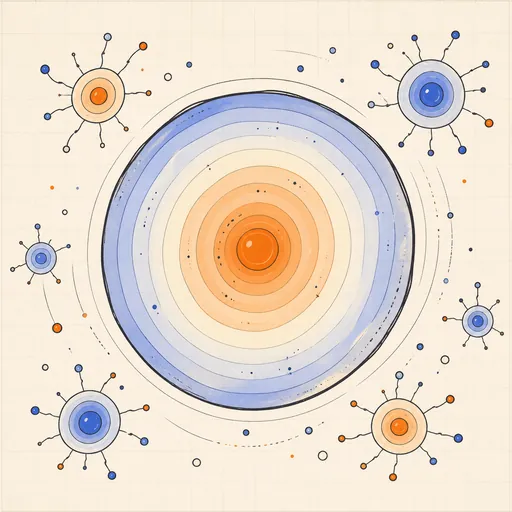
Lenia Continuous Life
Lenia, devised by Bert Chan in 2019, is Conway’s Game of Life set free into continuous space, time and state. Instead of live-or-dead cells, a smooth field takes any value from 0 to 1; instead of counting eight neighbours, each cell convolves the field with a soft ring-shaped kernel to measure its surroundings, and a bell-shaped growth function nudges the value up or down by a small time step. From this recipe emerge astonishingly organism-like patterns that pulse, rotate and swim. Load the canonical Orbium glider and watch it self-propel across the grid, paint your own smooth blobs of matter, or seed continuous noise and see what crystallises. Sliders control the growth centre μ, growth width σ, kernel radius R and the time step; a teal-to-gold glow renders the field and the total population is reported live. Export any frame as a PNG.
Runs 100% in your browser — simulations are computed locally on your device.
Read the full guide to this tool
Notes
- Lenia generalises the Game of Life to continuous values, space and time (Bert Chan, 2019): the next state is the current field plus a small step of a Gaussian growth mapping applied to a kernel convolution, G(u) = 2·exp(−(u−μ)²/2σ²) − 1.
- The Orbium is Lenia’s emblematic glider — a smooth, self-propelling soliton found at μ = 0.15, σ = 0.017, R = 13 — one of hundreds of stable lifeforms Chan and others have catalogued across the parameter space.
- Tiny changes to μ, σ or the kernel radius bifurcate the dynamics between patterns that dissolve to nothing, settle into still shapes, or lock into moving and rotating creatures — the same edge-of-chaos richness that makes the discrete Game of Life so surprising.
- Runs 100% in your browser — simulations are computed locally on your device.
Related tools
Boids Flocking Simulator
Watch lifelike flocking emerge from three local rules with Reynolds’ boids model.
Particle Life
A few coloured species and one table of likes and dislikes — and cells, chains and chasing creatures emerge by themselves.
Slime Mould Networks
Watch millions of Physarum agents self-organise into living transport networks.
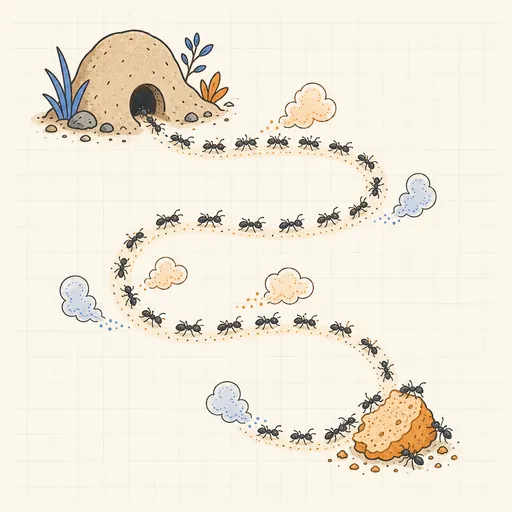
Ant Colony Pheromone Trails
Watch ants self-organise foraging highways with evaporating pheromone trails.
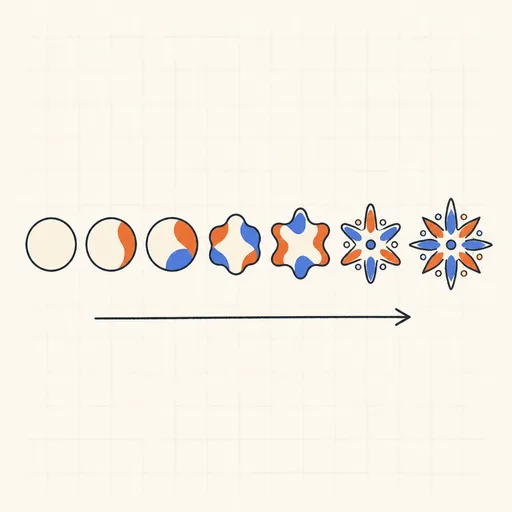
Evolving Creatures
See natural selection reshape a population of foraging creatures generation by generation.
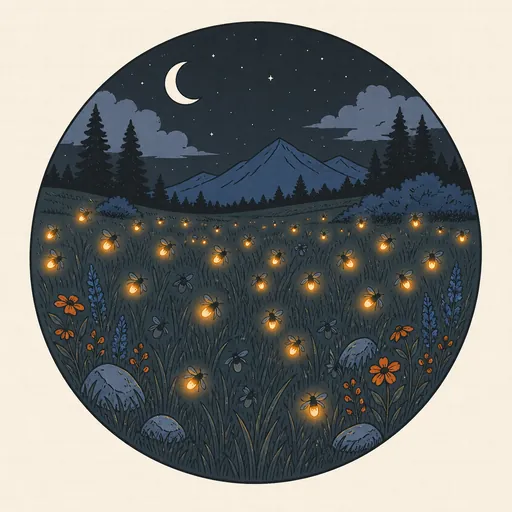
Firefly Synchronization
See a meadow of fireflies fall into spontaneous unison as pulse-coupled oscillators.