The Orbital Mission Planner, Explained
After reading this you can read a porkchop plot, understand the Lambert-solved transfer arc behind it, and estimate the total \Delta v of an interplanetary mission from first principles.
What the planner does and one example
An interplanetary transfer is a coasting arc that leaves one planet's orbit and arrives at another. The planner treats the Sun as the only gravitating body during the coast. It picks a departure date and an arrival date, computes where each planet sits on those dates, then solves for the single elliptical orbit that connects the two positions in exactly the flight time you chose. That orbit costs a certain velocity change to enter and another to match the target planet at arrival. Sum the two and you get the mission's heliocentric \Delta v.
Do that for a grid of departure and arrival dates and you get a contour map. Low-cost windows show up as nested closed loops that look like a pork chop, which is where the name comes from. For an Earth to Mars trip, the cheapest window recurs about every 26 months. That gap is the synodic period, the time for the two planets to return to the same relative geometry.
Every point on the plot is a full solution to Lambert's problem, not an interpolation. Click one and the solar system view flies that exact arc using the same numbers the contour used.
When to use it, and when not
Use the planner to build intuition about launch windows, transfer times, and the trade between waiting for a good date versus paying more fuel to leave early. It is honest about the shape of the cost surface, the phase angle needed at departure, and how far a real window sits from the ideal minimum.
Do not use it as a flight-ready trajectory. Three effects are left out. First, the burns reported are heliocentric only: they ignore the cost of climbing out of the departure planet's gravity well and the cost of capturing into orbit at the destination. Second, the coast is a two-body Sun arc, so no gravity assists, no perturbations from other planets, and no solar radiation pressure. Third, the planet positions come from approximate J2000 elements, accurate to a fraction of a degree over a few decades but not to the arcsecond a real navigation team needs.
The math: Lambert's problem and the burns
Start with the transfer arc. You know the Sun-relative position of the origin planet at departure, call it \vec{r}_1, and the position of the target at arrival, \vec{r}_2. You know the flight time t_f. Lambert's problem asks for the two velocity vectors, at each end, of the unique conic connecting \vec{r}_1 to \vec{r}_2 in that time.
This is the universal-variables form the solver iterates. Here \mu = 1.327 \times 10^{11}\ \text{km}^3/\text{s}^2 is the Sun's gravitational parameter, z is the iteration variable (positive for an elliptical arc), S(z) is a Stumpff function, A depends on the two radii and the swept angle, and y(z) folds those together. The solver adjusts z until the right side equals the known left side, then reads off the departure and arrival velocities.
Once you have the transfer velocity at each end, the burns are simple vector differences against the planets' own orbital velocities:
The first term is the departure injection: how much you must change Earth's heliocentric velocity to be on the transfer orbit. The second is the arrival burn: how much you must change again to match the target planet. The porkchop plot contours this sum.
A worked example: Earth to Mars
The demo defaults fly Earth to Mars near a favorable window. Work the ideal case first so you have a number to compare against.
The Hohmann baseline
A Hohmann transfer is the cheapest two-burn ellipse between two circular coplanar orbits. Its perihelion touches Earth's orbit at r_1 = 1.496 \times 10^8\ \text{km} and its aphelion touches Mars at r_2 = 2.279 \times 10^8\ \text{km}.
- Semimajor axis of the transfer: a = (r_1 + r_2)/2 = 1.888 \times 10^8\ \text{km}.
- Earth's circular speed: v_1 = \sqrt{\mu/r_1} = 29.78\ \text{km/s}.
- Speed needed at perihelion of the transfer: v_p = \sqrt{\mu(2/r_1 - 1/a)} = 32.73\ \text{km/s}. Departure burn \Delta v_1 = 2.95\ \text{km/s}.
- Mars's circular speed: v_2 = \sqrt{\mu/r_2} = 24.13\ \text{km/s}.
- Speed at aphelion of the transfer: v_a = \sqrt{\mu(2/r_2 - 1/a)} = 21.48\ \text{km/s}. Arrival burn \Delta v_2 = 2.65\ \text{km/s}.
- Total heliocentric \Delta v = 5.60\ \text{km/s}. Transfer time is half the period of the ellipse: t_f = \pi\sqrt{a^3/\mu} \approx 259 days.
A real Lambert solution on the actual J2000 orbits lands close to this in the best window, near 5.6 to 6.0 km/s, higher because Mars's orbit is eccentric and inclined, so the geometry is never a perfect Hohmann.
Reading the porkchop plot
The plot has departure date on one axis and arrival date on the other. Contour lines join equal-\Delta v missions. The nested loops mark a window: the innermost loop is the cheapest set of date pairs. Diagonal bands running lower-left to upper-right are lines of constant flight time, because moving both dates together keeps the coast duration fixed.
Two shapes matter. The center of the innermost loop is the optimal launch. The width of the outer loops tells you how forgiving the window is: a wide loop means you can slip your departure by weeks and pay little, a tight loop means the window is unforgiving. For Earth to Mars the favorable windows are wide, tens of days, which is why every window is used.
Watch the phase angle the planner reports. For an Earth to Mars Hohmann, Mars must lead Earth by about 44 degrees at departure so it arrives at the aphelion point just as your spacecraft does. If the phase is far from this, no flight time will be cheap.
Explore the transfer angle yourself
The single idea a static plot hides is how the departure phase angle reshapes the whole cost surface. When the planets are badly phased, the cheapest possible transfer is still expensive. Move the phase and watch the minimum \Delta v rise and fall.
Common mistakes
The most frequent error is reading the heliocentric \Delta v as the fuel a rocket needs. It is not. A launch from low Earth orbit adds a large departure cost through the Oberth effect, and capture at Mars adds more. A crewed Mars mission's real \Delta v from the launch pad runs far above the 5.6 km/s heliocentric figure.
A second mistake is chasing the shortest trip. Short flight times look attractive but the cost climbs steeply. Cutting the Earth to Mars coast from 259 days to 180 days raises the total from about 5.6 to 7.4 km/s, a 32 percent penalty for a 30 percent time saving.
A third is ignoring the window rhythm. If you miss a favorable date pair, the next comparable window is roughly a synodic period away. For Earth and Mars that is about 780 days, so a missed window is a two-year wait, not a two-week one.
Related tools on this site
If you like watching physical models run from first principles, three neighbors use the same approach. The Nuclear Reactor Simulator integrates neutron and xenon dynamics in real time. The Bridge Builder & Truss Simulator solves the static force balance in every member as a truck crosses. The Circuit Simulator steps a network of components and shows current flowing on a grid.
Frequently asked questions
Why is the porkchop plot shaped like two blobs?
Lambert's problem has two families of solutions: a short-way arc that sweeps less than 180 degrees and a long-way arc that sweeps more. Each family produces its own cost basin, so a full plot often shows two low regions side by side. The planner picks the cheaper family at each date pair.
Why does my clicked mission cost more than the Hohmann baseline?
The Hohmann number assumes both orbits are circular and in the same plane. Mars's orbit has an eccentricity of about 0.093 and an inclination near 1.85 degrees to the ecliptic. Matching a tilted, elliptical target always costs a little more than the idealized minimum, typically a few tenths of a km/s.
What is the phase angle the planner reports?
It is the angle, measured at the Sun, between the origin planet at departure and the destination planet at arrival, or the required lead of the destination at launch. It tells you whether the planets are arranged so the transfer arc actually reaches the target.
How accurate are the launch dates?
The J2000 Keplerian elements with secular rates place the planets to within a fraction of a degree over the coming decades. That is good enough to land windows on realistic calendar dates and to reproduce the 26-month Earth to Mars rhythm, but not good enough for actual navigation.
Can I plan a mission with a gravity assist?
No. The coast is a single two-body arc around the Sun. A gravity assist requires modeling a close flyby of a third body, which changes the spacecraft's heliocentric velocity for free. That is outside what this planner computes.
Related tools
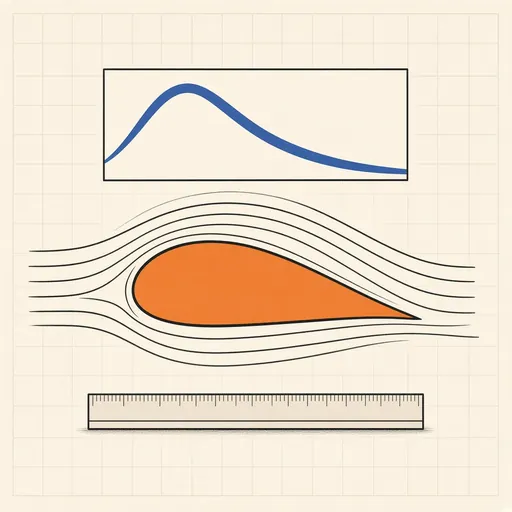
Airfoil Designer & Analyzer
Shape a NACA airfoil, see its pressure distribution and plot lift and drag polars, XFOIL-style, in the browser.
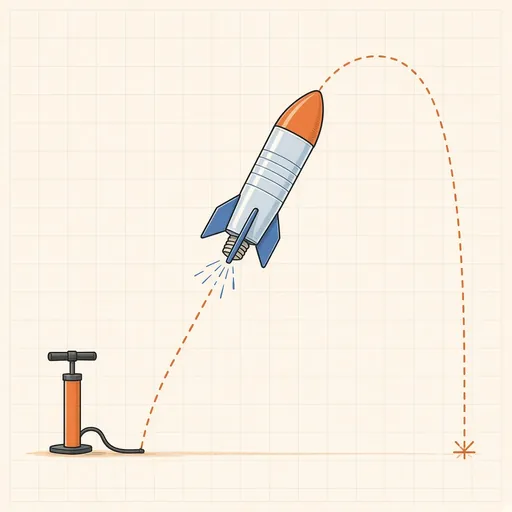
Bottle Rocket Simulator
Fill a soda-bottle water rocket, pump it up and launch it: find the water level, pressure and fins that fly highest.
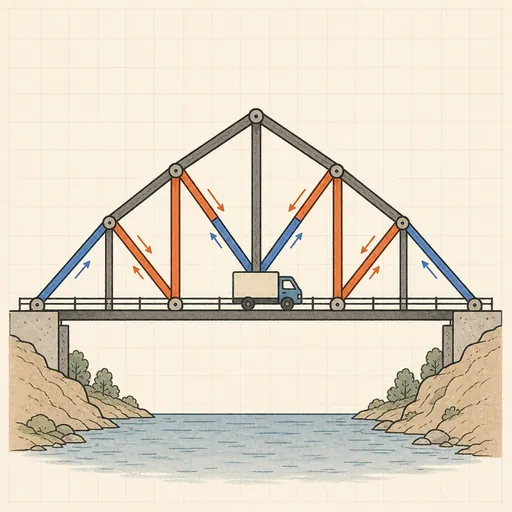
Bridge Builder & Truss Simulator
Design a truss bridge, send a truck across and watch every member strain, buckle or snap under load.
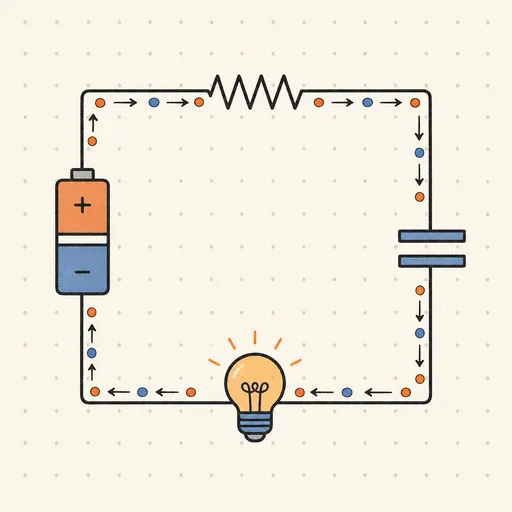
Circuit Simulator
Build analog circuits on a grid and watch current flow live — batteries, resistors, capacitors, LEDs and more.
Earthquake Shake Table Simulator
Shake a multi-story building with an earthquake and watch it sway, crack or survive, with base isolation and dampers.
Gear Generator
Design involute spur gears, racks and planetary sets, watch them mesh and export SVG or DXF for laser cutting.