Bicycle Stability, Explained
After reading this you will understand why a riderless bicycle can balance itself, how lean and steer couple through the benchmark equations, and how to read the self-stable speed window that this simulator computes.
What self-stability is, and the hook
Roll a bicycle without a rider up to about jogging speed, let go, and shove it sideways. It does not fall. The front wheel flicks toward the direction of the fall, the bike carves a shallow arc, and the lean straightens out. That recovery happens with no rider and no motor. The machine steers into its own fall and catches itself.
This is not a trick of one special frame. It is a property of the coupled motion of two angles: how far the frame leans from vertical, and how far the front assembly is steered. When speed, geometry and mass distribution line up, the coupled system is stable. Push it off balance and it returns to upright travel. The simulator integrates the standard equations that describe this, watches the bike from behind and above, and reports the range of speeds where the balance works.
The claim to test is concrete. For the reference bicycle in this model, the self-stable window runs from roughly 4.3 to 6.0 m/s. Below 4.3 the bike wobbles itself over. Above 6.0 it slowly leans down. In between, it recovers on its own.
When the model applies, and when it does not
Use this model to reason about balance and steering at small angles. It is the right tool for questions like "does trail help stability?", "what does removing the gyroscopic effect do?", and "why must you steer right to turn left?". It gives numbers you can check.
Do not use it as a motorcycle or a real ride simulator. The equations are linearized, so they only hold for small lean and steer, a few degrees at most. The wheels are knife edges rolling without slip, so there is no tyre grip limit and no skid. There is no rider adding control torque, no frame flex, and no air drag. The steer angles you see are drawn larger than life so the motion is visible.
A stable bike here does not mean a rideable bike. Self-stability is measured for a hands-off machine and small disturbances. A real rider adds active control that can stabilize a bike far outside this window, or destabilize one inside it.
The benchmark equations
The Whipple benchmark bicycle (Meijaard, Papadopoulos, Ruina and Schwab, 2007) reduces to two degrees of freedom: the lean angle \phi of the rear frame and the steer angle \delta of the front assembly. The linearized motion obeys one matrix equation.
Here q = [\phi, \delta]^T is the pair of angles. M is the mass matrix (inertia). C_1 collects the gyroscopic and steer-rate coupling, and it is multiplied by forward speed v. The stiffness splits in two: K_0 is scaled by gravity g and carries the toppling effect, while K_2 is scaled by v^2 and carries the self-righting effect that grows with speed. Every matrix is 2 by 2 and fixed by the geometry and mass of the bike.
The two facts to hold onto: the destabilizing term (g K_0) is constant, while the stabilizing term (v^2 K_2) grows as the square of speed. That competition is why a slow bike falls and a faster one can catch itself. The gyroscopic term (v C_1) grows linearly and helps steer the front end into the fall.
To find stability at a given speed, assume a solution of the form q = q_0 e^{\lambda t}. Substituting turns the differential equation into a polynomial in \lambda. The bike is stable when every root \lambda has a negative real part, so every disturbance decays. If any root has a positive real part, that mode grows and the bike falls.
Reading the eigenvalues
Each root \lambda = \sigma + i \omega describes one motion. The real part \sigma sets growth or decay: negative means the disturbance shrinks. The imaginary part \omega sets oscillation: nonzero means the bike wobbles as it recovers or falls.
Two named modes matter.
- Weave
- An oscillating side-to-side wobble, a complex pair of roots. At low speed its real part is positive (growing wobble). The weave speed is where that real part crosses zero and the wobble starts to decay.
- Capsize
- A slow, non-oscillating lean-over, a single real root. At high speed this root turns positive and the bike leans down gently. The capsize speed is where it crosses zero.
The self-stable window is the speed band where the weave has settled down but the capsize has not yet set in, so every root has a negative real part at once. The simulator finds this band with a Routh-Hurwitz test, which checks the sign of the real parts from the polynomial coefficients directly, without solving for the roots.
A worked example with the default bike
Tracing the benchmark window
Load the tool with its defaults (press the demo button) and read the stability scan. The defaults use the benchmark geometry, trail near 0.08 m, a nominal centre-of-mass height, and the gyroscopic effect switched on. Follow the logic step by step.
- At
v = 2m/s the stabilizing term scales as v^2 = 4, small next to the toppling term. The weave real part is about+1.3per second, so a wobble grows. The bike falls. This matches the chart above. - At
v = 4.3m/s, v^2 \approx 18.5. The weave real part has just crossed to negative. This is the weave speed, the lower edge of the window. - At
v = 5m/s the least stable root sits near-0.28per second. A disturbance shrinks by a factor e^{-0.28} \approx 0.756 each second. After4seconds it is down to e^{-1.12} \approx 0.326 of its start. The bike is comfortably self-stable. - At
v = 6.0m/s the capsize root reaches zero. This is the capsize speed, the upper edge. - Above
6.0m/s the capsize root is positive but tiny, near+0.1per second at6.5m/s. The lean grows slowly: a factor e^{0.1} \approx 1.105 per second, so it takes several seconds to visibly lean over.
The window between steps 2 and 4, from 4.3 to 6.0 m/s, is the self-stable band the readout reports.
Countersteering, seen in the sign of lean
Press the handlebar-nudge button while the bike rolls in the window. A brief steer torque to the right does something that surprises many people: the bike first leans left, then curves left. To go left you begin by steering right.
The mechanism is direct. Steering the front wheel right makes the contact patches track right, moving the support out from under the centre of mass to the right. The bike falls left. Once it is leaning left, the same coupling that gives self-stability steers the front wheel back to the left, and the bike carves a left turn that holds the lean. The strip chart shows this cleanly: the steer angle spikes positive (right) while the lean angle goes negative (left). The two have opposite signs during the transient.
This is not a quirk of bicycles. Any single-track vehicle turns this way. Motorcyclists are taught countersteering explicitly. The reason you rarely notice it on a bicycle is that at low speed the effect is small and your hands do it without conscious thought.
Common mistakes when interpreting the model
The first mistake is believing the gyroscope alone holds the bike up. It helps, but it is not required. The nudge experiment and the 2011 Science paper by Kooijman and coauthors both show that a bike with the gyroscopic effect cancelled can still self-stabilize if the mass distribution and trail are chosen well. Toggle the gyroscopic effect off in the tool: the weave speed shifts, but a stable window can survive.
The second mistake is reading large angles from the display literally. The steer angles are exaggerated for visibility, and the equations are only valid for small angles anyway. Treat the picture as a qualitative guide to the sign and timing of the motion, not a measurement of degrees.
The third mistake is expecting a single "stable speed". Stability is a band, not a point. There is a weave speed at the bottom and a capsize speed at the top, and both move when you change trail or mass height. A bike stable at 5 m/s can be unstable at both 3 and 7 m/s.
The fourth mistake is treating the capsize instability as dangerous. Above the window the capsize root is small, around +0.1 per second. The lean grows so slowly that a rider corrects it without noticing. This is why fast riding feels stable even though the hands-off model calls it unstable.
Related simulations
If the eigenvalue view of stability interests you, the Double Pendulum shows the opposite case: a system whose nearby starts diverge instead of converging. For the gyroscopic torque that helps steer the front wheel into the fall, see Gyroscope Precession, which isolates that effect. The Orbit Sandbox gives another linearized-versus-full-dynamics contrast, and Soft-Body Jelly shows how added flexibility changes the modes of a spring-mass system, which is exactly the frame flex this benchmark leaves out.
Frequently asked questions
Why does a riderless bike stay up at all?
Because the front assembly steers into the fall fast enough to move the contact patches back under the centre of mass. The stabilizing effect grows with the square of speed, so above the weave speed a disturbance decays instead of growing. Trail and the gyroscopic effect both speed up that self-steering.
Do you really steer right to turn left?
Yes. A brief steer to the right shifts the support out to the right and drops the bike into a left lean, and then the bike carves left. In the tool the steer angle spikes one way while the lean goes the other. This is countersteering, and it is how every single-track vehicle initiates a turn.
Is the gyroscopic effect necessary for stability?
No. Turning it off in the tool shifts the weave speed but can leave a stable window intact. The 2011 Kooijman experiment built a bike with cancelled gyroscopic effect and near-zero trail that still self-stabilized, showing mass distribution can do the job alone.
Why does the bike become unstable at high speed?
The slow capsize mode. Above the capsize speed its growth rate turns positive, so the bike leans over gradually. The rate is small, near 0.1 per second, which is why a rider corrects it effortlessly and fast riding still feels solid.
How accurate is this for a real bicycle?
It reproduces the measured weave and capsize speeds of a real hands-off bike well, which is why it is the field's benchmark. But it assumes small angles, no tyre slip, no rider and a rigid frame, so do not read it as a full description of hard cornering or a motorcycle.
Related tools
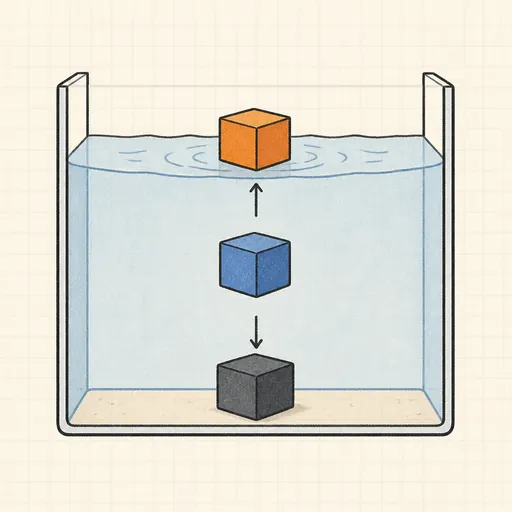
Buoyancy Tank
Drop blocks of different density into water and watch Archimedes decide what floats, sinks or hovers.
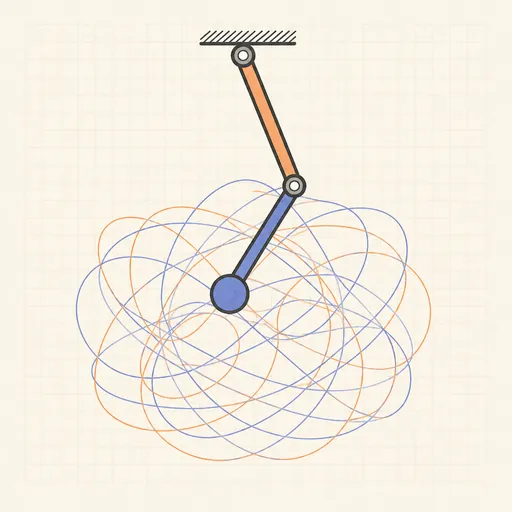
Double Pendulum
Swing a chaotic double pendulum and split it into a rainbow swarm to watch nearby starts diverge.
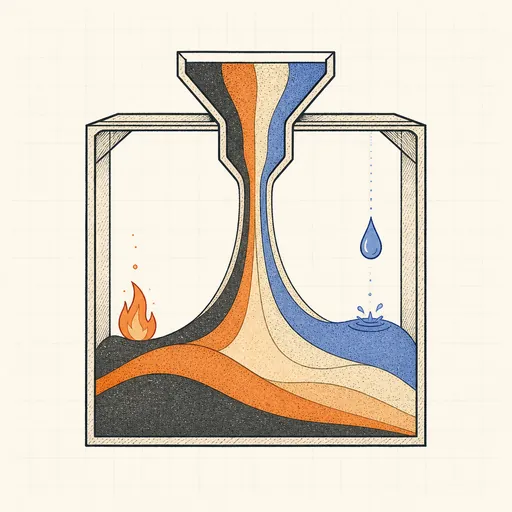
Falling-Sand Playground
Paint sand, water, oil, fire and more and watch them pour, settle, burn and react pixel by pixel.

Fluid Flow Simulator
Stir glowing dye through a real-time GPU fluid simulation.
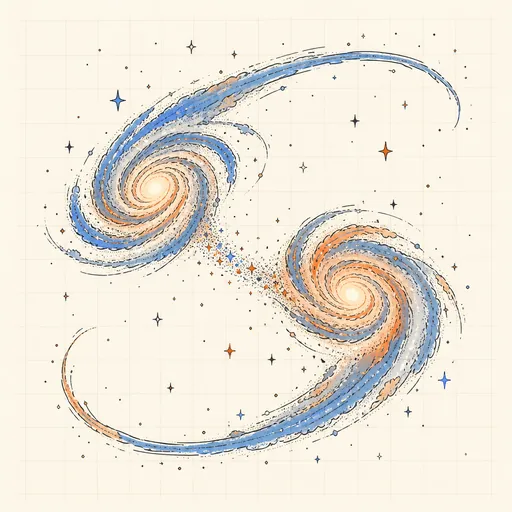
Galaxy Collision Simulator
Smash two spiral galaxies together and watch tidal tails and bridges form.
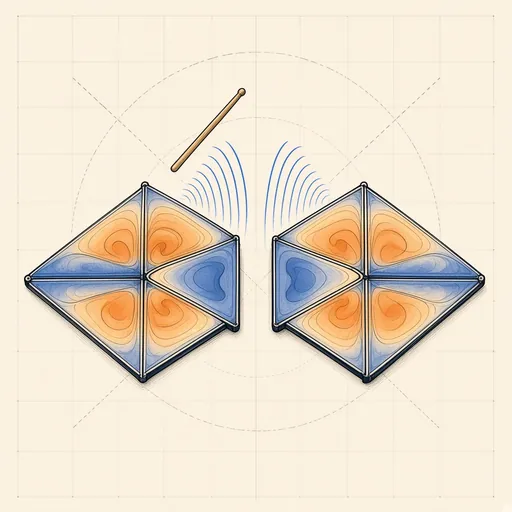
Hear the Shape of a Drum
Draw any drum and hear its true vibration modes — then meet two different drums that sound exactly the same.