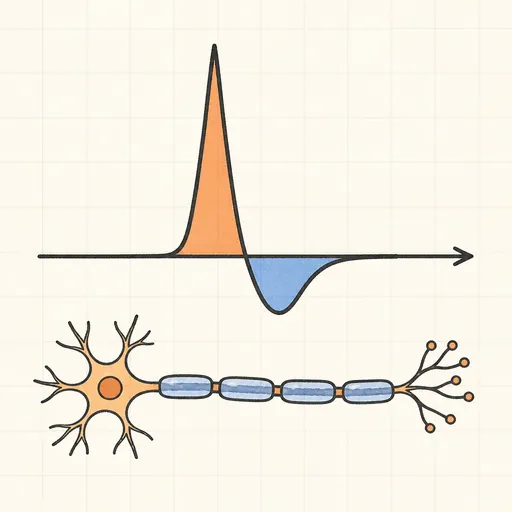
Neuron Action Potential
A neuron fires an all-or-nothing electrical spike — an action potential — when a stimulus pushes its membrane past a threshold. The FitzHugh–Nagumo model is the classic two-variable caricature of this excitable behaviour: a fast voltage-like variable v and a slow recovery variable w that together produce spikes, thresholds and a refractory period. Set a steady stimulus current or inject a brief pulse, and the tool integrates the equations and shows both the voltage trace over time and the trajectory in the phase plane, with the two nullclines drawn in. Turn the current up far enough and the neuron fires over and over in a steady train.
Runs 100% in your browser — simulations are computed locally on your device.
Read the full guide to this tool
Notes
- Equations: dv/dt = v − v³/3 − w + I and dw/dt = ε(v + a − bw); v is the fast membrane voltage and w the slow recovery current.
- A small stimulus decays back to rest, but one past threshold triggers a full spike of nearly fixed size — the all-or-nothing law of nerve impulses.
- After a spike the neuron is briefly refractory and cannot fire again; hold the current high enough and it fires repetitively at a rate set by the stimulus.
- Runs 100% in your browser — simulations are computed locally on your device.
Related tools

Boids Flocking Simulator
Watch lifelike flocking emerge from three local rules with Reynolds’ boids model.

Lenia Continuous Life
Grow smooth self-organising lifeforms like the gliding Orbium in a continuous cellular automaton.

Particle Life
A few coloured species and one table of likes and dislikes — and cells, chains and chasing creatures emerge by themselves.
Slime Mould Networks
Watch millions of Physarum agents self-organise into living transport networks.

Ant Colony Pheromone Trails
Watch ants self-organise foraging highways with evaporating pheromone trails.
Evolving Creatures
See natural selection reshape a population of foraging creatures generation by generation.