SVM Playground
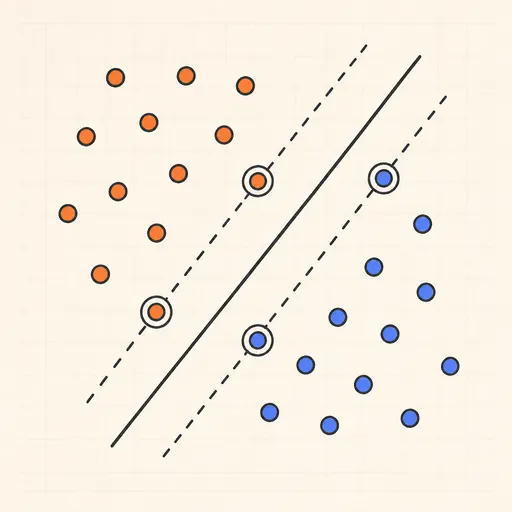
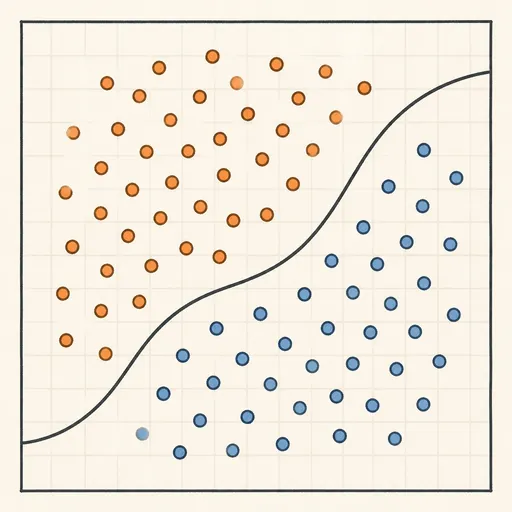
A support vector machine draws the decision boundary that separates two classes with the widest possible margin, keeping only the borderline points — the support vectors — in the final model. Click to add points of either class or load a preset (separable blobs, overlapping blobs, a ring inside a ring), pick a linear, polynomial or RBF kernel and drag the C and gamma sliders; the machine retrains instantly with a simplified SMO solver. The canvas shades both decision regions, marks the margin band where |f(x)| < 1, draws the boundary and rings every support vector, while the readout reports the support vector count and training accuracy. Watch a small C widen the margin and a large RBF gamma wrap the boundary around single points.
Runs 100% in your browser — models are trained and computed locally on your device.
Read the full guide to this tool
Notes
- The dual problem maximises Σαᵢ − ½ΣΣαᵢαⱼyᵢyⱼK(xᵢ,xⱼ) subject to 0 ≤ αᵢ ≤ C and Σαᵢyᵢ = 0; only points with αᵢ > 0 — the support vectors — influence the boundary.
- C trades margin width against violations: a small C tolerates misclassified points and widens the margin, a large C approaches the hard-margin machine.
- The RBF kernel exp(−γ‖x−x′‖²) has width 1/√γ: a large γ memorises individual points and overfits, a tiny γ approaches a nearly linear boundary.
- Training uses simplified sequential minimal optimization capped at 200 points and a fixed iteration budget, so the solution is close to, not exactly, the optimum.
- Runs 100% in your browser — models are trained and computed locally on your device.
Related tools
Decision Tree Builder
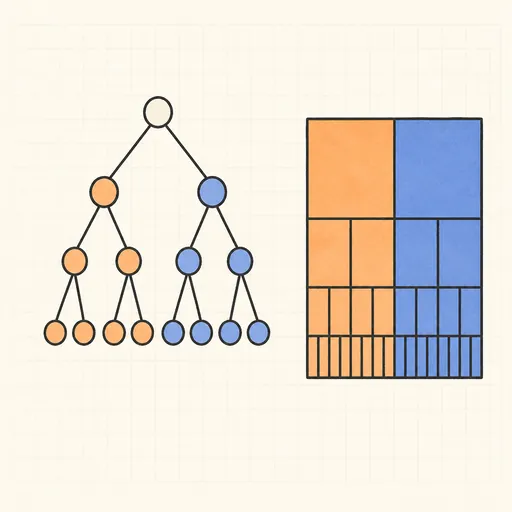
Grow a CART decision tree split by split and watch the partition map and tree diagram build together.

Function Sketch Finder
Sketch a curve on a zoomable coordinate grid and search dozens of function families for the equations that fit it best.
Linear Regression Playground
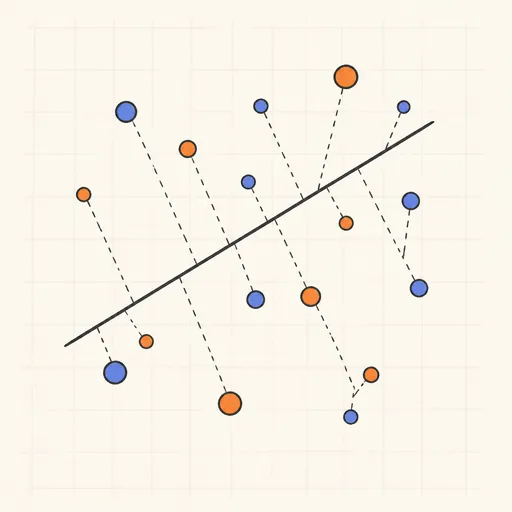
Place points, watch the least-squares line follow, and see gradient descent crawl across the loss surface.
Overfitting Sandbox
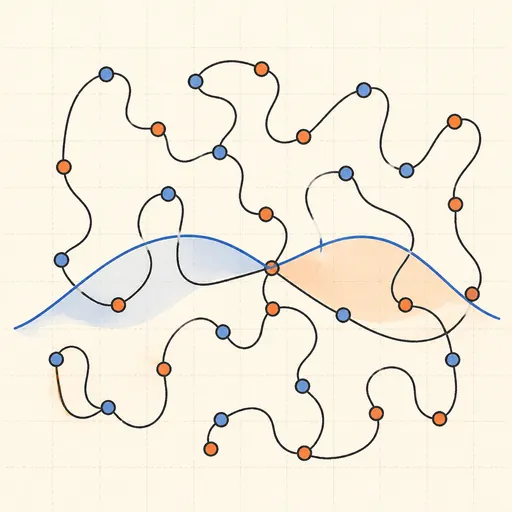
Crank a polynomial’s degree on noisy data and watch the train/test error curves split apart.
Logistic Regression Playground
Paint two classes of points and watch logistic regression carve out its probability boundary by gradient descent.

Naive Bayes Classifier Demo
Score your own message with a word-count spam filter, or watch Gaussian naive Bayes classify 2D points.