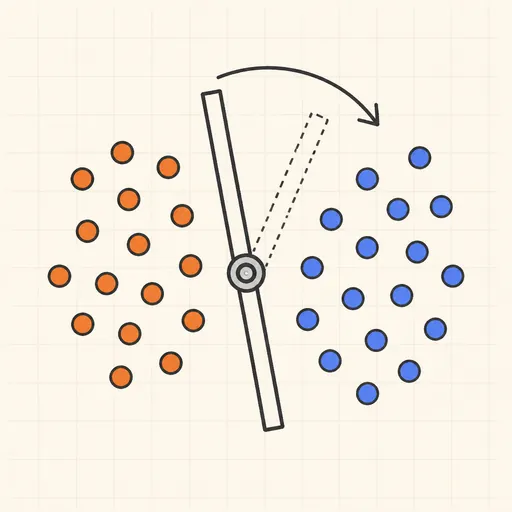
Perceptron Learning Animation
The perceptron is the original neural network: a single neuron that predicts the sign of w·x + b and learns only from its mistakes. Each step the animation finds a misclassified point, rings it, and applies the update w ← w + η·y·x — you watch the weight-vector arrow swing from the origin and the perpendicular decision boundary rotate toward the offending point. Load linearly separable blobs to see it converge, a tight-margin dataset to see it grind through many more updates, and XOR to see it fail forever — the demonstration that ended the first neural-network era. A learning-rate slider and a shuffle button change the trajectory, and the status tracks epochs, mistakes per pass and total updates, with a banner once a full clean pass proves convergence.
Runs 100% in your browser — models are trained and computed locally on your device.
Read the full guide to this tool
Notes
- Update rule: only when a point is misclassified, i.e. y·(w·x + b) ≤ 0, set w ← w + η·y·x and b ← b + η·y; correctly classified points change nothing.
- The perceptron convergence theorem bounds the number of updates by (R/γ)² on separable data with margin γ and radius R — the tighter the margin, the longer it can take.
- On non-separable data such as XOR the rule cycles forever, the limitation Minsky and Papert made famous in 1969; fixing it takes hidden layers (see the neural network playground).
- Starting from zero weights, the learning rate only rescales w and b uniformly, so it never changes which points get misclassified — it matters only for a nonzero initial w.
- Runs 100% in your browser — models are trained and computed locally on your device.
Related tools
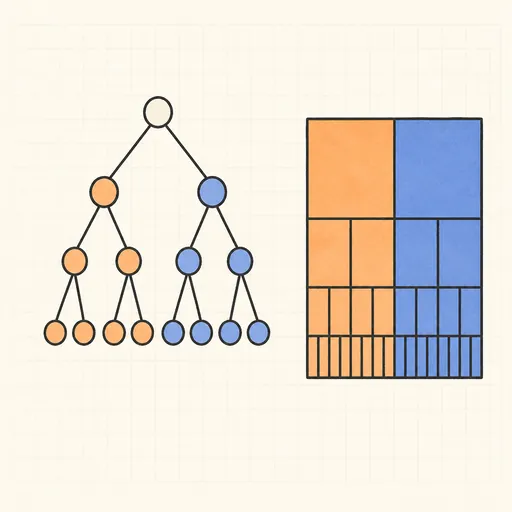
Decision Tree Builder
Grow a CART decision tree split by split and watch the partition map and tree diagram build together.
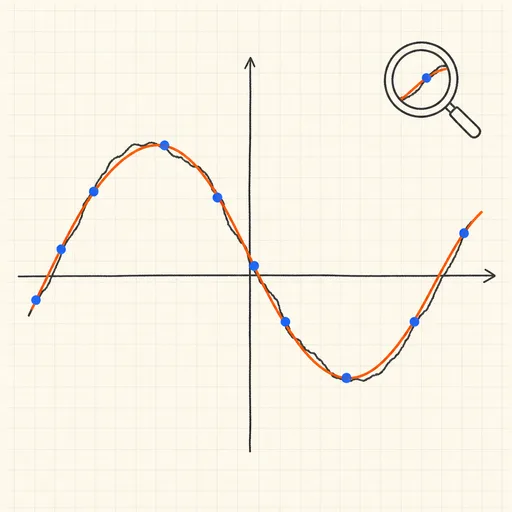
Function Sketch Finder
Sketch a curve on a zoomable coordinate grid and search dozens of function families for the equations that fit it best.
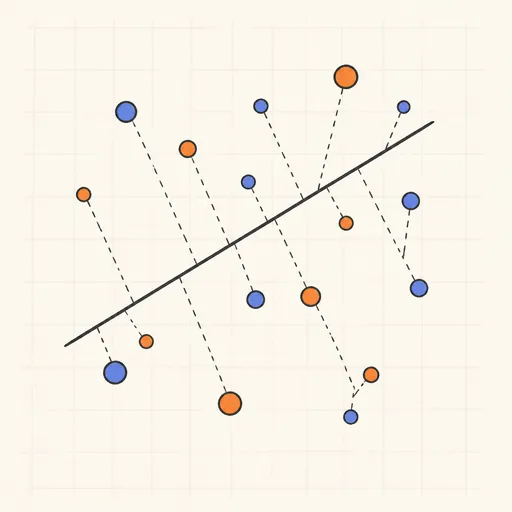
Linear Regression Playground
Place points, watch the least-squares line follow, and see gradient descent crawl across the loss surface.
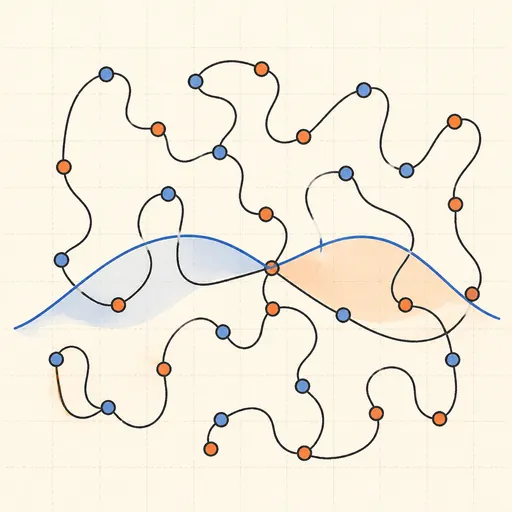
Overfitting Sandbox
Crank a polynomial’s degree on noisy data and watch the train/test error curves split apart.
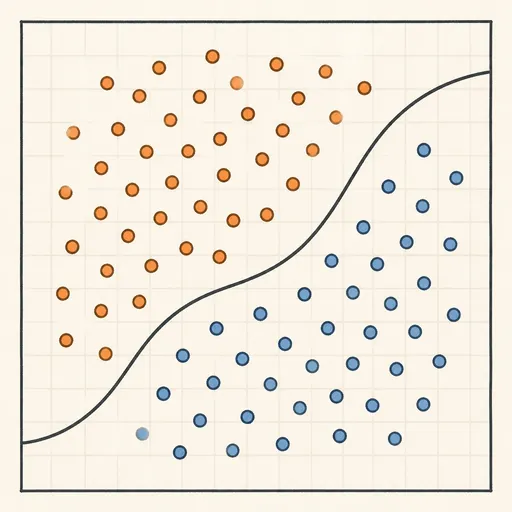
Logistic Regression Playground
Paint two classes of points and watch logistic regression carve out its probability boundary by gradient descent.

Naive Bayes Classifier Demo
Score your own message with a word-count spam filter, or watch Gaussian naive Bayes classify 2D points.