Bike Tire Pressure, Explained
After reading this you can compute sensible front and rear starting pressures from your weight, your bike's weight and your tire width, and you will know why a wider tire wants far less air than the sidewall maximum suggests.
What tire pressure actually controls
Your tires hold you off the ground by trapping air under pressure. The contact patch, that small flattened area where rubber meets road, carries your weight. The physics is blunt: the area of the contact patch times the internal pressure equals the load on that wheel. Raise the pressure and the patch shrinks. Drop the pressure and the patch grows.
Here is the hook. Take a 75 kg rider on a 9 kg bike, so 84 kg of system weight. The rear wheel carries roughly 55% of that, about 46.2 kg or 453 newtons. At 80 psi (about 551,600 pascals) the contact patch is only 453 / 551600 = 8.2 square centimeters, roughly the size of a postage stamp. That is the entire connection between you and the road at the back.
Pressure decides how that patch behaves over bumps. Too high and the tire cannot deform around road texture, so the whole bike bounces and you lose speed to vibration. Too low and the tire squirms, rolls slowly and risks pinch flats or rim strikes. The calculator finds a middle starting point.
When to use this, and when not
Use it when you fit a new tire width, switch surfaces, change from tubes to tubeless, or when your current pressure is simply a habit you never questioned. The output is a starting point you refine over two or three rides.
Do not treat it as a hard number. Rim internal width changes the tire's real mounted volume, and a 28 mm tire on a wide modern rim measures closer to 30 mm. Casing suppleness, temperature, and whether you race or tour all shift the ideal. The calculator has none of that context, so it aims for the center of a sensible range.
Never chase the number past the limits printed on your equipment. If the tire sidewall says 5 bar maximum and this tool suggests 5.2, use 5. The rim manufacturer's ceiling also applies, and on hookless rims it is often the binding limit.
The formula and the intuition behind it
The model starts from a base pressure that scales with wheel load and falls steeply as the tire gets wider. A compact form that matches the modern low-pressure consensus is:
Here P is pressure in psi, L is the load on that wheel in kilograms, w is the tire width in millimeters, and k is a constant that sets the overall scale. The exponent 1.5 on width is the important part: doubling width does not halve the pressure, it cuts it by a factor of 2^{1.5} \approx 2.83.
Load per wheel comes from the split. The rear typically carries about 55% of system weight on a road bike and the front about 45%, because your hips sit behind the bottom bracket:
with L_\text{front} = 0.45 \cdot (m_\text{rider} + m_\text{bike}) for the front. Surface and tubeless setup apply multipliers on top. Rough asphalt and gravel want lower pressure to absorb impacts, so they scale P down. Tubeless has no inner tube to pinch, so it safely runs about 5 to 10% lower again.
Typical multipliers: smooth asphalt 1.00, rough 0.90, gravel 0.80, wet 0.95, and tubeless 0.93 versus 1.00 for tubes. The constant k is chosen so a 75 kg rider on 28 mm tubed tires lands near the pressures experienced riders actually run today.
A worked example with the demo numbers
75 kg rider, 9 kg bike, 28 mm, smooth asphalt, tubes
- System weight:
75 + 9 = 84kg. - Rear load:
0.55 × 84 = 46.2kg. Front load:0.45 × 84 = 37.8kg. - Width factor: 28^{1.5} = 148.2.
- With k = 210, rear base pressure:
210 × 46.2 / 148.2 = 65.5psi. Front base:210 × 37.8 / 148.2 = 53.6psi. - Smooth asphalt multiplier is
1.00and tubes is1.00, so nothing changes. - Rounded results: rear 66 psi, front 54 psi.
That front-to-rear gap of about 12 psi is not a rounding quirk. It follows directly from the 55/45 load split. If you inflate both tires to the same number, your front is overinflated for the load it carries, which is exactly the tire you least want skittering in a corner.
Set the rear first, ride a familiar rough section, then match the front by feel. Many riders end up running the front 10 to 15 psi below the rear and only notice how much smoother the steering became.
How width reshapes the whole answer
The steep width term is what surprises people coming from narrow tires. Keep the rear load at 46.2 kg and k = 210, then sweep the width:
| Width (mm) | Width factor w^{1.5} | Rear pressure (psi) |
|---|---|---|
| 23 | 110.3 | 88.0 |
| 25 | 125.0 | 77.6 |
| 28 | 148.2 | 65.5 |
| 32 | 181.0 | 53.6 |
| 38 | 234.2 | 41.4 |
| 45 | 301.9 | 32.1 |
This is why the old 100+ psi habit from 23 mm tires is wrong on modern 28 to 32 mm rubber. The correct pressure for a 32 mm tire is roughly 54 psi at this load, not 90. Run 90 and you are bouncing over every seam and losing time, which is the impedance loss the footnote mentions.
Reading and adjusting your results
Treat the numbers as the center of a window about 10 psi wide. The tool already hints at plus or minus 5 psi. Adjust within that window by feel and evidence, not superstition.
- Buzzy, harsh, bouncing on rough tarmac
- Too high. Drop 3 to 5 psi and repeat the same road.
- Vague, squirmy, tire rolls in hard corners
- Too low. Add 3 to 5 psi, especially at the front.
- Rim strikes or pinch flats on impacts
- Too low for your terrain or your weight. Add pressure or fit a wider tire.
- Fine everywhere
- Leave it. Record the numbers so you can reproduce them.
Temperature matters more than most riders assume. Air pressure tracks absolute temperature, so a tire pumped to 66 psi (about 80.7 psi absolute at sea level) in a 5 C garage rises to roughly 80.7 × (308 / 278) = 89.4 psi absolute, about 74.7 psi gauge, once the tire warms to 35 C on a summer road. That is an 8 psi swing from temperature alone. Check pressure at the temperature you will ride in.
Common mistakes
The first mistake is equal front and rear pressure. The load split is real; honor it. The second is trusting the sidewall maximum as a target rather than a ceiling. A 700x32 tire may print 70 psi max, but your calculated 54 psi is the faster and more comfortable number, and 70 is only the line you must not cross.
The third mistake is ignoring measured width. A tire labeled 28 mm on a 21 mm internal rim can measure 30 to 31 mm. If you know the real width, use it: the difference between 28 and 31 mm is a width factor of 31^{1.5} = 172.6 versus 148.2, which drops the rear from 65.5 to about 56.2 psi.
The 55/45 split is a road-position average. Aggressive aero positions push more weight forward, touring loads with rear panniers push it back. If you carry heavy rear bags, add a few psi to the rear and treat the front as unchanged.
Try the trade-off yourself
Related tools
Once pressure is sorted, the physics of going faster is the next step. The Cycling Speed & Power Calculator models how rolling resistance, aerodynamics and grade combine into speed, which is where lower pressure earns its time. For fit and gearing, see the Bike Frame Size Calculator and the Bike Gear Ratio Calculator. To place your engine on a scale, the Power-to-Weight (W/kg) Calculator and the Climb Time & VAM Calculator both use the same system weight you entered here.
Frequently asked questions
Why is my front tire pressure lower than my rear?
Because the rear wheel carries more of your weight, about 55% versus 45% at the front. For an 84 kg system that is 46.2 kg rear and 37.8 kg front, which produces roughly 66 psi rear and 54 psi front on 28 mm tires. Matching them overinflates the front.
Should I really run pressures this low?
On modern wide tires, yes, within reason. Lab and field testing shows that once pressure is high enough to avoid rim strikes, going higher increases vibration losses on real roads faster than it reduces tire flex losses. The calculated number sits near that break-even, so start there and adjust by feel.
Does tubeless let me go much lower?
A little. Without a tube there is no pinch flat to worry about, so about 5 to 10% lower is safe, roughly the 0.93 multiplier used here. On 28 mm that turns 66 psi rear into about 61 psi. It is not a licence to run 30 psi on the road.
My tire measures wider than the label. Which number do I use?
The measured width, because it reflects the real air volume. A labeled 28 mm tire that measures 31 mm should be treated as 31 mm, which lowers the calculated rear pressure from about 66 to 56 psi.
How often should I check pressure?
Before every ride if you can, and always at the temperature you will ride in. Tubes lose several psi per week and tubeless setups can lose pressure overnight. A cold-morning reading also understates your riding pressure by several psi once the tire warms up.
Related tools
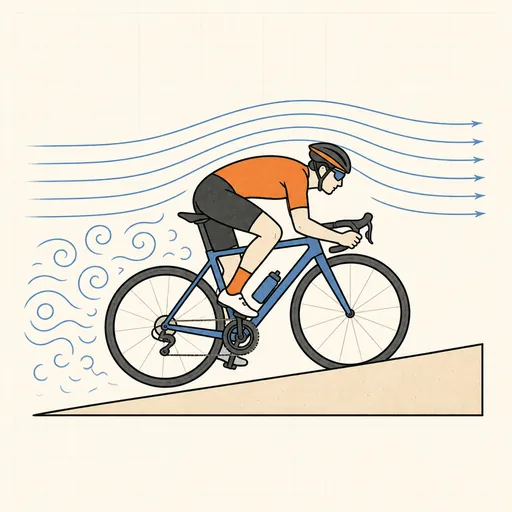
Cycling Speed & Power Calculator
Physics model: speed from watts (or watts from speed) with CdA, rolling resistance and grade.
Power-to-Weight (W/kg) Calculator
FTP watts per kilogram, rider level and all seven Coggan training zones.
Rowing Split ↔ Watts Converter
Concept2 split to watts, calories per hour and projected times for 2k, 5k and more.
Bike Frame Size Calculator
Road, MTB and hybrid frame size from your height and inseam.
Bike Gear Ratio Calculator
Gear ratio, gear inches, development and speed at cadence for any chainring/cog.
Climb Time & VAM Calculator
How long a climb takes at your watts, with VAM and speed.