Power-to-Weight (W/kg), Explained
After reading this you will know how to turn your FTP and body weight into a watts-per-kilogram number, read that number against rough rider levels, and split your FTP into the seven Coggan training zones.
What power-to-weight measures
Power-to-weight is your sustainable power divided by your body mass, reported in watts per kilogram (W/kg). It answers one question: on a climb, who pulls away and who gets dropped?
Here is the hook. Two riders both hold 280 W up a 6% grade. Rider A weighs 60 kg, Rider B weighs 90 kg. Rider A produces 280 / 60 = 4.67 W/kg. Rider B produces 280 / 90 = 3.11 W/kg. On the flat they might match each other, because raw watts fight air resistance and both push 280 W. On the climb, most of the resistance is gravity, which scales with weight. Rider A carries less mass per watt, so Rider A rides away. That gap is the whole reason cyclists track W/kg instead of watts alone.
When the number matters and when it does not
W/kg matters most when you are lifting your own weight against gravity: sustained climbs, punchy hills, and any race decided uphill. The steeper and longer the climb, the more W/kg predicts the outcome and the less raw watts matter.
On flat ground the story flips. Air drag rises with roughly the square of speed and depends on your frontal area and drag coefficient (CdA), not directly on your mass. A heavy rider with high raw watts often wins a flat time trial while losing every climb. If you want to see that trade-off in physical units, the Cycling Speed & Power Calculator turns watts into speed with CdA, rolling resistance and grade, and the Climb Time & VAM Calculator shows how W/kg sets your time up a specific climb.
W/kg is not a fitness score and not a target to chase by starving yourself. You can raise the ratio by adding power or by losing mass, but losing mass past a healthy point costs you power and health. Treat the number as one input, not a verdict.
The formula and why division is the right move
Here FTP is your functional threshold power in watts, and weight is your body mass in kilograms. The result is watts per kilogram. That is the entire calculation for the headline number.
Division is correct because gravity resistance on a climb is proportional to mass. The power needed to raise a mass m at climbing speed v up a grade g_r is approximately P \approx m \cdot 9.81 \cdot v \cdot g_r. Rearrange it and the speed you can sustain uphill is v \approx (P/m) / (9.81 \cdot g_r). Your climbing speed depends on P/m, which is exactly W/kg. Two riders with the same W/kg climb at nearly the same speed regardless of size, ignoring air drag, which is small at climbing speeds.
The seven Coggan zones
Once you have an FTP, you can slice it into training zones. The Coggan model defines seven zones as percentages of FTP. The calculator prints each zone in watts so you know what number to hold on the road or trainer.
| Zone | Name | % of FTP | Watts at 250 FTP |
|---|---|---|---|
| 1 | Active recovery | < 55% | < 138 |
| 2 | Endurance | 56 to 75% | 140 to 188 |
| 3 | Tempo | 76 to 90% | 190 to 225 |
| 4 | Threshold | 91 to 105% | 228 to 263 |
| 5 | VO2max | 106 to 120% | 265 to 300 |
| 6 | Anaerobic | 121 to 150% | 303 to 375 |
| 7 | Neuromuscular | > 150% | > 375 |
Each watt figure is just the percentage times 250. Zone 4 top is 1.05 × 250 = 262.5, which rounds to 263. Change your FTP and every band scales with it, so a good FTP estimate matters more than any single zone edge.
Worked example with the demo data
FTP 250 W, weight 75 kg
These are the tool's default values, so you can reproduce every number by pressing the demo button.
- Divide FTP by weight:
250 / 75 = 3.333W/kg. - Round for reporting: 3.33 W/kg.
- Compare against the level bands below. For a male rider, 3.33 W/kg sits in the middle of the recreational-to-moderate range, roughly a solid club rider on the flat.
- Build the zones. Zone 2 endurance runs from
0.56 × 250 = 140to0.75 × 250 = 188W. Threshold Zone 4 runs from228to263W. VO2max Zone 5 runs from265to300W.
If this rider lost 3 kg and held the same FTP, the ratio becomes 250 / 72 = 3.47 W/kg, a gain of 0.14. Adding 10 W of FTP at 75 kg gives 260 / 75 = 3.47 as well. Either path lands the same place. That equivalence is worth remembering: power and weight trade off proportionally.
Reading the level bands honestly
The calculator maps your W/kg to an approximate rider level. These bands are rough and describe flat-terrain racing fitness for a roughly one-hour effort. They are not selection criteria and not a diagnosis. Use them to sanity-check where you sit, not to rank yourself.
| Level | Male W/kg | Female W/kg |
|---|---|---|
| Untrained | < 2.5 | < 2.0 |
| Recreational | 2.5 to 3.2 | 2.0 to 2.7 |
| Moderate club | 3.3 to 4.0 | 2.8 to 3.5 |
| Strong club / cat 3 | 4.1 to 4.7 | 3.6 to 4.1 |
| Regional / cat 1 to 2 | 4.8 to 5.5 | 4.2 to 4.9 |
| Elite / pro | > 5.5 | > 4.9 |
The male and female bands differ because average lean mass and hemoglobin levels differ across large populations. Your individual result is your own; population bands only set context. A pro men's Grand Tour climber holds well above 6 W/kg for 20 to 40 minutes, which is why the demo rider at 3.33 is not getting up that mountain first.
Common mistakes
Most errors come from a wrong FTP or a wrong unit, not from the division.
- Using a 20-minute peak as FTP
- A 20-minute best is higher than your one-hour power. The common field estimate multiplies it by 0.95. If your 20-minute test averaged 290 W, use
290 × 0.95 = 275.5W as FTP, not 290. Skipping the 0.95 inflates your W/kg by about 5%. - Entering weight in pounds
- The formula needs kilograms. A 165 lb rider is
165 / 2.205 = 74.8kg, not 165. Entering 165 by mistake would report250 / 165 = 1.52W/kg, which looks untrained and is simply wrong units. - Comparing across durations
- W/kg only compares fairly at the same effort length. A 5-second sprint W/kg and a one-hour FTP W/kg are different animals. This tool uses FTP, so compare it against other people's FTP-based numbers.
- Chasing the ratio through the scale
- Losing mass raises W/kg only until you start losing power. Below a healthy body composition the FTP drops faster than the weight, and the ratio falls. This is a training and nutrition question for a professional, not a slider to max out.
Related tools
Once you know your W/kg and zones, these tools put the number to work. Use the Bike Gear Ratio Calculator to check whether you have a low enough gear to hold your climbing cadence. The Bike Tire Pressure Calculator and the Bike Frame Size Calculator handle the fit and rolling side, which affects your effective speed at a given power. If you also row, the Rowing Split ↔ Watts Converter reports watts and calories per hour for Concept2 splits so you can compare efforts across sports.
Frequently asked questions
What is a good W/kg for an amateur cyclist?
For a male recreational-to-club rider, 2.5 to 4.0 W/kg at FTP is typical; for a female rider, 2.0 to 3.5. The demo rider at 3.33 W/kg is a solid club level. These are one-hour numbers and rough guides, not thresholds you must clear.
How do I find my FTP without a lab test?
Do a hard, evenly paced 20-minute effort on a known course or trainer and record your average power. Multiply by 0.95. If your 20-minute average was 263 W, your FTP estimate is 263 × 0.95 = 250 W. It is an estimate with an error bar of several percent, so retest before reading too much into small changes.
Why does the tool ask for sex?
Only to pick the level band it compares your number against. The W/kg math and the zone watts do not change with sex. The male and female bands differ because large-population averages differ, not because your own result changes.
Does more W/kg always win the race?
No. On flat and rolling courses, raw watts against air drag matter more than W/kg. A 90 kg rider at 3.5 W/kg (315 W) often beats a 60 kg rider at 4.5 W/kg (270 W) in a flat sprint or time trial, then loses to that same rider on a long climb.
How much does losing weight change my W/kg?
At FTP 250 W, each kilogram lost adds about 0.04 to 0.05 W/kg while your power holds. Going from 75 to 72 kg moves you from 3.33 to 3.47. The gain shrinks at higher weights and grows at lower ones, because the ratio is nonlinear in weight.
Related tools
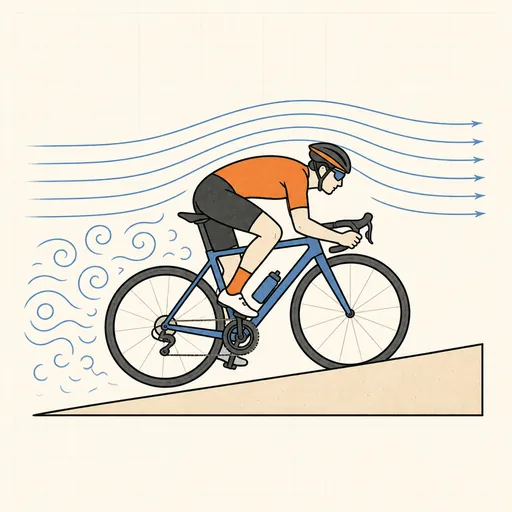
Cycling Speed & Power Calculator
Physics model: speed from watts (or watts from speed) with CdA, rolling resistance and grade.
Rowing Split ↔ Watts Converter
Concept2 split to watts, calories per hour and projected times for 2k, 5k and more.
Bike Frame Size Calculator
Road, MTB and hybrid frame size from your height and inseam.

Bike Gear Ratio Calculator
Gear ratio, gear inches, development and speed at cadence for any chainring/cog.
Bike Tire Pressure Calculator
Front and rear starting pressures from rider weight and tire width.
Climb Time & VAM Calculator
How long a climb takes at your watts, with VAM and speed.