Climb Time and VAM, Explained
After reading this you can estimate how long any climb takes from its length, grade and your sustainable watts, read the VAM number the tool reports, and know how far to trust the answer.
What the calculator does and one quick example
Give the calculator a climb (length and average grade), your weight, your bike weight and the power you can hold, and it returns three numbers: your time to the top, your speed, and your VAM. VAM stands for velocità ascensionale media, the average vertical speed, measured in vertical meters climbed per hour.
Here is the hook. Take a 70 kg rider on an 8 kg bike holding 250 W up an 8 km climb at 7.5%. That is a total mass of 78 kg and a power-to-weight of about 3.2 W/kg. The tool puts the time near 33 minutes at a speed close to 14.5 km/h, with a VAM around 1090 m/h. Drop 5 kg of body weight at the same 250 W and the time falls by roughly a minute, because on a steep grade almost every watt is lifting mass against gravity.
When to use it, and when not
Use the model to pace a known climb, to compare two setups (lighter wheels versus more training), or to convert a target VAM into a pacing power. It works best on sustained climbs of 4% or more where gravity dominates and small errors in aerodynamics barely matter.
Be careful on shallow or rolling terrain. Below about 3% the air resistance term grows large and depends on your riding position, so a single CdA assumption can be off by 10% or more. The model also assumes a steady effort. If you attack and fade, your average power on paper will not match the ride.
This is an educational estimate for training and race planning. It is not coaching or medical advice, and it cannot promise a time on any given day. Heat, fatigue, road surface and wind all move the real number.
The physics, one term at a time
The power you produce at the wheel is spent on three things: lifting your mass up the slope, overcoming rolling resistance, and pushing air aside. Written as a balance:
Here P is power in watts, m is total mass (rider plus bike) in kilograms, g = 9.81 m/s², \theta is the road angle, C_{rr} is the rolling resistance coefficient (about 0.005), \rho is air density, C_dA is your drag area in m² (about 0.4 on the hoods), and v is speed in m/s.
Grade in percent, G, relates to the angle by \tan\theta = G/100. At 7.5% the angle is small, so \sin\theta \approx 0.0748 and \cos\theta \approx 0.9972. The gravity term uses the sine, the rolling term uses the cosine.
Altitude enters through air density. Higher base altitude means thinner air, a smaller aero term, and slightly faster climbing at the same power. Density falls roughly like this:
h is altitude in meters. At sea level \rho \approx 1.225 kg/m³. At 500 m it is about 1.167, and at 2000 m about 1.006, roughly 18% thinner than at the sea.
Why steep climbs scale with W/kg
On a steep grade the cubic aero term is tiny because speed is low. At 14.5 km/h (4.03 m/s) the aero power is 0.5 \times 1.167 \times 0.4 \times 4.03^3 \approx 15 W, only 6% of a 250 W effort. Rolling resistance adds about 78 \times 9.81 \times 0.005 \times 4.03 \approx 15 W. The remaining 220 W lifts you.
Drop the two small terms and the balance becomes P \approx m g \sin\theta \cdot v. Rearranged, vertical speed depends only on power per kilogram:
The left side is vertical speed in m/s. Multiply by 3600 to get VAM in m/h. So VAM tracks W/kg almost directly, which is why the pros use the mental shortcut \text{VAM} \approx \frac{(P/m)\times 100}{2.6 + G/10}. The 2.6 and the grade correction fold in the small aero and rolling losses.
Reproducing the demo numbers
Defaults: 70 kg rider, 8 kg bike, 250 W, 8 km at 7.5%, base 500 m. Total mass 78 kg, air density about 1.167 kg/m³.
- Angle: \theta = \arctan(0.075) = 4.29^\circ, so \sin\theta = 0.07479, \cos\theta = 0.9972.
- Gravity resistance per unit speed: 78 \times 9.81 \times 0.07479 = 57.23 N.
- Rolling resistance: 78 \times 9.81 \times 0.005 \times 0.9972 = 3.815 N.
- Solve 250 = (57.23 + 3.815)v + 0.5\times1.167\times0.4\times v^3 for v. That is 250 = 61.05\,v + 0.2334\,v^3.
- Trying v = 4.03: 61.05\times4.03 + 0.2334\times4.03^3 = 246.0 + 15.3 = 261, a little high. Trying v = 3.96 gives 241.8 + 14.5 = 256. The root sits near v = 3.93 m/s, or
14.1km/h. - Time up 8 km: 8000 / 3.93 = 2036 s, about
33.9minutes. - VAM: the climb gains 8000 \times 0.0748 = 598 vertical meters. Over 0.566 h that is 598 / 0.566 = 1057 m/h.
The quick estimate agrees: \frac{3.205\times100}{2.6+0.75} = \frac{320.5}{3.35} = 957 m/h in the roughest form, and the full model lands near 1060 once the exact geometry is used. Both put you around 34 minutes.
How results move when you change the inputs
Two levers dominate: your W/kg and the grade. The chart below holds mass at 78 kg and grade at 7.5% and sweeps power. Time falls fast at first, then flattens, because time is proportional to 1/P once aero is negligible.
Reading the VAM number
VAM is the fair way to compare efforts on different climbs, because it strips out how steep or long the road is and reports pure vertical rate. Rough bands for a trained rider on a real climb:
| VAM (m/h) | Rough W/kg | Rider level |
|---|---|---|
| 700 to 900 | 2.5 to 3.0 | Recreational |
| 900 to 1100 | 3.0 to 3.7 | Keen amateur |
| 1100 to 1400 | 3.7 to 4.6 | Strong club racer |
| 1400 to 1800 | 4.6 to 6.0 | Elite / pro |
To turn a VAM goal into a power target, work backwards. If you want 1200 m/h and weigh 78 kg total, you need vertical speed of 1200/3600 = 0.333 m/s, so the gravity power alone is 78 \times 9.81 \times 0.333 = 255 W, plus roughly 25 W for rolling and air, giving about 280 W.
Common mistakes
Forgetting the bike. A 65 kg rider is really 73 kg on the road with an 8 kg bike and bottles. Using body weight alone overstates W/kg by 12% and predicts a time about 12% too fast on a steep grade.
Using peak power instead of sustainable power. A 34 minute climb is an FTP-length effort. Put in your one-minute number and the model happily reports a time you cannot hold.
Ignoring altitude for high climbs. Air is thinner up high, which helps a little through less drag, but your aerobic power also falls above roughly 1500 m. The tool models the air, not your lungs, so trim your power input for alpine efforts.
Trusting three digits. The CdA and Crr are assumptions. Treat the time as plus or minus a couple of percent, not a stopwatch reading. On a 34 minute climb that is close to a minute either way.
Related tools
Your climbing power expressed per kilogram sets everything here, so start with the Power-to-Weight (W/kg) Calculator to place your FTP in the training zones. For flat and rolling roads where aerodynamics matter more, the Cycling Speed and Power Calculator uses the same physics with full control over CdA. To be sure you have a low enough gear to hold cadence on a 10% ramp, check the Bike Gear Ratio Calculator. Rolling resistance in the model assumes a sensible pressure, which the Bike Tire Pressure Calculator can suggest.
Frequently asked questions
Why does losing weight help so much on climbs?
On a steep grade roughly 90% of your power lifts mass. Time scales almost inversely with W/kg, so shedding 3 kg from 78 kg raises W/kg by about 4% and cuts a 34 minute climb by roughly 80 seconds at the same power.
Is VAM better than average speed for comparing climbs?
Yes, for steep climbs. Speed depends heavily on grade: 14 km/h at 7.5% and 9 km/h at 12% can be the same effort. VAM converts both to vertical rate, so 1060 m/h is 1060 m/h regardless of the road angle.
Does the calculator include wind?
No. It assumes still air, so a headwind on an exposed climb makes you slower than predicted, and a tailwind faster. At climbing speeds the effect is smaller than on the flat but not zero.
Why is my real VAM lower than the quick formula?
The 2.6 in the shortcut assumes clean tarmac, good tires and a typical position. Rough roads, wide tires or a headwind push the effective constant higher and drop your VAM by 50 to 150 m/h.
What grade counts as steep enough to ignore aero?
Around 5% and up, aero is under 10% of your power at climbing speed. Below 3% it grows past 20%, so the answer starts depending on your position and the CdA assumption becomes the main source of error.
Related tools
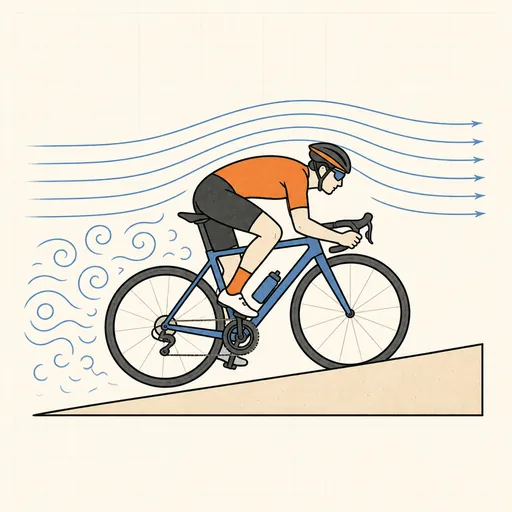
Cycling Speed & Power Calculator
Physics model: speed from watts (or watts from speed) with CdA, rolling resistance and grade.

Power-to-Weight (W/kg) Calculator
FTP watts per kilogram, rider level and all seven Coggan training zones.
Rowing Split ↔ Watts Converter
Concept2 split to watts, calories per hour and projected times for 2k, 5k and more.
Bike Frame Size Calculator
Road, MTB and hybrid frame size from your height and inseam.

Bike Gear Ratio Calculator
Gear ratio, gear inches, development and speed at cadence for any chainring/cog.
Bike Tire Pressure Calculator
Front and rear starting pressures from rider weight and tire width.