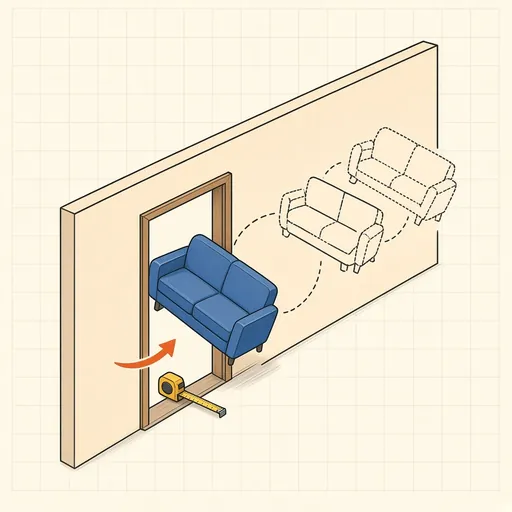
Will It Fit? Furniture Moving Planner
Every move has the moment: the sofa is wedged in the doorway and someone shouts "pivot". This planner does the pivoting before the delivery van arrives. Describe the item (a sofa with its arms, back and legs, a fridge, a mattress, a wardrobe or an upright piano) and the tight spot: a door off a narrow hallway, a corridor corner, a staircase with a turn at the top, or an elevator or van. A six-degrees-of-freedom motion planner, the kind of algorithm that steers robot arms, then searches through positions and orientations on several processor cores at once, testing each one against the walls with exact box-on-box collision checks. If a way exists, you get the move as a 3D animation and a step-by-step storyboard, with the tightest gap along the way. If none exists, a cut-plane argument often proves it: at the moment the door frame cuts the item in half, that slice has to fit through the opening, and when even the smallest possible slice is too big, no amount of pivoting will help. It also tries the usual fixes, such as taking the legs off or the door off its hinges, and finds the longest sofa that would still go through.
Runs 100% in your browser — simulations are computed locally on your device.
Notes
- The planner works in the item’s full six-dimensional configuration space: three numbers for where it is and three for how it is turned. It grows two trees of collision-free poses (bidirectional RRT-Connect), one from the start and one from the destination, aimed at the opening by poses derived from the cut-plane analysis.
- "Fits" is a verified path: poses along it, less than a centimetre of movement apart, were each checked with your safety gap around every wall. "Won’t fit" from the cut-plane test is a proof. "No way found" means the search ran out of time without finding one, which in borderline cases is worth a second, longer search.
- The default example: a 160 × 90 × 85 cm loveseat meets an 81 cm door in the side of a 107 cm hallway. Upright or on its back it is too wide whichever way it faces, yet the planner finds a way: stand it on end, feed the top of the backrest through first and swing the rest after it, with about a centimetre to spare.
- For a flat item that cannot tilt, the longest one that turns a right-angled corner between hallways a and b wide is the minimum over angles θ of (a − w·cos θ)/sin θ + (b − w·sin θ)/cos θ, where w is its width: 163 cm for two 100 cm hallways and a 60 cm deep item. The planner reproduces that limit and beats it whenever there is headroom to tilt.
- Items are rigid: cushions do not squash and mattresses do not bend, so for those the answer errs on the safe side, and a sofa’s legs count unless you tick "Legs taken off". Measure the narrowest point: a door between the stops with the door fully open, a hallway at the skirting boards or radiators.
- Plans keep the item’s lowest point within the lift height you set, so every move is something two people can carry.
- Runs 100% in your browser — simulations are computed locally on your device.
Related tools
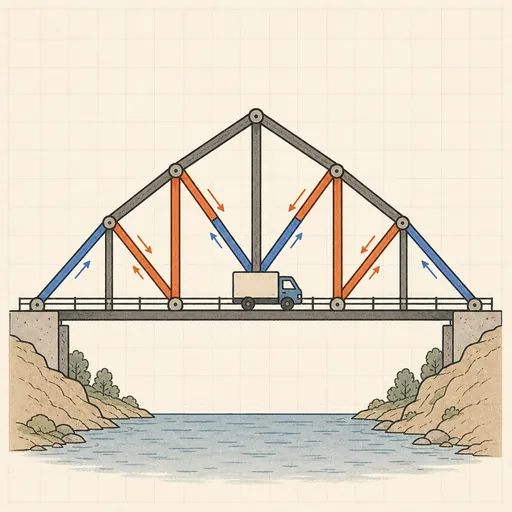
Bridge Builder & Truss Simulator
Design a truss bridge, send a truck across and watch every member strain, buckle or snap under load.
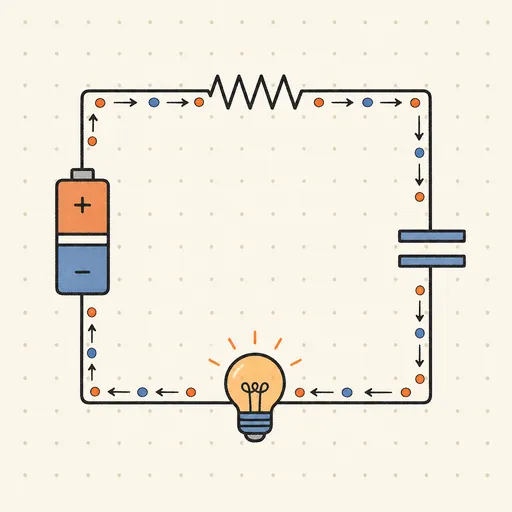
Circuit Simulator
Build analog circuits on a grid and watch current flow live — batteries, resistors, capacitors, LEDs and more.

Nuclear Reactor Simulator
Run a pressurized-water reactor: pull control rods, manage xenon and temperature — or SCRAM before it overheats.
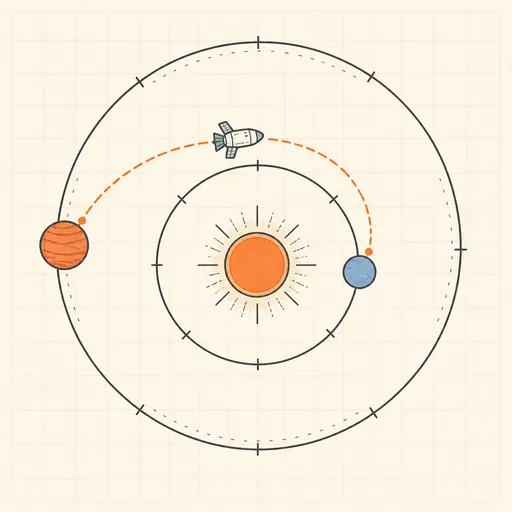
Orbital Mission Planner
Plan an interplanetary transfer: pick two planets, scan launch windows on a porkchop plot and fly the mission.

Power Grid Simulator
Run an electric grid through a full day — dispatch plants, hold 50 Hz and survive cascading failures.
Rocket Designer & Staging Lab
Build a multi-stage rocket, launch it, and see if your design reaches orbit.