Voronoi & Lloyd Relaxation
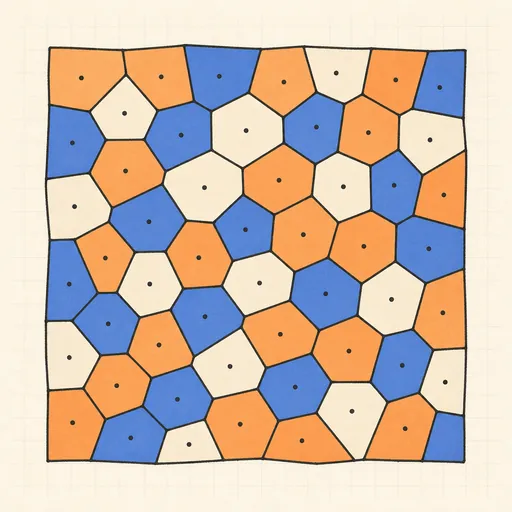
A Voronoi diagram splits the plane into cells, one per seed point, where each cell is everywhere closer to its seed than to any other. Scatter seeds by clicking or randomising and the tool paints the cells live, with the Delaunay triangulation (the dual graph joining neighbouring seeds) available as an overlay. Then run Lloyd’s relaxation: repeatedly move each seed to the centre of its own cell, and the ragged random pattern smooths step by step into an even, organic honeycomb. Drag seeds around to reshape the cells, change the distance metric, and watch tissue-like structure emerge from scattered dots.
Runs 100% in your browser — simulations are computed locally on your device.
Read the full guide to this tool
Notes
- Every point in a cell is closer to that cell’s seed than to any other, so the cell walls are the perpendicular bisectors between neighbouring seeds.
- Lloyd’s relaxation moves each seed to its cell centroid and repeats; the diagram converges toward a centroidal Voronoi tessellation, an even honeycomb-like packing.
- Voronoi and its dual Delaunay triangulation underlie mesh generation, nearest-neighbour lookup, and models of everything from cell tissue to mobile-phone coverage.
- Runs 100% in your browser — simulations are computed locally on your device.
Related tools
3D Geometry Board
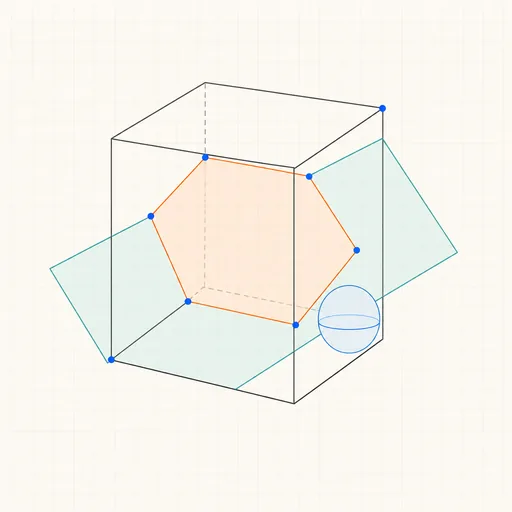
Points, lines, planes, spheres and polyhedra on an orbiting camera — slice solids with planes, unfold nets, drop the Dandelin spheres into a cone and drag everything.
Bézier Curve Playground
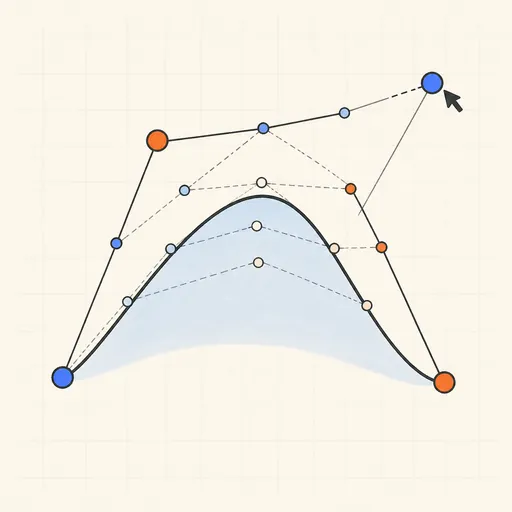
Drag control points and watch De Casteljau’s algorithm construct a Bézier curve step by step.
Central Limit Theorem Demo
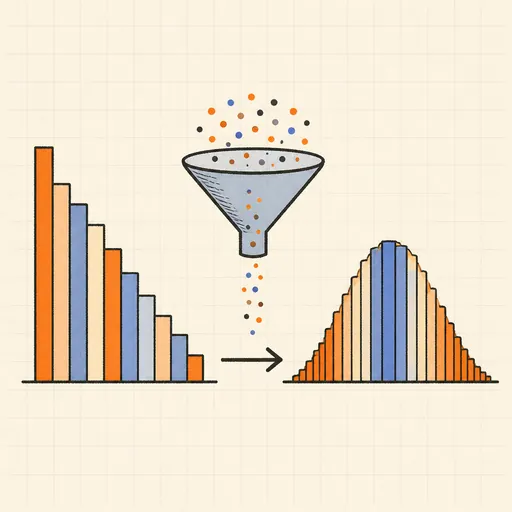
Sample from any lopsided distribution and watch the averages pile up into a bell curve.
Conway’s Game of Life
Paint cells and watch Conway’s cellular automaton breed gliders, guns and oscillators.
Dynamic Geometry Board
Construct with points, lines, circles and transformations, then drag anything — the construction stays true, and a checker tells you which relations are theorems.
Fantasy Map Generator
Roll a seed and get a continent: coastlines, mountains, rivers, biomes and named towns, ready for your campaign.