
Iterated Prisoner’s Dilemma Tournament
The tournament that made cooperation a science: strategies for the iterated prisoner’s dilemma play long matches against each other, scoring by the classic payoffs (temptation 5, reward 3, punishment 1, sucker 0 — all four editable). The roster spans the famous archetypes: Always Cooperate, Always Defect, Tit for Tat, Generous Tit for Tat, Grudger, Pavlov, Random and the sly Prober. Round-robin mode plays every pairing and builds the score matrix and leaderboard; evolutionary mode reruns the tournament each generation and lets population shares grow by replicator dynamics, drawn as a stacked area chart over the generations. A noise slider flips moves at random — and shows why unforgiving strategies fall apart in a noisy world while generous ones keep winning.
Runs 100% in your browser — simulations are computed locally on your device.
Read the full guide to this tool
Notes
- Tit for Tat won both of Axelrod’s tournaments with four traits: nice (never defects first), retaliatory, forgiving, and clear enough to be recognised.
- Under noise plain Tit for Tat locks into vendettas of alternating defection; Generous Tit for Tat forgives a fraction of defections and breaks the echo.
- Pavlov (win-stay, lose-shift) repeats a move that paid and switches after a bad round — it corrects errors and exploits unconditional cooperators, and dominates many evolutionary runs.
- In evolutionary play success is frequency-dependent: Always Defect thrives among cooperators, starves once they are gone, and retaliators inherit the wreckage — cooperation can be evolutionarily stable.
- Runs 100% in your browser — simulations are computed locally on your device.
Related tools
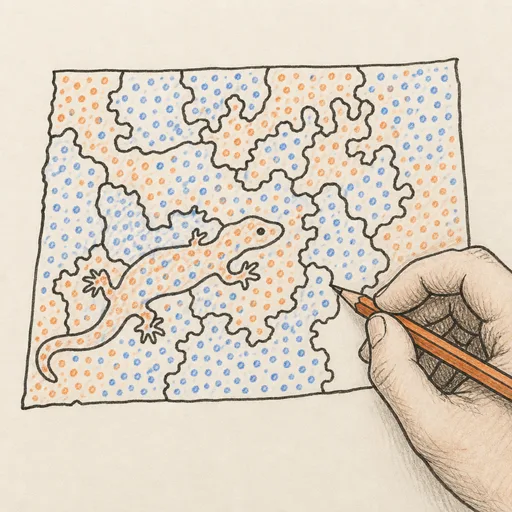
Gerrymandering Sandbox
Draw the districts yourself and watch the same voters produce opposite election results.
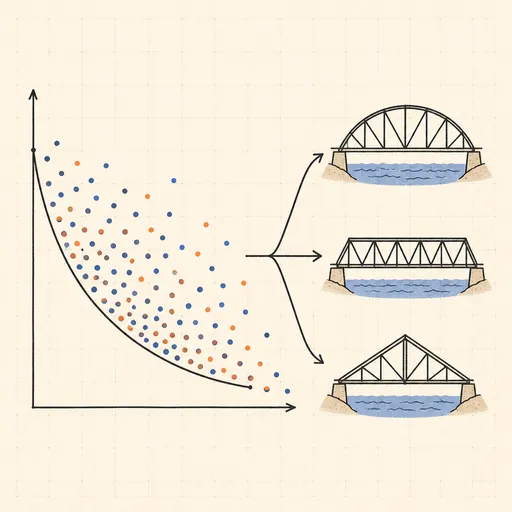
Pareto Frontier Evolution
Watch a genetic algorithm breed bridge designs and trace out the weight-vs-stiffness Pareto frontier, generation by generation.
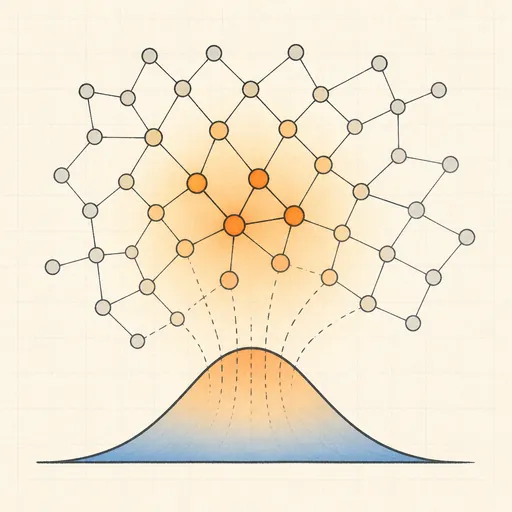
SIR Epidemic Simulator
Watch an epidemic spread and burn out with the classic susceptible–infected–recovered model.

Sailing & Tacking Simulator
Sail a boat against the wind — trim to the polar diagram, ride the shifts and race the optimal route.
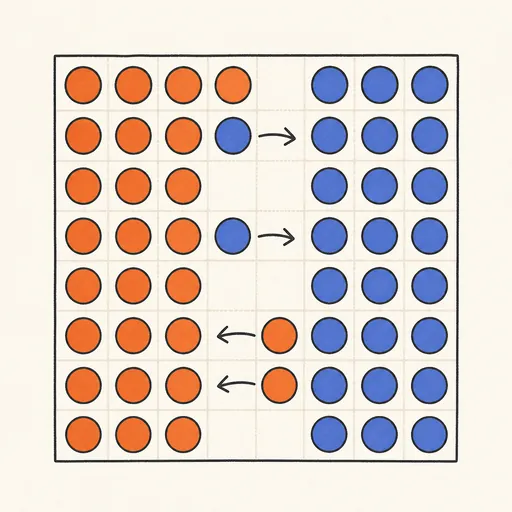
Schelling’s Segregation Model
Give agents a mild preference for similar neighbours and watch a mixed city sort itself into stark blocks.
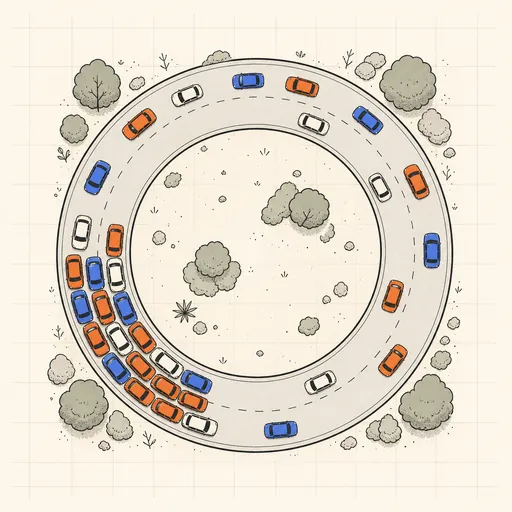
Traffic Jam Simulator
See phantom traffic jams appear from nothing on a ring road with the Nagel–Schreckenberg model.