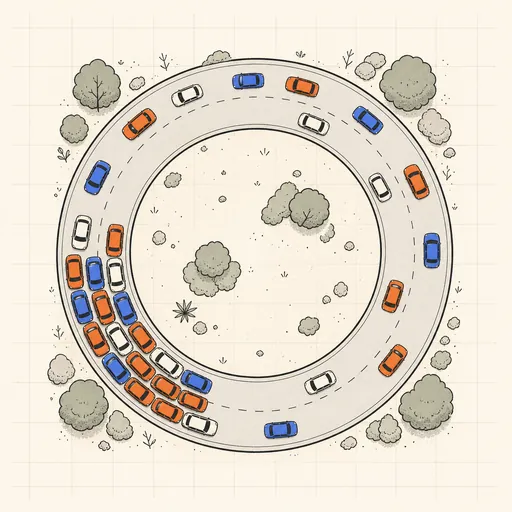
Traffic Jam Simulator
The Nagel–Schreckenberg model is a cellular automaton that reproduces real highway traffic from four simple rules applied to every car each tick: accelerate, brake to avoid the car ahead, randomly dawdle with probability p, then move. Cars drive around a one-lane ring road, so no one enters or leaves. Drag the density, the maximum speed and the dawdle probability, and the simulator animates the ring with cars coloured by speed while a space-time diagram scrolls underneath — the dark backward-moving stripes are jams. The average flow (throughput) is reported live so you can find the density that maximises it.
Runs 100% in your browser — simulations are computed locally on your device.
Read the full guide to this tool
Notes
- Rules per step: speed up by one (to the limit), slow to the gap ahead, with probability p drop speed by one, then advance. The random dawdle is the only source of noise.
- Above a critical density, jams appear spontaneously with no accident or bottleneck — a single random brake tap propagates backward into a standing wave.
- Flow rises with density until the critical point, then collapses: more cars past that point means less throughput, the fundamental diagram of traffic.
- Runs 100% in your browser — simulations are computed locally on your device.
Related tools

Gerrymandering Sandbox
Draw the districts yourself and watch the same voters produce opposite election results.
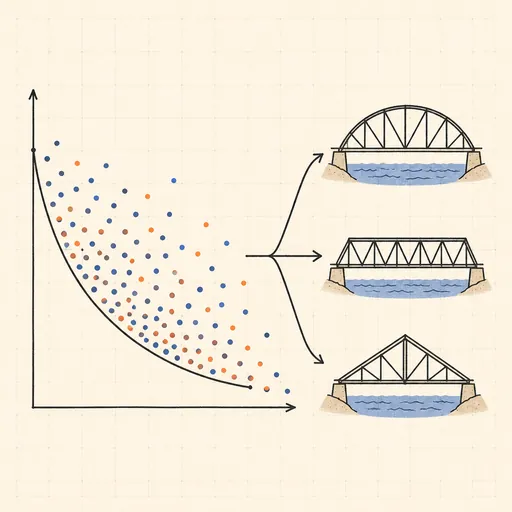
Pareto Frontier Evolution
Watch a genetic algorithm breed bridge designs and trace out the weight-vs-stiffness Pareto frontier, generation by generation.
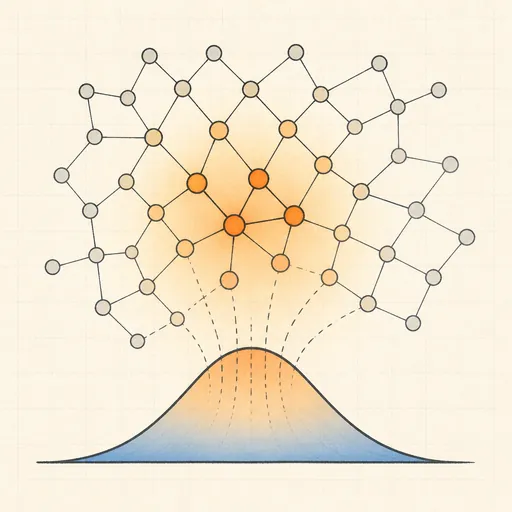
SIR Epidemic Simulator
Watch an epidemic spread and burn out with the classic susceptible–infected–recovered model.

Sailing & Tacking Simulator
Sail a boat against the wind — trim to the polar diagram, ride the shifts and race the optimal route.
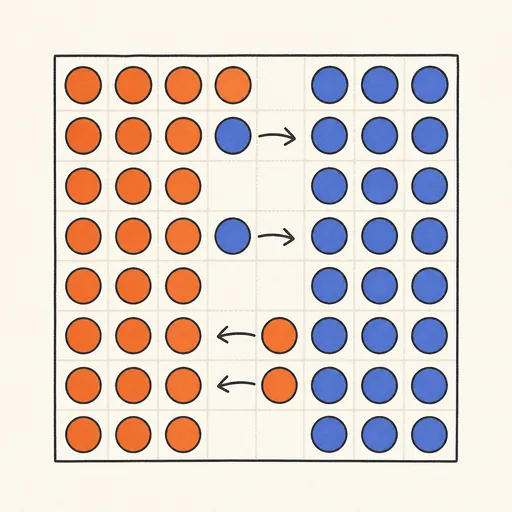
Schelling’s Segregation Model
Give agents a mild preference for similar neighbours and watch a mixed city sort itself into stark blocks.
Tsunami Simulator
Set off an undersea earthquake anywhere and watch the tsunami cross real ocean floors — with arrival times at tide gauges around the world.